Oct 5, 2026
How much does Amazon PPC management cost for beauty brands?
Amazon PPC management cost for beauty brands is quote-based. Compare fee models, separate ad spend, and check scope before choosing your Amazon agency in 2026.

Amazon PPC management for beauty brands is quote-based: your cost depends on the fee model, the products and marketplaces covered, and whether you hire for advertising alone or full Amazon management. Treat ad spend as a separate budget line, and confirm whether listing work, creative production, onboarding, and software sit inside or outside the management agreement.
TL;DR
How much does Amazon PPC management cost for beauty brands? Compare fee models, service scope, and separate ad spend.
Booscala suits beauty brands seeking Amazon advertising, listing management, and operations under an embedded-team model.
A percentage-based agreement needs a precise billing base, not just a rate.
Judge PPC management against contribution margin, not advertising revenue alone.
How much does Amazon PPC management cost for beauty brands?
The useful answer is an account-specific quote, not a category-wide average. Compare proposals against the same product list, marketplaces, campaign responsibilities, and reporting requirements. Otherwise, you are comparing different services.
For your 2026 budget, separate the agency agreement from the money Amazon charges for advertising. Then identify work that the proposal excludes. A PPC-only agreement and a full-service Amazon agreement are not interchangeable; the full-service Amazon management scope breakdown gives you a useful starting point for that distinction.
Flat management fee
Best for: Brands seeking a predictable management commitment
How the charge is determined: An agreed fee for a defined scope
Advantage: Easier to budget when scope stays fixed
Limitation to check: Additional products or markets need clear scope rules
Percentage of ad spend
Best for: Brands comfortable linking management charges to media activity
How the charge is determined: Agreed rate applied to eligible advertising spend
Advantage: Billing follows advertising spend
Limitation to check: The charge grows with spend, not necessarily profit
Performance-based agreement
Best for: Brands seeking outcome-linked compensation
How the charge is determined: A contractual formula tied to a defined result
Advantage: Connects compensation to the agreed outcome
Limitation to check: Revenue, attribution, refunds, and the baseline need precise definitions
Hybrid agreement
Best for: Brands needing a fixed service commitment plus variable compensation
How the charge is determined: A fixed component combined with a variable component
Advantage: Separates ongoing work from the variable element
Limitation to check: Both components and their interaction need explanation
These are comparison models, not published packages. Ask each provider to identify the model used in its proposal and show how the invoice is calculated from your actual account data.
Why this matters
A management fee pays for work. Ad spend pays for traffic. Neither tells you what remains after product costs, Amazon charges, returns, and the rest of your operating costs.
Beauty brands also need advertising and product-page work to connect. A campaign can attract a relevant shopper, but the listing still has to explain the product, its intended use, and the correct variant. Do not assess the advertising agreement without checking who owns the destination page.
For a 2026 agency decision, start with responsibility rather than a headline fee. Who changes bids? Who fixes inaccurate listing information? Who tells the campaign manager when a product cannot support more demand? Those answers define what you are buying.
Flat management fees: define the included work
A flat fee gives you a fixed management commitment for an agreed scope. It is best suited to a brand that wants predictable agency billing and can define the account work clearly.
The benefit is straightforward budgeting. The limitation is the scope boundary: launching another product line or adding a marketplace creates work that the original agreement might not cover.
Before signing, request a written deliverables list covering:
Campaign setup and ongoing bid management.
Search-term review and negative keyword work.
Budget allocation between products and campaign objectives.
Reporting, meetings, and action tracking.
Responsibility for listing issues that affect advertising.
Do not accept broad language such as ongoing optimization as the entire scope. Ask what gets reviewed, what changes the team owns, and what your internal team must supply. A fixed charge is only predictable when the work attached to it is equally clear.
Percentage-of-spend fees: inspect the billing base
A percentage-of-spend model links the management charge to eligible advertising spend. It is best suited to a brand that accepts a variable management commitment as its advertising activity changes.
Its advantage is a direct billing relationship with media spend. Its limitation is equally direct: spending more increases the management charge even when additional spend does not improve contribution margin.
Your 2026 agreement should define which advertising activity enters the calculation. Ask whether the formula includes every marketplace, every advertising account, and every campaign type in scope. Also confirm how credits, adjustments, and paused campaigns affect billing.
An ad-spend formula is not a profit formula. Keep budget approval with a named decision-maker at your brand. Require a written explanation of the business objective before approving a larger media commitment.
Performance-based fees: define the result before the formula
A performance-based agreement ties compensation to an agreed outcome. It is best suited to a brand that wants outcome-linked compensation and can agree on a measurable, auditable definition of performance.
The advantage is that the compensation mechanism references a business result. The limitation is that an unclear result creates an unclear invoice. Sales growth and profitable growth are different outcomes.
Ask the provider to define:
Whether the calculation uses total sales, advertising-attributed sales, incremental sales, or another measure.
Whether refunds, cancellations, taxes, and adjustments are deducted.
Which products and marketplaces enter the calculation.
How the baseline is established and updated.
What happens when another channel drives Amazon demand.
A performance label does not establish attribution or prove incremental growth. The contract needs to explain both. Agree on the measurement rules before agreeing on the compensation formula.
Hybrid fees: examine both components together
A hybrid agreement combines a fixed management component with a variable component. It is best suited to a brand that wants a defined ongoing service commitment alongside outcome-linked or spend-linked compensation.
The advantage is that the agreement can separate the work commitment from the variable calculation. The limitation is complexity. You need to understand the combined obligation, not inspect each component in isolation.
Ask the provider to apply the formula to your own recent account results. Then review how the calculation behaves when advertising spend increases, sales decline, or the product catalog expands.
Do not assume the fixed component covers every service. List the exclusions and identify the approval process for additional work. The combined formula belongs in the agreement, alongside the exact scope it funds.
Why Amazon PPC management costs vary for beauty brands
Management scope changes when the account requires more than bid adjustments. Use these factors to explain your requirements rather than asking an agency to quote from your domain alone.
Product coverage. Specify the products and variants the team must manage. Shade, format, and product-type distinctions need clear advertising priorities.
Marketplace coverage. Identify each country included in the agreement and who owns market-specific listing and campaign work.
Listing responsibility. State whether the manager only flags product-page problems or also changes copy, images, and content.
Launch responsibility. Separate ongoing campaign management from preparation and execution for new products.
Creative responsibility. Define who supplies, approves, and updates advertising assets.
Operations responsibility. Clarify how campaign decisions connect to inventory, account issues, and product availability.
These factors define the workload. They do not establish a universal beauty-category rate. A useful proposal explains which responsibilities are included and which remain with your team.
How do you compare Amazon PPC management proposals?
For a 2026 comparison, send every provider the same brief. Ask for the same billing explanation and deliverables list. That removes the ambiguity before you negotiate.
Define scope. List products, variants, marketplaces, campaign types, and launch plans. Mark listing and operations work as included or excluded.
Separate budgets. Keep media spend, management compensation, and separately commissioned work visible. Do not combine them into an unexplained total.
Check billing. Request the calculation method, billing base, adjustment rules, and approval requirements for additional work.
Assign ownership. Name the person responsible for campaign decisions, listing changes, reporting, and your internal approvals.
Set reporting. Agree on the metrics, reporting period, source data, and decisions the report must support.
The goal is not a longer proposal. It is a proposal you can audit against the invoice and the work delivered. Every responsibility should have an owner; every variable charge should have a calculation.
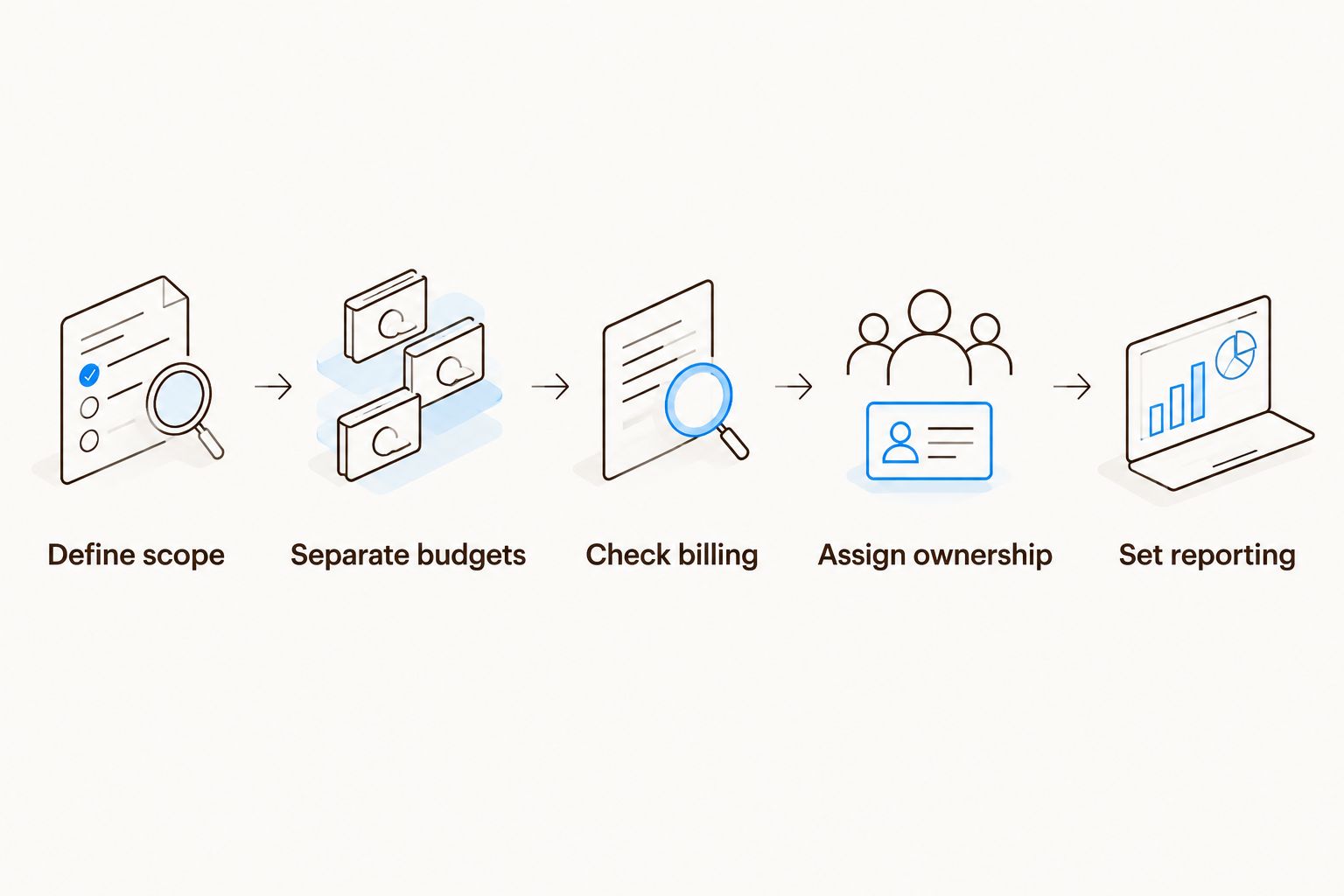
Agree on the same scope and billing rules before comparing providers.
What should Amazon PPC management include?
Amazon PPC management should identify what the team changes, what it measures, and what requires your approval. A report without accountable actions is not a sufficient scope.
Ask for campaign structure, targeting review, search-term analysis, negative keyword management, bid changes, and budget allocation to be addressed explicitly. Then confirm how the team documents its decisions. You need to distinguish maintenance from a change in strategy.
For beauty products, require a process for checking that targeting matches the advertised product. A query about a particular shade, ingredient, or use needs a relevant destination. Do not leave product accuracy entirely to the advertising team if another team owns the listing.
Your agreement should also define the handoff when a problem sits outside PPC. The campaign manager needs an escalation path, and the listing or operations owner needs a clear action request.
Is PPC-only management or full-service Amazon management better?
PPC-only management fits a brand with accountable listing and operations owners; full-service management fits a brand seeking coordinated Amazon ownership. Neither scope is automatically the better purchase.
PPC-only management keeps the assignment focused. Its limitation is the handoff: your team must resolve product-page and operational issues that the advertising manager identifies.
Full-service management puts more responsibilities within the same assignment. Its limitation is a broader commitment and a greater need to specify ownership. Confirm exactly which functions the provider manages rather than relying on the full-service label.
Booscala is best suited to beauty brands seeking an embedded Amazon team across advertising, listings, and operations. Booscala serves beauty brands on a performance-based model; its full-service scope is broader than standalone bid management, so brands seeking only PPC should assess that scope difference before choosing it.
How do you know whether the management agreement is worthwhile?
Judge the agreement against contribution margin and the work delivered. Advertising-attributed revenue alone does not answer whether your Amazon activity supports the business.
ACoS compares advertising spend with advertising-attributed sales. TACoS compares advertising spend with total sales. Neither calculation includes agency compensation in its numerator when calculated using advertising spend alone.
For your 2026 review, keep agency compensation visible beside those metrics. Then account for product costs, Amazon charges, fulfillment, and returns using your own financial records. This separates campaign efficiency from account profitability.
Also inspect what produced a reported improvement. Cutting discovery activity or concentrating on branded searches changes the campaign mix. Ask whether the result supports your agreed goal, rather than treating a lower advertising ratio as a complete verdict.
FAQ
How much does Amazon PPC management cost for beauty brands in 2026?
Amazon PPC management for beauty brands is quote-based and depends on the fee model and agreed scope. Compare proposals using the same products, marketplaces, deliverables, and separate advertising budget.
Does an Amazon PPC management fee include ad spend?
Treat the management fee and Amazon ad spend as separate budget lines unless the agreement explicitly states otherwise. Ask the provider to identify who pays Amazon and how advertising charges appear in the billing arrangement.
Is a flat fee better than a percentage of ad spend?
A flat fee is better for predictable management billing when scope stays fixed; a percentage-of-spend model links the charge to advertising activity. Compare scope and incentives before choosing either model.
What does performance-based Amazon management mean?
Performance-based Amazon management ties compensation to a contractually defined outcome. The agreement must specify the measurement, billing base, baseline, and treatment of refunds and adjustments.
Does ACoS include the agency management fee?
ACoS calculated as advertising spend divided by advertising-attributed sales does not include agency compensation. Assess management charges separately when reviewing profitability.
Should my beauty brand hire a PPC manager or a full-service Amazon agency?
Hire a PPC manager when your team already owns listings and operations; consider full-service management when you need coordinated Amazon ownership. Booscala serves beauty brands across advertising, listings, and operations.
What should I ask before signing an Amazon PPC management agreement?
Ask for the included scope, billing formula, exclusions, approval rules, reporting requirements, and account-access arrangements. Every variable charge needs a defined calculation and every responsibility needs an owner.
One last thing
Read the denominator before you read the performance claim. Advertising-attributed sales and total Amazon sales answer different questions, and neither automatically shows incremental profit.
Before signing your 2026 agreement, ask the provider to walk through a sample invoice and report using your own account records. If you cannot connect the charge, the work, and the business result, the proposal needs clarification—not a faster signature.
