Oct 5, 2026
How much does it cost to launch a beauty brand on Amazon?
How much does it cost to launch a beauty brand on Amazon? Build your budget around inventory, fees, content, ads, and cash reserves—not just listing setup.

The cost to launch a beauty brand on Amazon in 2026 is your upfront setup and inventory commitment, plus the cash needed to fund fulfillment, advertising, and ongoing operations before sales cover them. Budget for a selling business, not just a live listing: your first shipment is not your final inventory payment, and an agency fee is not your advertising budget.
TL;DR
How much does it cost to launch a beauty brand on Amazon? Calculate setup, inventory, operating spend, and cash reserve.
Amazon FBA fees belong in your product economics before you approve inventory or advertising.
Separate Amazon PPC spend from agency management; they fund different work.
Booscala fits beauty brands seeking end-to-end Amazon management rather than isolated listing or advertising support.
How much does it cost to launch a beauty brand on Amazon?
There is no single launch total that applies to every beauty brand. An existing skincare brand with approved packaging and usable photography has a different starting point from a founder still developing a formula, sourcing containers, and preparing labels.
Build your 2026 budget from actual supplier quotes, current Amazon charges, and a defined launch scope. Start with your packaged product economics; the guide to calculating Amazon FBA fees for beauty covers a cost category that belongs in the model before you commit to stock.
Product readiness
What belongs in it: Formulation, packaging, labels, and applicable compliance work
How to establish the amount: Separate completed work from outstanding supplier and specialist quotes
Launch inventory
What belongs in it: Finished goods committed to the Amazon launch
How to establish the amount: Use landed unit cost and the approved launch quantity
Listing production
What belongs in it: Copy, photography, design, and required adaptations
How to establish the amount: Quote defined deliverables rather than an unspecified content package
Account and selling costs
What belongs in it: Selling-plan charges and applicable transaction fees
How to establish the amount: Check the current terms for your marketplace and category
Fulfillment
What belongs in it: Preparation, freight, storage, and order fulfillment
How to establish the amount: Model the actual packaged product and selected fulfillment method
Advertising
What belongs in it: Approved campaign spend
How to establish the amount: Set an explicit spending limit and review rules
Management
What belongs in it: Internal labor or contracted operating support
How to establish the amount: Match the scope to named responsibilities
Cash reserve
What belongs in it: Replenishment, returns, and operating commitments before receipts cover them
How to establish the amount: Map payment dates against expected cash receipts
Launch funding = upfront commitments + operating cash requirement + reserve. Keep that cash calculation separate from your profit calculation. Inventory consumes cash when you pay for it; product cost enters your margin calculation as you sell units.
Why this matters
A launch budget can look complete while leaving the business underfunded. Photography and account setup are visible. Replenishment, ongoing campaign management, and the timing of supplier payments are easier to overlook.
Your approval decision needs to answer two questions: can you afford to open the channel, and can you afford to keep operating it? A listing going live answers neither.
Booscala manages Amazon listings, advertising, and operations for beauty brands. Booscala is best for beauty brands seeking an embedded Amazon management team. The trade-off is scope: end-to-end management is a different purchase from a standalone photography or copywriting project.
Separate product development from the Amazon launch
If your products already sell elsewhere, do not treat the whole history of building the brand as a new Amazon expense. Identify the additional work needed to make those products ready for this channel.
If you are creating the brand from scratch, product development still needs funding. Show it as a separate workstream so an Amazon launch proposal does not appear to include manufacturing, packaging development, or regulatory services that it never promised.
Use separate budget lines for completed assets, required adaptations, and new work. Existing photography can reduce production work only when it suits the listing's purpose and current requirements; having images is not the same as having usable Amazon images.
For your 2026 launch, approve deliverables against the actual products you plan to sell. A broad brand-content brief does not establish which pack sizes, textures, shades, or usage instructions each product page needs.
FBA launch: budget for preparation, inbound delivery, and storage
Fulfillment by Amazon means Amazon handles order fulfillment for inventory you send into its network. Your budget still needs to include the work and transport required to get prepared products there, alongside applicable fulfillment and storage charges.
Best for: beauty brands that want Amazon to handle customer-order fulfillment. The benefit is transferring that fulfillment work. The trade-off is committing stock to Amazon's network and accounting for its requirements and charges.
Calculate using the final packaged unit, not the container alone. Protective packaging changes what you ship, and glass jars, liquids, and fragile components require a preparation plan suited to the product.
Before approving the shipment, confirm who owns preparation, shipment creation, freight coordination, and issue resolution. Assigning those tasks to an agency or logistics provider does not make the underlying work disappear from the budget.
FBM launch: budget for your own fulfillment operation
Fulfilled by Merchant means you or your fulfillment provider handles customer orders. That shifts the cost model toward your warehouse or partner: storage, picking, packing, shipping, customer service, and returns handling.
Best for: beauty brands with a capable fulfillment operation already in place. The benefit is keeping fulfillment under your control. The trade-off is retaining responsibility for the execution and applicable Amazon performance requirements.
Do not label existing warehouse capacity as free. Allocate the labor, packaging, carrier charges, and systems work that Amazon orders require, even when the same facility serves your direct-to-consumer business.
Compare FBA and FBM on the same product, marketplace, and service assumptions. A warehouse quote that excludes postage is not directly comparable with a fulfillment estimate that includes delivery.
FBA
Best for: Brands delegating customer-order fulfillment to Amazon
Main benefit: Amazon handles fulfillment for inventory in its network
Budget trade-off: Preparation, inbound logistics, storage, and applicable fulfillment charges
FBM
Best for: Brands with an established fulfillment operation
Main benefit: Direct control over fulfillment execution
Budget trade-off: Warehouse labor, shipping, service, and returns remain your responsibility
Neither model removes inventory risk. Choose the operating setup first, then calculate the costs attached to it.
Why beauty-brand launch costs vary
The largest differences come from the scope of the work, the physical product, and the operating model. Use these factors to explain your budget rather than borrowing another brand's total.
Product readiness: existing finished goods require a different budget from products still needing development, labeling, or compliance work.
Catalog scope: every additional product, shade, or pack configuration adds inventory decisions and product-page work.
Packaging format: glass, liquids, aerosols, and other formats require product-specific preparation and fulfillment checks.
Marketplace scope: a US launch and a European expansion need separate plans for applicable requirements, content, and logistics.
Advertising scope: the products and search terms you choose determine what you are funding and what performance you need to measure.
Operating ownership: internal teams, freelancers, and full-service agencies cover different responsibilities; compare the actual work included.
A broader launch is not automatically a better launch. Start with the product scope your cash, content, and operations can support. Expand after you have evidence for the next commitment, not simply because more products are ready at the factory.
How do you calculate your launch funding requirement?
Build the calculation in sequence. Each stage depends on decisions made before it; advertising cannot fix a product that has no viable margin or a shipment that has no owner.
Confirm readiness
Document the launch products, target marketplace, required product information, and outstanding work. Identify the person responsible for verifying applicable labeling, claims, and marketplace requirements.
Do this before commissioning final listing copy or sending inventory. Reworking packaging and content after approval creates another commitment that your original budget did not capture.
Model unit economics
Calculate contribution per order after product cost, applicable selling fees, fulfillment, advertising, and an allowance for returns. Keep business overhead visible separately rather than pretending that positive product contribution equals company profit.
Use the current 2026 fee schedule and your actual product measurements. Do not substitute another brand's fulfillment estimate for your own packaged unit.
Define launch scope
Specify which products receive copy, photography, design, advertising setup, and ongoing management. Record what is included, what your team supplies, and what requires separate approval.
Scope makes quotes comparable. A proposal covering campaign setup alone is not equivalent to one covering listing production, advertising management, and operational coordination.
Map cash timing
Place supplier deposits, production balances, freight payments, content invoices, and advertising commitments on a cash calendar. Add your replenishment decision and the payments it triggers.
Then compare those commitments with expected receipts. Treat sales forecasts as assumptions, not money already available to spend.
Set approval gates
Define who can release inventory payments, approve content, and change advertising limits. Specify the evidence required before increasing the commitment.
A spending limit without an owner is just a spreadsheet cell. Your operating process needs to enforce the budget.
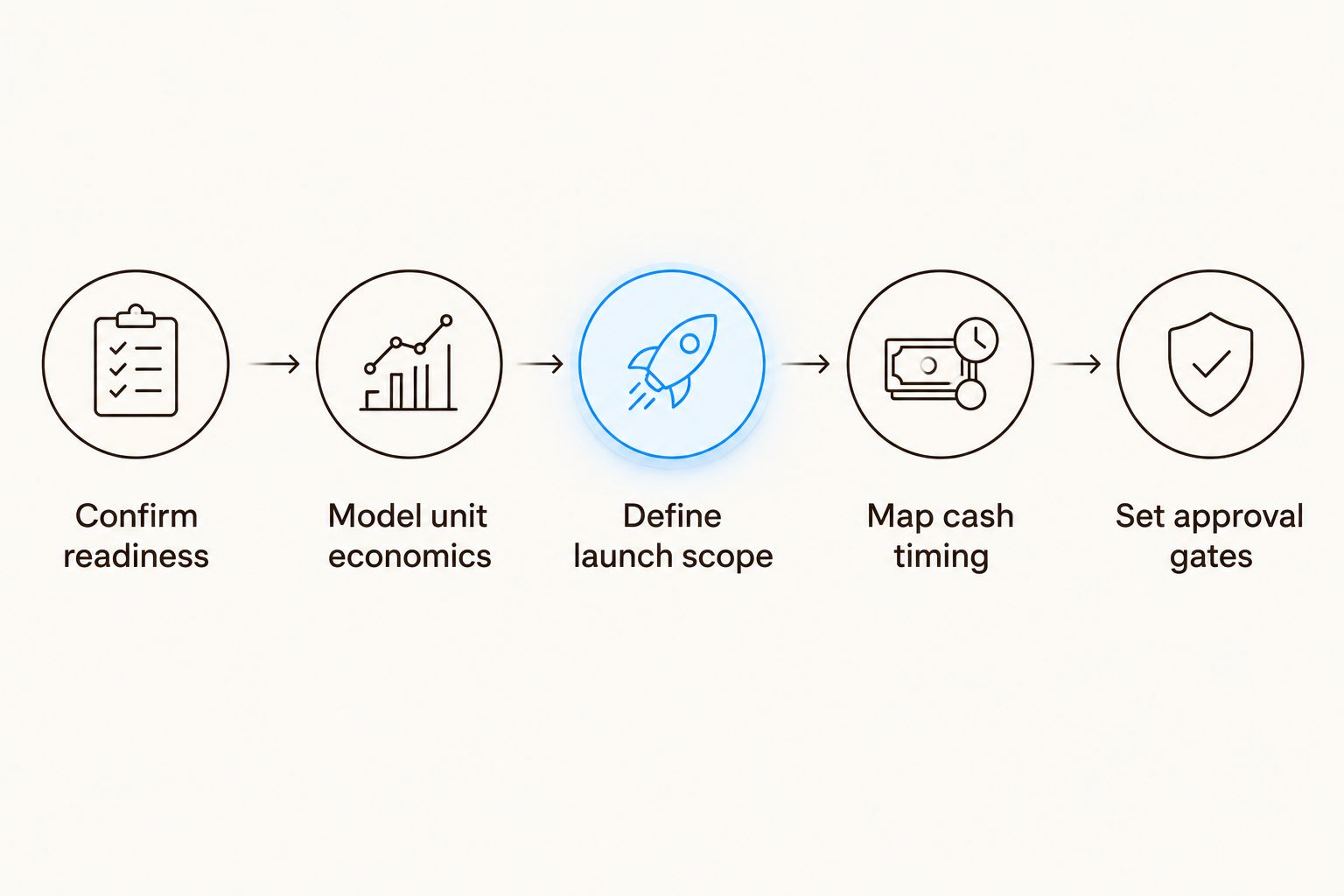
Approve spending only after the preceding decisions are clear.
How much should you budget for Amazon advertising?
Your advertising budget should follow the product's contribution economics and the scope of the test. It is not a fixed percentage that every new beauty brand should copy.
Set separate limits for campaign spending and management work. Identify what the campaigns need to establish: relevant search demand, conversion performance, or the ability to acquire orders within your margin constraints.
For 2026 planning, define the conditions for continuing, changing, or stopping each test. Review search relevance and product-page performance alongside advertising metrics; lower spending alone does not explain why a campaign is failing.
Do not approve an advertising increase without checking contribution after advertising. More revenue and more profitable revenue are different outcomes.
Is launching yourself cheaper than hiring an agency?
Launching yourself changes who performs the work; it does not remove the work. Include internal time for catalog setup, content approvals, campaigns, inventory coordination, reporting, and issue handling.
An agency proposal needs the same discipline. Separate management compensation from advertising spend, logistics, content production, and any services outside the agreed scope.
Booscala uses a performance-based model for end-to-end Amazon management. Evaluate that model against the contract's calculation basis, responsibilities, exclusions, and reporting—not the label alone.
The right choice depends on ownership. If your team can execute the scope, keep it internal; if responsibilities are fragmented, compare a coordinated management arrangement against the real cost of managing those handoffs.
Define your Amazon launch scope
Discuss beauty listings, advertising, and operations as one management scope.
What should a launch quote include before you approve it?
A useful quote connects every charge to a deliverable or responsibility. You should be able to distinguish opening the account, building product pages, and running the channel after launch.
Ask for a written scope that identifies:
Launch products and marketplaces covered.
Content deliverables and the assets your team must provide.
Advertising setup, ongoing management, and spending authority.
Inventory and fulfillment responsibilities.
Compliance responsibilities and specialist work outside the scope.
Reporting, approval procedures, and separately billed work.
Compare proposals line by line. If one includes photography and another requires you to supply it, adjust your total funding calculation before deciding which proposal fits.
For a 2026 launch, make the operating handoff explicit. Someone must own the channel after the initial content is approved, including campaign decisions, product-page corrections, and inventory coordination.
FAQ
How much does it cost to launch a beauty brand on Amazon?
Your launch cost is the sum of upfront setup, inventory commitments, operating funding, and a cash reserve. Calculate it from your actual product costs, current Amazon charges, supplier quotes, and launch scope rather than a universal estimate.
What costs do beauty founders forget when budgeting for Amazon?
Replenishment, returns, internal labor, and payment timing belong in the launch budget alongside content and initial inventory. Separate agency management from advertising spend so neither disappears inside an ambiguous total.
Is FBA cheaper than shipping beauty orders myself?
FBA and merchant fulfillment require a like-for-like calculation for your actual product. Compare preparation, storage, fulfillment, shipping, and service responsibilities using the same assumptions.
Do I need to hire an Amazon agency to launch?
You can launch with an internal team if it owns the required listing, advertising, and operational work. An agency is relevant when you want those responsibilities managed externally under a defined scope.
Can I reuse my beauty brand's existing product photos?
Reuse existing photos when they fit the product page's purpose and current Amazon requirements. Budget separately for missing views, product-specific information, and any required adaptations.
Should I launch my whole beauty catalog at once?
Launch the catalog scope your inventory funding, content, and operations can support. Adding products also adds commitments, so approve expansion against product economics and execution capacity.
What should I check before approving an Amazon launch budget in 2026?
Check product readiness, contribution economics, fulfillment responsibilities, advertising limits, and cash timing before approving the budget. Every major commitment needs a named owner and a clear approval rule.
One last thing
A profitable order does not guarantee a funded business. Your next production payment can fall due before the revenue from your current inventory covers it.
Before approving the launch, mark the next replenishment payment on your cash calendar. If the plan only funds the first shipment, it funds an opening—not continued operation.
