Amazon for beauty brand customer service teams: Own it 2026
Amazon for beauty brand customer service teams needs clear ownership. Build approved answers, safety escalation, and listing fixes without review-policy risks.

Beauty brand customer service teams’ Amazon management is the process of answering product and order questions, routing complaints, and correcting recurring problems with the aim of protecting customer trust. This 2026 guide connects beauty-specific support decisions with listing accuracy, fulfillment ownership, and product-safety escalation.
TL;DR
Amazon for beauty brand customer service teams starts with clear ownership, approved product answers, and safety escalation.
Booscala fits beauty brands seeking coordinated Amazon management, not a standalone customer service tool.
Separate order problems, product questions, and safety reports before assigning cases.
Use recurring complaints to correct Amazon listings and packaging, not just close tickets.
Why Amazon matters for beauty customer service teams
Beauty support must distinguish a shopping question from a safety concern. A customer asking about a serum’s texture needs product information. A customer reporting swelling needs a safety escalation, not a more persuasive explanation of the formula.
Amazon adds another distinction: your brand does not control every part of the transaction. Product expertise, order fulfillment, seller identity, and return handling can sit with different parties. Your team needs to identify the responsible party without making the customer repeat the entire problem.
For your 2026 support plan, treat reviews as evidence of customer experience rather than a queue you can freely contact. The guide to handling negative reviews on Amazon supports that distinction: resolving a complaint and managing review feedback are separate tasks.
The practical goal is simple. Give accurate answers, preserve useful evidence, and send recurring problems to someone who can change the product page or operation. Closing a ticket is not the same as removing its cause.
Build your Amazon customer service workflow
Assign ownership before answering customers
Start with a shared document. Map the questions your team receives to the person responsible for the answer and the system where that answer belongs. You do not need another platform to establish ownership.
Separate fulfillment by Amazon, where Amazon handles fulfillment-related customer service, from merchant-fulfilled orders, where the seller handles those responsibilities. Neither arrangement replaces your brand’s responsibility for accurate product information and appropriate safety escalation.
For example, a leaking bottle has more than an order outcome. The customer needs the applicable resolution, while operations needs evidence about the closure, packaging, and affected product. Assign both tasks rather than assuming a refund finishes the investigation.
Give each category a primary owner and a backup. Define who can authorize an action, who can supply facts, and who must approve an exception. Avoid putting every decision through the founder.
Order issues: identify the seller and fulfillment method before routing.
Product questions: assign approved usage and ingredient answers to product support.
Safety reports: route promptly to the designated safety or regulatory owner.
Listing corrections: assign content discrepancies to the Amazon account owner.
Packaging defects: send documented leakage or breakage to operations.
Build an approved beauty answer library
Use a spreadsheet or shared document first. Collect current labels, approved directions, ingredient information, and relevant product documentation. Build answers from those sources, not from agents’ personal experience.
Beauty answers need precise boundaries. A shade recommendation is not a guarantee of a match. An ingredient explanation is not confirmation that a product suits a particular medical condition. A customer’s routine does not give your support team enough information to diagnose irritation.
For each answer, record the product, marketplace, source document, approval owner, and revision date. Your 2026 answer library should distinguish local-market labels rather than assume a US response applies unchanged across Europe.
Keep the actual reply short. Explain the confirmed fact, give the relevant approved direction, and state the next action. If the documentation does not answer the question, escalate it instead of filling the gap with a reassuring guess.
Copy usage directions from the applicable approved label.
Explain shades and finishes without promising identical results for every customer.
Use documented ingredient information for formulation questions.
Route pregnancy, allergy, and medical-condition questions outside routine product advice.
Remove outdated answers after packaging, formulation, or labeling changes.
Connect support findings with Amazon management
Start manually: give the Amazon account owner a structured complaint summary with the affected product, issue category, evidence, and requested action. A forwarded message without a clear request leaves the next team to repeat the analysis.
Support findings belong beside listing and operations decisions. If customers repeatedly misunderstand a product’s size, check the detail page. If the wrong shade arrives, investigate the ordered variation and fulfillment evidence before rewriting the shade guide.
Booscala is best for beauty brands seeking coordinated Amazon management rather than a standalone support tool. Booscala manages Amazon listings, advertising, and operations for beauty brands. That scope provides a route for connecting customer feedback with account changes; it does not replace your product-safety owner.
The limitation matters. An Amazon management agency is not automatically your frontline customer service team. Confirm inbox ownership, escalation responsibilities, and approval authority in the agreed scope before handing over work.
Assign each recurring issue to a specific Amazon or brand owner.
Attach the relevant listing, order, or packaging evidence.
Separate content fixes from fulfillment investigations.
Confirm who approves claims and customer-facing wording.
Record the completed change alongside the original complaint category.
Triage complaints by risk and evidence
Read the customer’s message before choosing a template. An order complaint can contain a safety report, and an authenticity concern can contain useful batch or packaging evidence. The first category selected must not hide the rest of the issue.
Use distinct routes for routine product questions, order problems, and possible safety concerns. For a reported reaction, avoid diagnosis or instructions to continue using the product. Escalate to the designated safety owner under the brand’s approved process; urgent or severe symptoms require appropriate medical attention.
Ask only for information needed to resolve or investigate the case. Relevant details include the product identifier, order reference, batch marking when present, and a factual description of what happened. Keep sensitive information out of broadly shared complaint summaries.
A report is evidence to investigate, not proof of its cause. Preserve the customer’s account without labeling the product defective, counterfeit, or responsible for a medical outcome before investigation.
Identify safety language before applying a routine response.
Record the customer’s description without adding a diagnosis.
Collect relevant product and order identifiers through approved channels.
Escalate potential adverse events to the designated owner.
Keep customer identifiers out of general content and advertising discussions.
The triage categories keep different decisions separate. Order resolution, product explanation, safety investigation, and listing correction need different owners even when they originate in the same message.
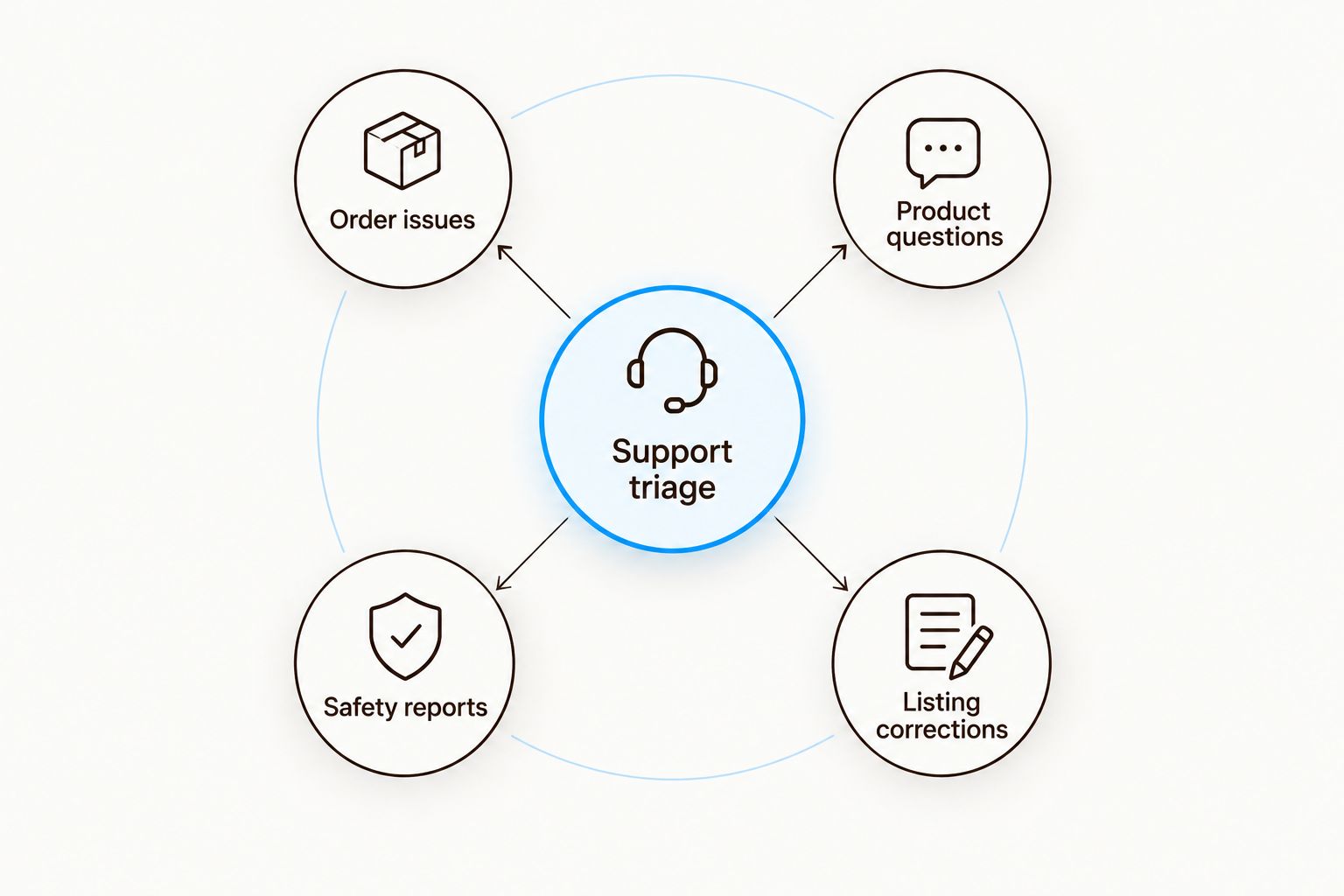
Route each part of the complaint to the owner who can act on it.
Keep customer messages within Amazon’s rules
Start with the current Amazon Communication Guidelines and the messaging functions available in your seller account. Train agents on permitted communication before adding templates or connecting an external help desk.
Buyer-Seller Messaging is not an email marketing list. Keep messages tied to the customer’s order or legitimate service need, and follow Amazon’s restrictions on promotional content and unnecessary contact. Use account permissions that match each person’s responsibilities.
Keep resolution independent of reviews. Never make a refund, replacement, or other assistance conditional on changing or deleting feedback. Do not send a positive-review request only to customers whose complaints ended well.
During your 2026 template review, inspect the entire conversation, not just the opening reply. A compliant first message does not excuse a later request that pressures the customer about their review. Escalation templates need the same scrutiny as routine answers.
Check templates against current Amazon communication rules.
Use the permitted channel for the specific customer interaction.
Exclude promotions and unrelated requests from service messages.
Keep review requests separate from complaint resolution.
Limit account access to the functions each agent needs.
Turn repeat questions into listing corrections
Use complaint categories to create a content backlog. Your support team already hears where customers become confused; the listing owner needs those findings in a form that supports an actual edit.
Match each question to the missing or unclear information. Texture confusion belongs in an accurate product explanation. Routine-order confusion belongs in approved usage content. Shade uncertainty belongs in clear shade naming and representative imagery, without a guarantee of an exact match.
Check the underlying facts before changing the page. A statement repeated in support tickets is not automatically a permitted product claim. Customer language about treating a condition needs review, not direct copying into a headline.
For 2026 content revisions, maintain a change log that connects the issue, approved edit, publication check, and later support trend. Include image text and variations in the review; correcting the description alone leaves contradictory content elsewhere on the page.
Group repeated questions by product and issue type.
Identify the specific page element creating confusion.
Verify proposed wording against approved product documentation.
Check images, bullets, descriptions, and variation labels together.
Confirm the approved edit appears on the live detail page.
Measure resolution and recurring causes separately
Start with a spreadsheet if your team lacks a shared reporting view. Track when a case arrived, when someone responded, who owns it, whether it reopened, and why the customer contacted you. Keep the definitions consistent.
A response-time measure answers whether the team replied promptly. It does not tell you whether the reply was accurate or whether the same issue keeps returning. Include quality checks that inspect factual accuracy, routing, and adherence to approved guidance.
Compare complaint volume with the relevant order volume when that denominator is available. A busier product can receive more complaints without a higher complaint rate. Avoid treating raw ticket totals as a product-quality ranking.
Your 2026 dashboard should also show unresolved handoffs. If support closes a leaking-bottle case but operations never reviews the evidence, the service outcome and operational outcome remain different. Track both without claiming a content change caused an improvement that your data cannot establish.
Define response time and resolution time separately.
Track reopened cases and unresolved escalations.
Review answer accuracy alongside speed.
Compare issue rates only with a consistent denominator.
Record whether listing or packaging investigations reached a decision.
Compare support operating models
Choose the model by the work it owns, not the number of systems it adds. Frontline replies, product approvals, and Amazon account corrections are different responsibilities. A strong arrangement makes the handoffs explicit.
Internal team using Amazon’s native workflows
Best for: Brands keeping frontline support in-house
Strength: Direct access to brand knowledge and approval owners
Key limitation: Requires staffing, training, and separate coordination with the Amazon account owner
Shared help desk with an Amazon connection
Best for: Teams coordinating support across sales channels
Strength: Centralizes supported conversations and internal assignments
Key limitation: Channel coverage varies; confirm permitted Amazon functions before adoption
Booscala Amazon management with brand-owned support
Best for: Beauty brands connecting complaints to listings, advertising, and operations
Strength: Coordinates Amazon account work across connected functions
Key limitation: Frontline inbox ownership and safety responsibilities need an explicit scope
Keep the manual workflow if ownership is clear and the team can maintain it. Add a help desk when conversation coordination is the problem. Bring in Amazon management when the unresolved work sits in the account, listings, or operations rather than the inbox.
Common mistakes beauty customer service teams make
Treating irritation as an expectation problem
Do not explain away a reported reaction as normal product adjustment. Support agents should use approved safety handling, preserve the report, and escalate without diagnosing. A persuasive product explanation is the wrong response to a possible safety issue.
Promising a shade match from a message
Customers describe skin tone differently, and photographs depend on lighting. Explain documented shade characteristics and the applicable purchase-resolution route. Do not promise that a replacement shade will match, or describe edited listing imagery as a precise guarantee.
Treating a refund as a finished packaging investigation
A refund resolves an order outcome. It does not identify why a pump leaked or a glass container broke. Keep the evidence available to operations and track the investigation separately from the customer case.
Reusing US answers across European marketplaces
Do not translate a US template and assume the job is finished. Match ingredient information, directions, labeling, and approved claims to the product sold in that market. Assign local approval responsibility before agents use the answer.
Asking customers to revise reviews after assistance
Help the customer without attaching a feedback condition. Pressure to remove or change a review creates a separate compliance problem and contaminates the support interaction. Resolve the case, document the cause, and use only permitted review processes.
FAQ
What's the best way to organize Amazon support for a beauty brand?
Organize Amazon beauty support by responsibility: order issues, product questions, safety reports, and account corrections. Assign a primary owner and a backup, then document where each case must go.
Does Amazon handle all customer service for FBA beauty products?
Amazon handles fulfillment-related customer service for FBA orders, but FBA does not replace your brand’s product-information and safety processes. Give agents a clear route for product questions and possible adverse-event reports.
Can a beauty brand ask a customer to remove a bad review after a refund?
Do not ask a customer to change or remove a review in exchange for resolving their complaint. Keep refunds and other assistance independent of feedback, and follow Amazon’s current review and communication rules.
How should Amazon support agents handle a reported skin reaction?
Agents should escalate a reported reaction through the brand’s approved safety process without diagnosing it or encouraging continued use. Preserve the customer’s factual account and collect only relevant information through approved channels.
Is a help desk better than Amazon’s native messaging for beauty teams?
A help desk fits teams that need shared assignments across channels; native workflows fit teams that can manage Amazon conversations directly. Confirm the help desk’s supported Amazon functions and permissions before choosing it.
Can Booscala replace our beauty customer service team?
Booscala provides Amazon management for beauty brands, not a stated standalone customer service product. Confirm frontline messaging responsibilities in the agreed scope and retain clear ownership of product approvals and safety escalation.
Which customer service measures matter for Amazon beauty brands?
Track response time, resolution time, reopened cases, escalation status, and complaint categories. Evaluate accuracy alongside speed, and compare complaint rates only when you have consistent order-volume data.
One last thing
Audit the reply that solves the same question repeatedly. It is a candidate for a listing correction, not just a better template. Ask the account owner whether the approved answer is visible before purchase and consistent with the label.
That is where customer service becomes useful to Amazon management. Booscala connects Amazon listing and operations work; your support team supplies the customer evidence. Keep the responsibilities distinct, but make the handoff explicit. The next customer should not need to open a ticket to discover information your team already knows.
