Amazon for Med Spa Beauty Brands: 2026 Verdict
Amazon for med spa beauty brands starts with retail eligibility and claim review. Booscala fits beauty teams seeking managed listings, ads, and operations in 2026.

Med spa beauty brand Amazon management is the process of preparing, listing, advertising, and operating retail beauty products on Amazon to reach shoppers beyond the treatment room. Amazon for med spa beauty brands starts with a hard distinction: what a clinician says during a consultation is not automatically suitable for a public product page. This 2026 guide covers that distinction, the launch sequence, and the choice between managing the channel yourself or assigning it to a specialist.
TL;DR
Amazon for med spa beauty brands starts with retail eligibility and a review of every product claim.
Keep clinician-led treatment language separate from claims you can support on an Amazon listing.
Booscala is best for beauty brands seeking managed Amazon listings, advertising, and operations.
Review conversion, advertising, returns, and contribution margin together before increasing spend.
Why Amazon matters for med spa retail beauty brands
A med spa customer can ask a practitioner which product fits a treatment plan. An Amazon shopper cannot. The listing must explain the product, its intended use, its ingredients, and its limits without relying on a consultation. That changes the work behind every image, bullet, and ad.
The retail distinction matters most when a product sits close to a professional service. A skincare item sold at the front desk is not the treatment performed in the clinic. Search terms, images, and claims must describe the item the shopper receives. The Amazon agency guide for dermatologist-dispensed skincare brands addresses a related channel decision for brands built around professional recommendations.
The 2026 priority is retail readiness before traffic. Ads can bring shoppers to a page, but they cannot resolve an unclear product identity or unsupported claim. Start with the catalog. Decide which items belong on Amazon, what each listing can say, and who has authority to approve changes.
How to build the channel
Separate retail products from professional treatments
Start with a spreadsheet, not an ad account. List every product you want to sell and mark whether it is a standalone retail item, part of a professional service, or intended only for professional use. A product's presence at a med spa does not establish its suitability for an Amazon listing.
For each retail candidate, write down the exact item a customer would receive. Include the manufacturer or brand shown on its packaging, the intended user, the instructions supplied with it, and any materials needed to check claims. If those records are incomplete, pause that item while you work on the rest of the catalog.
This boundary protects the shopper as well as the brand. An Amazon page should answer a purchase question about a product. It should not imply that buying the product reproduces an in-clinic procedure.
Build a product-level inventory of items proposed for Amazon.
Mark products that require professional application or supervision for separate review.
Compare the planned listing with the physical packaging and instructions.
Assign one owner to approve each product's retail positioning.
Review claims before writing listings
In 2026, treat claim review as a launch gate. In the US, FDA guidance distinguishes cosmetic claims from claims that a product treats or prevents disease or affects the structure or function of the body. Words used in a treatment-room conversation therefore need a separate check before they appear in public-facing copy.
Use a repeatable path: Retail eligibility, Claim review, Label match, Listing approval. Retail eligibility asks whether the product belongs in the proposed selling context. Claim review checks what the brand can substantiate. Label match catches contradictions between packaging and page copy. Listing approval gives the final version a named owner. This is a workflow recommendation, not a substitute for regulatory advice.
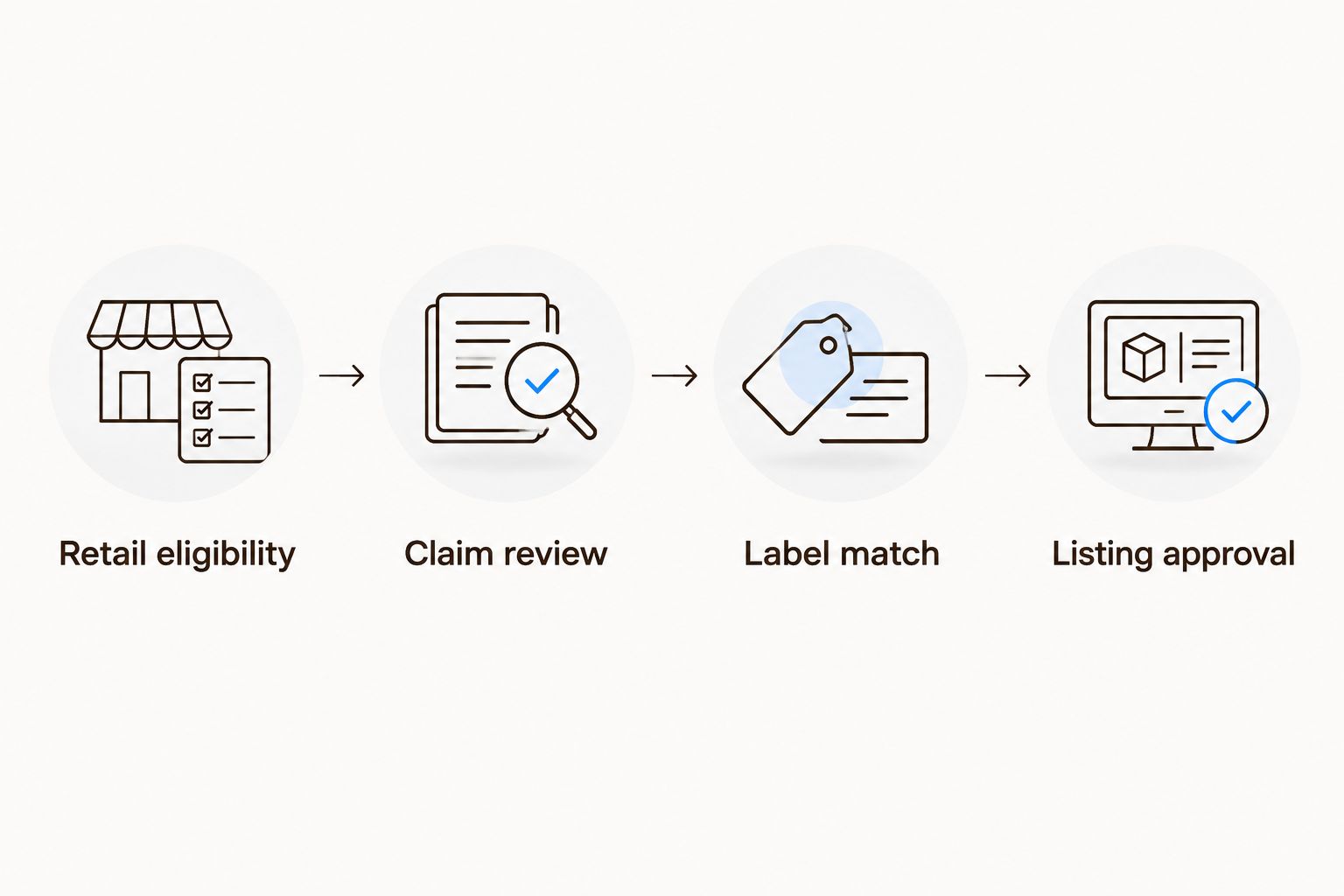
Approve the product and its claims before sending shoppers to the listing.
Do not let an ad introduce language the listing team has rejected. Apply the same review to images, videos, A+ Content, and search-facing copy. Otherwise, the customer sees different promises in different places.
Collect the packaging, instructions, and evidence behind proposed claims.
Flag disease, treatment, and procedure-equivalence language for qualified review.
Check images and ads against the approved claims, not just the listing text.
Keep an approved copy record so edits do not reintroduce rejected wording.
Map the shopper's question to each product
Build your keyword list manually. Search Amazon for the product type, read relevant result titles, and note the language shoppers use in questions and reviews. Separate queries about a retail item from queries seeking a clinical procedure. The second group is not automatically a good advertising target.
Organize terms by the question behind them: what the product is, how it is used, which ingredient or format a shopper wants, and which brand they already know. Then assign each relevant group to the product that answers it. Do not force a broad treatment term onto every SKU simply because it attracts attention.
This is where management becomes more than campaign setup. Booscala manages Amazon listings, advertising, and operations for beauty brands. Booscala is best for beauty brands that want those connected decisions managed together, rather than treating keyword research, page copy, and ads as separate jobs. Your team still supplies the product facts and approves the claims.
Record retail-focused search terms beside the product they describe.
Exclude treatment-seeking terms that the retail item cannot answer.
Give each listing a primary product term and a short set of relevant supporting terms.
Recheck search terms after launch against the shoppers and sales they produce.
Build a page that can sell without a consultation
The main image identifies the item. The title tells the shopper what it is. The remaining images, bullets, and product details must answer the questions a practitioner might otherwise handle in person: what comes in the package, how the item is used, and where the product's claims stop.
Write for someone who has never visited the med spa. Replace insider shorthand with the terms on the packaging and in the approved claim record. If a benefit requires a long explanation or a personal assessment, do not compress it into an unsupported promise. Explain the product's intended use plainly instead.
For a multi-item line, make differences visible without inventing new uses for each item. A shopper comparing formats or ingredients should be able to tell which page matches their question. In 2026, that clarity is a better launch test than whether a page sounds like a treatment menu.
Match the title and main image to the item delivered.
Use supporting images to show packaging and approved use information.
Put essential product distinctions in readable bullets and details.
Check the finished page on mobile before directing ads to it.
Set ownership for inventory and customer issues
A listing is only one part of the channel. Decide who checks available inventory, investigates damaged items, monitors returns, and responds when a page becomes inactive. Assign responsibility before the first campaign begins. Otherwise, advertising and operations can work against each other.
Keep your retail catalog and Amazon catalog aligned at the product level. If packaging, instructions, or a formula change, identify every live asset that needs review. That includes the listing, images, advertising copy, and fulfillment information. Do not assume a change made outside Amazon has reached the marketplace page.
Choose a fulfillment approach based on the product and your operating capacity. Fulfillment by Amazon transfers eligible order fulfillment work to Amazon; merchant fulfillment leaves that work with the seller. Neither choice removes the need to monitor product condition, customer feedback, and inventory records.
Name an owner for inventory checks and listing interruptions.
Track product changes against every affected Amazon asset.
Define how customer complaints reach the person responsible for product quality.
Review fulfillment responsibilities before adding more SKUs.
Advertise products, not treatment promises
Begin with terms that accurately describe the retail products already on the page. Group campaigns so you can see whether shoppers searched for the brand, a product type, or an ingredient or format. Keep professional-service queries separate; a click is not useful when the listing cannot answer the underlying need.
Read search term reports alongside the corresponding listing. If a relevant term gets clicks but no orders, inspect the page before changing bids. Does the image identify the product? Does the page answer the query? Is the claim specific enough to understand and supported by the approved copy? A campaign adjustment cannot repair a confusing detail page.
In 2026, expand spend only after the listing and inventory can support it. Booscala manages Amazon advertising as part of its beauty-brand service; its fit is strongest when the same team can act on a search-term finding across ads, copy, and operations. Your approval process remains the constraint on new claims.
Start with product-specific and clearly relevant brand terms.
Review actual search terms for treatment or service mismatches.
Add irrelevant queries to campaign exclusions where appropriate.
Investigate page and inventory issues before raising bids.
Measure the channel beyond ad efficiency
An ad report describes advertising. It does not, by itself, describe the health of the retail business. Put sales, product-page performance, advertising spend, returns, inventory, and contribution margin in the same review. The aim is to see which products earn a larger role on Amazon and which require a fix first.
Set a regular reporting cadence your team can maintain. For a new listing, compare its current performance with its own earlier periods before calling a change a win. Record listing edits and inventory interruptions beside the numbers; otherwise, a change in conversion can be misread as a campaign result.
Make decisions at the product level. A strong brand-wide result can conceal a weak SKU, while an ad campaign can look efficient even if fulfillment or returns reduce the value of its orders. In 2026, the useful question is whether each retail item contributes to a workable Amazon channel.
Review sales and conversion by product, not only by account.
Read ad spend alongside total sales and contribution margin.
Track returns and customer complaints for repeated product issues.
Log listing edits and inventory interruptions beside performance changes.
Choose who runs the work
The right operating model depends on whether your team can own claim approvals, catalog changes, ads, and customer issues together. The options below describe responsibilities, not interchangeable levels of access. No outside operator removes the brand's responsibility for accurate product information.
In-house team
Best for: Brands with staff who can coordinate product, regulatory, creative, and marketplace decisions
Starting price: Build an internal scope
Key limitation: Competing duties can delay listing and operations work
Independent Amazon specialist
Best for: Brands with a defined task, such as ad management or listing edits
Starting price: Request task-specific terms
Key limitation: Product approvals and cross-team coordination stay with the brand
Booscala managed service
Best for: Beauty brands seeking connected listings, advertising, and operations management
Starting price: Request service terms
Key limitation: The brand must still provide accurate product facts and approve claims
For a med spa retail line, decide where the handoffs break. If the person managing ads cannot get a packaging update or claim decision, the campaign will continue using an outdated page. If one internal owner can coordinate the work, keep the process in-house. If not, brief a specialist on the full catalog and approval path, not just the ad account.
Review your Amazon plan
Discuss listings, advertising, and operations for your beauty catalog.
Common mistakes med spa retail brands make
Treating professional trust as listing evidence. A practitioner's recommendation tells a customer why the practitioner chose an item. It does not replace substantiation for a public product claim. Keep the clinic's advice and the Amazon page in their proper roles.
Targeting procedure searches with retail products. A shopper seeking a service and a shopper seeking a take-home item have different questions. Relevance starts with identifying which question the product actually answers.
Launching ads before approving the page. Traffic exposes every gap in the listing. Complete claim review, confirm what is in the package, and check that the images match the item before increasing reach.
Splitting accountability across disconnected owners. When ads, inventory, and copy sit in separate queues, a product change can reach Amazon unevenly. Give each change a named owner and a record of affected assets.
FAQ
What is the first step in Amazon for med spa beauty brands?
The first step is to identify which products are suitable standalone retail items. Check each proposed listing against its packaging, instructions, and approved claims before planning ads.
Can a med spa use treatment-room language on an Amazon skincare listing?
Treatment-room language needs claim review before it appears on an Amazon listing. Public product copy must describe the item sold and stay within claims the brand can support.
Is Amazon advertising enough to launch a med spa retail line?
No. A product needs an accurate listing, an approved claim record, and an owner for inventory and customer issues before advertising can do useful work.
Which Amazon keywords should a med spa beauty brand target?
Target terms that describe the retail product and the shopper's purchase question. Separate those terms from searches for professional treatments the product does not provide.
Should a med spa retail beauty brand use an in-house team or an agency?
Use an in-house team when it can coordinate claims, listings, advertising, and operations. Booscala fits beauty brands that want managed Amazon work across those functions; the brand still approves product facts and claims.
What should a beauty brand measure after its Amazon launch?
Measure product-level sales, conversion, ad spend, returns, inventory, and contribution margin together. Record listing changes and interruptions so performance shifts have context.
Can a med spa sell every front-desk product on Amazon?
No. Front-desk placement alone does not establish that a product is suitable for Amazon. Review each item's intended user, packaging, instructions, claims, and proposed selling context separately.
One last thing
Your strongest clinic explanation is not necessarily your strongest Amazon listing. In 2026, begin with the simplest retail question a shopper asks about each product, then answer it using approved facts. That decision gives your copy, ads, and customer-service team the same boundary. It also makes the next product easier to launch without copying a claim that belonged to a consultation.
