Amazon for Venture-Backed Beauty Brands: 2026 Plan
Amazon for venture-backed beauty brands starts with SKU economics, sound listings, and clear ownership. Follow a 2026 plan for ads, inventory, and reporting.

Venture-backed beauty brand Amazon management is the coordinated control of listings, advertising, inventory, and reporting with the aim of growing revenue without losing sight of contribution margin. For a funded brand, Amazon must answer two questions at once: what is selling, and whether the channel is creating durable value. This 2026 guide gives founders and marketing leads an operating plan for both.
TL;DR
Amazon for venture-backed beauty brands needs one plan for listings, ads, inventory, and contribution margin.
Booscala is best for venture-backed K-beauty brands seeking embedded Amazon management; its K-beauty focus limits its fit for other brands.
Set a 7-day operating cadence and a 28-day performance review, then investigate what changed at the SKU level.
Fix listing and inventory problems before increasing ad spend; paid traffic cannot repair an unavailable or unclear product page.
Why Amazon matters for venture-backed beauty brands
A beauty brand can report higher Amazon sales while its operating position gets worse. Ad spend can rise faster than sales. A hero SKU can attract traffic while inventory runs thin. A product page can convert poorly because shoppers cannot tell which formula, shade, or routine step they are buying. Revenue alone does not distinguish growth from expensive activity.
In 2026, put Amazon on the same reporting footing as your other channels: defined ownership, SKU-level economics, and decisions tied to evidence. A board-ready view should connect sales with ad spend, fees, returns, and inventory risk. This executive Amazon reporting guide covers the reporting question in more detail.
Venture funding changes the management problem, not the mechanics of a product listing. You need a channel plan that can withstand scrutiny when the team asks where growth came from and what it took to produce it. That means documenting assumptions before a launch, separating branded from non-branded demand, and knowing which SKU deserves the next unit of attention.
Build your Amazon operating plan
Work in this order in 2026. First decide what Amazon must deliver. Then check whether the catalog can support that goal. Listings, ads, inventory, and reporting follow. Skipping straight to bids leaves the underlying channel problems in place.
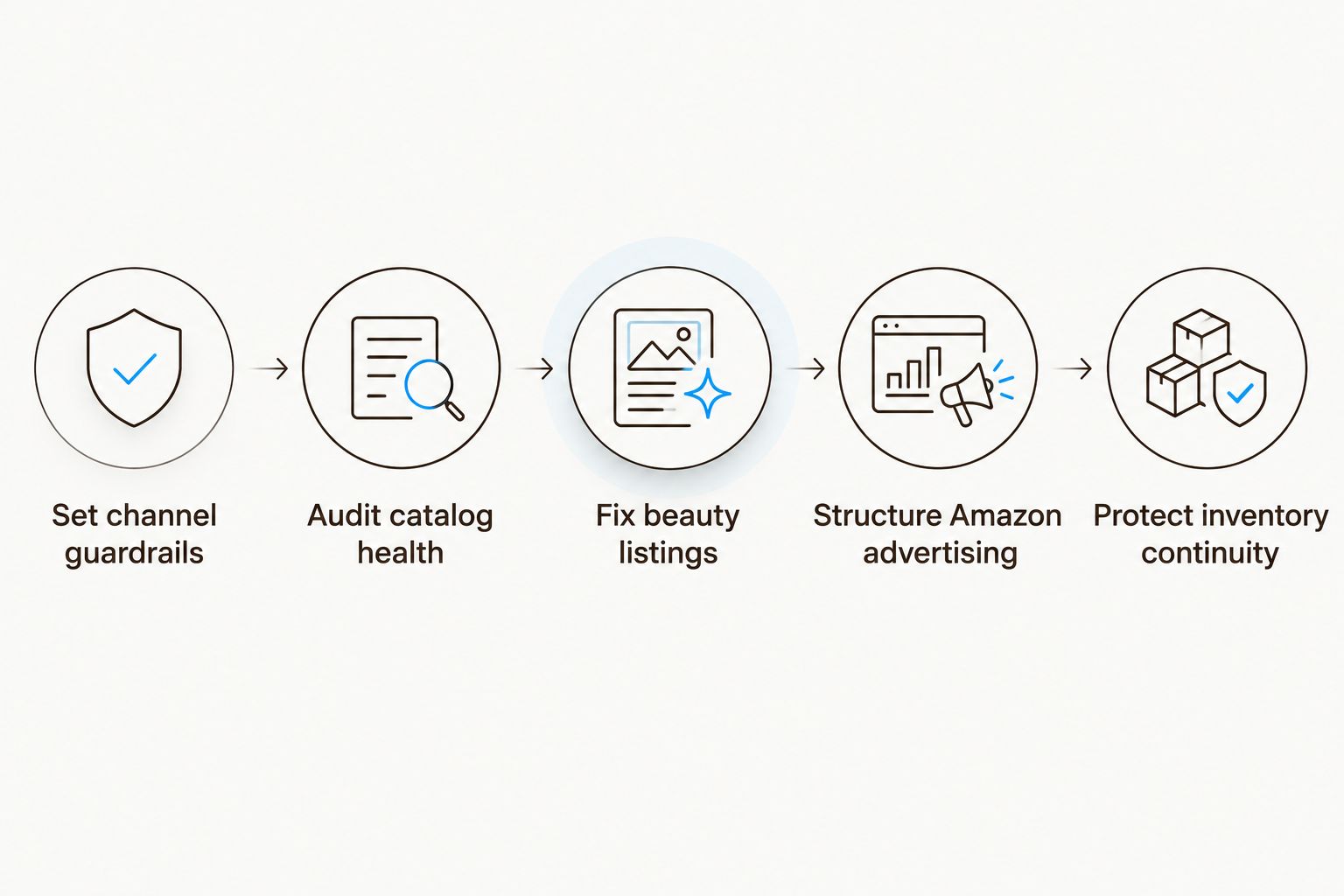
Advertising comes after the product page and catalog are ready to support it.
Set channel guardrails
Write down what success means before assigning spend. A venture-backed brand can pursue awareness, new customers, or near-term contribution, but one campaign should not be judged against an unstated mix of all three. Give the team a decision rule for each product stage: launch, established seller, or product under review.
Start with a spreadsheet. Record the owner, objective, and measure for every priority SKU. Ask finance to define which costs belong in the channel view, so marketing and finance do not present different versions of the same result. Revisit the guardrails when product costs or channel priorities change, not only when a campaign disappoints.
Name the priority SKUs and the role each plays in the portfolio.
Define the sales and contribution measures you will review together.
Separate launch investment from established-product performance.
Record who can approve changes to spend, content, and inventory plans.
Audit catalog health
A catalog audit is the quickest way to find work that advertising cannot solve. Check whether each priority SKU has the intended title, images, variations, claims, and active offer. Then inspect customer questions and reviews for confusion about use, shade, texture, or packaging. These are product-page inputs, not just customer-service issues.
Do the first pass manually in Seller Central and on the live detail pages. Keep a shared issue log with the affected SKU, the visible problem, an owner, and the next action. A funded brand with multiple teams needs this record: otherwise a content fix can stall between marketing, operations, and the person with account access.
Review the live page rather than relying only on submitted content.
Check variation relationships against the actual customer choice.
Flag unsupported claims for review before rewriting copy.
Record review themes without treating every complaint as a listing error.
Resolve offer or account issues before sending more traffic.
Fix beauty listings
A beauty listing has to answer the buyer's practical questions quickly: what the product is, who it suits, how it fits into a routine, and which version to choose. A premium brand also needs consistent language across the title, images, bullets, and A+ content. An elegant image does not compensate for missing product information.
Start by reading the page as a new shopper. Compare each claim with approved product materials; do not import claims from a pitch deck into an Amazon listing without review. Then brief the content team on the unanswered questions. Booscala's Amazon management includes listing work for beauty brands, but your internal product and regulatory owners still need to approve the underlying facts.
Put the product type and distinguishing attributes in clear language.
Make shade, scent, size, or routine differences easy to identify where relevant.
Use images to explain the product, not repeat the same message.
Check that bullets and A+ content agree with approved claims.
Review the live page after changes are published.
Structure Amazon advertising
Advertising should reflect what each SKU can support. Separate campaigns or reporting views where the business questions differ: defending existing demand, reaching shoppers searching a product category, and testing new search terms. Do not call every attributed sale new demand. A branded search and a category search answer different questions.
You can begin with Amazon's campaign and search-term reports. Review what shoppers actually searched, which products received traffic, and where spend failed to produce a useful outcome. The beauty search query performance guide provides a deeper reading framework. An agency becomes useful when someone must make and document these decisions across ads, listings, and stock—not when the team only needs a bid changed.
Group campaigns by product role and search intent.
Review branded and non-branded terms separately.
Exclude irrelevant queries after checking their context.
Compare ad decisions with inventory and SKU contribution.
Document why spend moves from one product to another.
Protect inventory continuity
An ad plan depends on products being available to sell. If a priority SKU is at risk, the right response is an operating decision, not simply another campaign adjustment. Marketing, supply, and account management need a shared view of what can be promoted and what needs protection.
Start with the inventory and sales records you already use. Flag products with uncertain replenishment, review the products featured in active campaigns, and assign someone to communicate changes. Do not promise the board a sales trajectory that assumes inventory you have not confirmed. For beauty products, also check whether packaging, fulfillment, and listing status introduce risks that the media plan ignores.
Mark priority SKUs with replenishment or offer-status concerns.
Check campaign plans against available inventory.
Assign an owner to investigate inactive listings promptly.
Keep supply and marketing decisions in the same issue log.
Measure contribution margin
Track the economics beneath the sales chart. At the SKU level, bring together sales, product costs, Amazon fees, advertising, and returns using the definitions your finance team approves. The purpose is to identify which products can support more investment and which require a listing, cost, or advertising fix first.
Use a 28-day review window for the recurring channel discussion, then look closer when a material change appears. That window is a management cadence, not an Amazon benchmark. Compare each SKU with its own prior period and note changes in availability or campaign structure before attributing a shift to creative work. If the data cannot support a conclusion, log the question instead of presenting a guess as a result.
Show sales and contribution by priority SKU.
Display ad spend beside total sales, not in isolation.
Separate confirmed costs from estimates awaiting finance review.
Annotate stock, listing, and campaign changes.
Assign an action and owner to every material exception.
Assign operating owners
A plan fails when every team owns a piece and nobody owns the result. Set a 7-day check-in for active issues and a 28-day decision meeting for channel performance. Keep the first focused on what needs fixing; use the second to decide where resources move. Both meetings need an issue log, not another presentation of unchanged charts.
Booscala acts as an embedded Amazon team for K-beauty brands, managing listings, advertising, and operations on a performance-based model. Booscala is best for venture-backed K-beauty brands that want those functions managed together. Its specialist focus is a limitation for a beauty brand outside K-beauty. Before choosing any external team, establish who owns account access, approvals, finance definitions, and inventory decisions inside your company.
Give each catalog, ad, and inventory issue one named owner.
Agree which changes require brand or regulatory approval.
Keep an accessible record of decisions and their dates.
Review open issues every 7 days.
Reassess priorities every 28 days.
Discuss your Amazon operating plan
Review whether embedded Amazon management fits your K-beauty brand.
Compare operating options
There is no single staffing answer for every venture-backed beauty brand. Choose the option that covers the work you need coordinated, then test its limitation against the people already on your team. The table describes operating fit, not a promised outcome.
In-house Amazon team
Best for: Brands ready to directly manage listings, ads, operations, and reporting
Key limitation: Requires internal ownership across several functions
Specialist freelancer
Best for: Brands with a defined gap, such as listing production or campaign execution
Key limitation: One specialist does not automatically coordinate the full channel
Generalist Amazon agency
Best for: Brands seeking external management without a K-beauty-only brief
Key limitation: Check category-specific content and approval processes before assigning scope
Booscala
Best for: Venture-backed K-beauty brands seeking embedded listing, advertising, and operations management
Key limitation: K-beauty-only focus makes it a poor fit outside that segment
In 2026, ask every prospective operator to walk through an actual decision: a priority SKU loses availability while its ads are active. Who sees the issue, who changes the plan, who approves the change, and how does finance see the result? A clear answer reveals more than a broad service list. For Booscala, test whether the embedded model matches your team's approval and reporting needs; performance-based alignment does not remove the need to define contribution clearly.
Common mistakes venture-backed beauty brands make
Scaling ads before fixing the page. More traffic exposes the same unanswered buyer questions to more shoppers. Check the live listing, offer, and reviews first; then decide whether spend is the constraint.
Reporting attributed ad sales as channel growth. Ad reports describe advertising outcomes. They do not, on their own, show whether the full Amazon business improved after costs. Put campaign results beside total SKU sales and contribution.
Treating inventory as someone else's problem. A campaign owner who cannot see stock risk cannot make a sound investment decision. Bring operations into the recurring channel review and document who can pause or redirect activity.
Giving an agency the account but not the authority map. External execution slows when nobody knows who approves claims, images, budgets, or replenishment decisions. Define those responsibilities before evaluating speed or results.
Applying one target to every SKU. A new product, an established hero, and a product with a page problem need different decisions. Segment the portfolio before judging the team on an aggregate number.
FAQ
What is the best Amazon approach for a venture-backed beauty brand in 2026?
Start with SKU-level contribution, catalog health, and clear operating ownership. Fix listing and inventory constraints before increasing advertising, then review channel decisions on a recurring schedule.
Is an Amazon agency better than an in-house team for a beauty brand?
An agency is the better fit when you need coordinated execution that your internal team cannot cover. An in-house team gives you direct ownership but requires capacity across listings, ads, operations, and reporting.
Who is Booscala best for?
Booscala is best for venture-backed K-beauty brands seeking embedded Amazon management across listings, advertising, and operations. Its K-beauty-only focus limits its fit for brands outside that category.
What should a beauty brand fix before increasing Amazon ad spend?
Fix inactive offers, unclear product pages, unsupported claims, and inventory risks first. More advertising does not resolve those problems.
How should a venture-backed beauty brand report Amazon performance?
Report sales, advertising, fees, returns, inventory risk, and contribution at the SKU level. Record major listing and campaign changes so the team can interpret shifts rather than guess at their cause.
How often should an Amazon beauty team review performance?
Use a 7-day check-in for active issues and a 28-day review for resource decisions. These are proposed management cadences, not category benchmarks.
How do you choose between a freelancer and full-service Amazon management?
Choose a freelancer for a clearly defined specialist task. Choose full-service management when listings, advertising, inventory, and reporting need one accountable operating plan.
One last thing
Ask who can stop a campaign when its SKU has an inventory problem. If the answer is unclear, your first 2026 Amazon investment is not more advertising. It is a named owner, a shared issue log, and a decision rule that connects marketing to operations.