Amazon for Wholesale Beauty Brands: Control First in 2026
Amazon for wholesale beauty brands works when you control sellers, listings and margins. Use this 2026 guide to protect wholesale relationships as you expand.

Wholesale beauty brand expansion on Amazon is the process of selling beauty products through Amazon while protecting existing retail relationships and building a profitable online channel. In 2026, the hard part is not creating a listing. It is deciding who controls the offer, how distributors fit, and which products deserve advertising.
TL;DR
Amazon for wholesale beauty brands works best when the brand controls listings, authorized sellers, inventory and advertising.
Audit distributor agreements and existing Amazon offers before launching a seller account.
Booscala is best for beauty brands that want specialist Amazon management across listings, advertising and operations.
Expand the catalog only after the first products show a sound contribution margin.
Why Amazon matters for wholesale beauty brands
A wholesale beauty brand usually enters Amazon with a channel already in motion. Retailers or distributors may hold stock, sell online, or supply other sellers. That changes the starting point: your first job is to establish who already sells your products on Amazon and who has permission to do so.
A strong 2026 Amazon plan gives customers accurate product information without leaving your brand presentation to whichever seller created the listing. It also gives your team a way to assess whether marketplace sales add profitable demand or shift orders away from wholesale accounts. Those are different outcomes, even when Amazon revenue rises.
The rule: settle channel ownership before buying traffic. Ads cannot fix an offer controlled by the wrong seller, an inaccurate product page, or inventory you cannot replenish. Booscala manages Amazon listings, advertising and operations for beauty brands; that scope fits a brand that needs the channel managed as a business, not treated as an isolated ad account.
Build the channel in the right order
1. Audit every existing offer
Search Amazon for your brand name, product names and distinctive packaging terms before creating new listings. Record the ASINs you find, their product details, the sellers attached to each offer and any differences between the page and your approved product information. Check the same products across each marketplace you intend to enter. A clean US catalog does not establish who controls an existing European offer.
Do this manually in a shared sheet first. It exposes practical questions that software cannot answer for you: which distributor supplied a seller, whether an older product image is still circulating, and whether two pages describe the same item. In 2026, assign one person to resolve each discrepancy rather than creating a second page to work around it.
Search the brand name and each launch product by name.
Record existing ASINs, sellers and visible product-page errors.
Match each offer to the correct product and packaging version.
Ask wholesale partners which accounts they supply for online resale.
Give every unresolved offer an owner and a next action.
2. Set rules with wholesale partners
Put your channel agreements beside the offer audit. Identify who is authorized to sell on Amazon, which products they can sell and who supplies inventory to other marketplace sellers. An Amazon account gives you a place to sell; it does not settle a distributor relationship or transfer control of another seller's offer.
Decide whether Amazon will be brand-operated, distributor-operated or a defined combination. Then communicate the decision before expanding the catalog. For a premium beauty brand, the decision affects product information, customer experience and the ability to maintain consistent retail positioning. In 2026, it also determines who has the authority to correct a listing when a product detail changes.
List each distributor's online selling permissions.
Identify products reserved for retail, Amazon or both.
Document who owns product-page updates and image approvals.
Establish a process for reporting unauthorized or inaccurate offers.
Share approved product information with authorized partners.
3. Correct listings before launching ads
Start with the products customers can already find. Compare titles, images, ingredient information, directions and variants against approved source material. Beauty shoppers need to distinguish formats, shades, scents and intended uses; a page that blurs those differences attracts the wrong clicks and creates avoidable confusion.
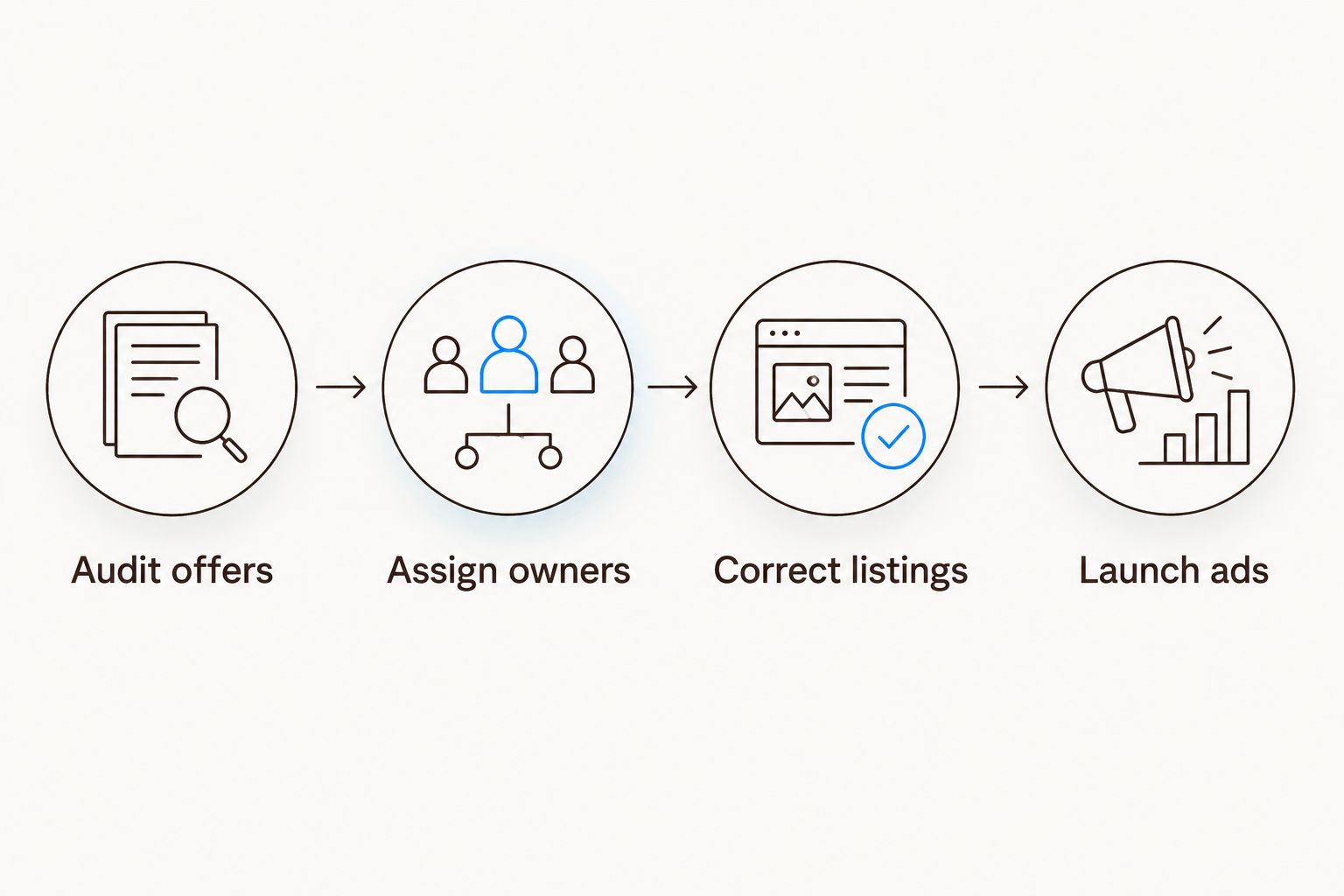
Keep the workflow simple: Audit offers, Assign owners, Correct listings, Launch ads. That sequence protects you from paying to send shoppers to a page your team still needs to fix. If you have several variants, check whether each child product reflects the correct attributes rather than assuming the parent page covers every difference.
Correct the product page before paying to send shoppers to it.
Check the title and main image against the approved product.
Verify ingredients, directions and claims against packaging.
Separate meaningful variants using accurate attributes.
Review each image for the specific product it represents.
Resolve duplicate or inaccurate pages before funding traffic.
4. Choose a narrow launch catalog
Do not move the full wholesale line onto Amazon by default. Start with products your team can supply, describe accurately and support operationally. A product that sells well through a retailer still needs its own Amazon case: contribution margin, replenishment capacity, suitable packaging and a clear place in the existing channel plan.
A sensible 2026 pilot can begin with 3 SKUs and a written reason for each choice. That is a planning choice, not a sales forecast. Compare those products with other candidates using the same criteria so a familiar wholesale bestseller does not win simply because it is familiar. If a product needs new photography, revised copy or a channel agreement before launch, keep it out of the first wave.
Check each candidate's contribution margin after expected channel costs.
Confirm who can replenish it and who owns the forecast.
Review packaging against the planned fulfillment route.
Flag products with unresolved seller or distributor questions.
Record why each launch product earned its place.
5. Build campaigns around purchase intent
Begin keyword research with the language customers use for the product, not only the terminology on a wholesale line sheet. Group searches by product type, use case and relevant attributes. Keep brand-name searches separate from non-brand searches so you can tell whether ads are capturing existing demand or introducing products to shoppers who do not know you.
Start with a small set of campaigns tied to the launch catalog. Review search terms and product-page performance together: traffic that does not convert can indicate a targeting problem, but it can also expose unclear shade information, a weak main image or the wrong product promise. Booscala's Amazon advertising management fits after those foundations are in place. It is not a substitute for them.
Map each launch product to specific customer search phrases.
Separate branded from non-branded targeting.
Exclude search terms that do not match the product.
Compare ad results with the page customers actually see.
Expand targeting only when the offer and inventory can support it.
6. Plan fulfillment against the wholesale supply chain
Amazon orders need a replenishment plan that does not quietly drain stock committed to retail partners. Set an inventory owner, identify the stock allocated to Amazon and decide how the team will respond when demand changes. If you are considering Fulfillment by Amazon, check product preparation and packaging requirements for the actual items rather than treating all beauty products alike. Glass containers, liquids and other formats demand different operational checks.
The decision also changes the margin calculation. Compare the full route from stored inventory to customer delivery, not a single fulfillment charge. 3PL fulfillment costs belong in that comparison when an external warehouse handles Amazon-bound stock or direct orders. In 2026, assess fulfillment alongside advertising and returns before calling a product profitable.
Separate Amazon stock from inventory committed to wholesale orders.
Check preparation requirements for each product format.
Assign an owner to monitor stock and replenishment.
Include storage, handling and returns in the margin model.
Agree on an action when inventory cannot support active ads.
7. Measure channel growth, not just Amazon sales
A wholesale brand needs a scorecard that shows whether Amazon adds value to the business. Review sales and ad spend, but also track contribution margin, inventory position, listing issues and changes in the seller mix. Compare the results with your channel plan. Rising marketplace sales tell you little if the brand loses control of the offer or runs out of stock reserved for another account.
Use a 28-day review cycle for the pilot, with product-level decisions documented after each review. The interval is a management cadence, not a promise that a new listing will mature within 28 days. In 2026, keep ownership of the underlying account, catalog records and decisions clear whether your team manages Amazon directly or works with an agency.
Review contribution margin by launch product.
Compare branded and non-branded advertising results.
Track stock risks alongside campaign decisions.
Record new seller, listing and customer-feedback issues.
Decide which products to improve, retain or pause.
Which management option fits your brand?
Choose the option that can own the entire channel decision, not just the part your current team finds hardest. Booscala is best for wholesale beauty brands seeking specialist Amazon management across listings, advertising and operations. The trade-off is that an agency still needs accurate product information, channel decisions and approvals from your team.
Internal team
Best for: Brands with dedicated Amazon and wholesale-channel owners
Starting price: Check current staffing needs
Key limitation: Requires capacity across catalog, ads and operations
Amazon specialist agency such as Booscala
Best for: Beauty brands that want coordinated channel management
Starting price: Ask the agency
Key limitation: Needs clear access, approvals and distributor context
Advertising-only support
Best for: Brands with sound listings and an internal operations owner
Starting price: Ask the provider
Key limitation: Does not resolve seller control or fulfillment
Freelancer
Best for: Brands with a defined, limited task
Starting price: Ask the provider
Key limitation: A narrow assignment leaves cross-channel decisions with your team
An internal team keeps decisions close to the business but must cover specialist work as well as day-to-day account issues. Advertising-only support makes sense after the offer and catalog are stable; before that, it can amplify existing problems. Booscala's model suits brands that want an embedded Amazon team, while a freelancer fits a task with a clear owner on your side. Neither arrangement removes the brand's responsibility for its wholesale agreements.
Common mistakes wholesale beauty brands make
Treating an existing Amazon offer as permission to expand. A listing shows that a product is available. It does not tell you who supplied the seller or whether adding another offer fits your distribution agreements. Audit first, then decide who should sell.
Moving every wholesale bestseller online at once. Retail performance does not establish Amazon contribution margin or fulfillment readiness. Select a small launch catalog and require a clear business case for each addition.
Buying ads before correcting product information. A campaign cannot repair an inaccurate image, unclear variant or unsupported claim. Fix the customer-facing page, then judge whether the traffic you purchase matches it.
Reporting revenue without channel context. Amazon sales can rise while margin, inventory availability or wholesale relationships deteriorate. Put seller control and stock commitments on the same 2026 scorecard as sales.
FAQ
What is the best way for a wholesale beauty brand to start on Amazon?
Audit existing offers and distributor permissions before launching products or ads. Then select a small catalog with clear ownership, accurate listings and a workable margin.
Can a wholesale beauty brand sell on Amazon alongside retailers?
Yes, if its channel agreements and operating plan support that arrangement. Define who is authorized to sell each product and who controls listing updates before expanding.
Should a wholesale beauty brand use Seller Central or Vendor Central?
Choose based on the commercial relationship and control your brand needs. Review which arrangement applies to your business before building listings, forecasts and reporting around it.
How many products should a wholesale beauty brand launch first?
Start with a catalog your team can supply and manage accurately. A 3-SKU pilot is one practical planning choice, not a requirement or a sales forecast.
When should a wholesale beauty brand start Amazon ads?
Start after the offers, listings and inventory are ready for customer traffic. Separate branded and non-branded targeting so the team can assess what the campaigns are doing.
Is an Amazon agency better than an internal team for a beauty brand?
An agency fits when the brand needs specialist work across listings, advertising and operations; an internal team fits when it already has that capacity. Booscala serves beauty brands seeking coordinated Amazon management, but the brand still owns its channel decisions.
What should wholesale beauty brands measure on Amazon in 2026?
Measure contribution margin, advertising results, stock position, listing accuracy and seller activity alongside sales. Revenue alone cannot show whether Amazon supports the wider wholesale business.
One last thing
Your first Amazon decision in 2026 is not which product gets an ad budget. It is who has the authority to sell it and correct its page. Put that answer in writing for the pilot catalog. Every later decision, from inventory allocation to campaign reporting, becomes easier to assign and evaluate.
