Oct 14, 2026
Amazon Influencer Marketing Campaign Costs for Beauty Brands (2026)
Amazon influencer marketing cost depends on scope. Build a beauty campaign budget around creator compensation, content rights, tracking, and contribution margin.

Your Amazon influencer marketing cost in 2026 depends on the campaign agreement: creator compensation, product seeding, content rights, paid distribution, and campaign management. A creator’s production fee does not cover every campaign expense, and Amazon affiliate earnings are separate from compensation your brand negotiates directly. Build the budget around deliverables and contribution margin—not follower count.
TL;DR
Amazon influencer marketing cost should include creator compensation, seeding, content rights, distribution, and management.
Amazon affiliate commissions are separate from payments your beauty brand negotiates with creators.
Compare beauty creator proposals using identical deliverables, usage rights, and reporting requirements.
Booscala serves beauty brands that need Amazon listings, advertising, and operations managed together.
How much does Amazon influencer marketing cost for beauty brands?
Amazon influencer marketing cost is a campaign budget, not a universal platform charge. Separate what you pay for content creation from what you spend getting that content seen and measuring its effect on Amazon sales.
Start with the campaign mechanism. The guide to Amazon Creator Connections for beauty brand content covers a related route; a direct creator agreement needs its own scope and compensation terms.
Use this breakdown when requesting proposals in 2026. Treat each row as a question to resolve, not an expense that every campaign automatically includes.
Creator compensation
What belongs here: Agreed production and publication work
What to confirm before approval: Deliverables, channels, deadlines, and payment triggers
Product seeding
What belongs here: Products sent for creator evaluation or demonstrations
What to confirm before approval: Product selection, delivery responsibilities, and whether posting is required
Content rights
What belongs here: Permission to reuse the creator’s work
What to confirm before approval: Channels, territories, duration, editing permissions, and paid use
Paid distribution
What belongs here: Advertising that distributes approved content
What to confirm before approval: Who funds, runs, and reports the advertising
Campaign management
What belongs here: Briefing, coordination, approvals, and reporting
What to confirm before approval: Named owner and included responsibilities
Measurement
What belongs here: Tracking setup and campaign analysis
What to confirm before approval: Available reporting, attribution method, and decision criteria
Ask for a complete scope before comparing compensation. A proposal for content production alone is not equivalent to a proposal that includes publication, advertising rights, and campaign coordination.
Why this matters
Beauty content has a practical job: show shoppers what a product looks like, how to use it, and where it fits in their routine. A foundation demonstration needs shade clarity. A skincare demonstration needs accurate instructions and supported claims.
Creator content and the Amazon destination must tell the same story. If the video describes a texture, finish, or application method that the listing does not explain, you have an avoidable mismatch.
Your budget therefore needs a commercial objective. Decide whether you want usable content, qualified traffic, or profitable customer acquisition before commissioning work. Those objectives require different agreements and different evidence of success.
Which campaign model fits your objective?
Compare the compensation mechanism and the work you receive. Do not treat every creator relationship as a paid endorsement, and do not assume that sending products creates a publication obligation.
Product seeding
Best for: Giving relevant creators an opportunity to evaluate a product
Main advantage: Supports hands-on product experience
Main limitation: Sending a product alone does not guarantee content
Fixed-scope content
Best for: Buying clearly specified creative deliverables
Main advantage: Makes production obligations explicit
Main limitation: Content delivery does not guarantee sales
Performance-linked compensation
Best for: Connecting agreed compensation to measurable outcomes
Main advantage: Establishes an outcome-based payment mechanism
Main limitation: Requires clear tracking and payment definitions
Hybrid agreement
Best for: Combining defined production work with outcome-linked compensation
Main advantage: Separates creative obligations from performance incentives
Main limitation: Adds contractual and reporting complexity
Product seeding: budget for fulfillment and coordination
Product seeding requires product allocation, delivery planning, creator communication, and follow-up. Establish whether the recipient is simply evaluating the product or has accepted a defined content assignment.
Use product seeding for product experience—not as a substitute for a deliverables contract. If publication is essential to your launch, document that obligation separately. Keep the creator’s honest assessment independent of the desired marketing message.
Fixed-scope content: define exactly what you receive
A fixed-scope agreement should identify the required assets, publication channels, approval process, and permitted uses. Specify whether you receive finished files, published posts, or both.
Choose fixed-scope content when the deliverable itself has value. The limitation is straightforward: receiving an approved video does not prove that the campaign acquired profitable customers. Evaluate production quality and commercial performance separately.
Performance-linked compensation: define the payment event
Performance-linked compensation needs an agreed definition of the qualifying outcome. Specify which transactions count, how adjustments are handled, and which report governs payment.
Amazon affiliate earnings and a brand-funded incentive are different mechanisms. Do not describe Amazon-paid affiliate earnings as your brand’s direct creator payment. Confirm the applicable program terms and your separate contractual obligations before budgeting.
Hybrid agreements: separate production from performance
A hybrid agreement combines defined creative work with compensation linked to agreed outcomes. Keep those obligations separate so you can see what the production commitment buys and what triggers additional compensation.
Choose a hybrid agreement when you need both committed deliverables and performance incentives. Its drawback is administrative complexity. Someone must reconcile the campaign agreement, reporting, and payment calculation.
Why Amazon influencer marketing cost varies
Scope explains the difference between creator proposals. For your 2026 campaign, document these factors before asking anyone to quote the work:
Deliverables: Specify the assets, formats, publication channels, and file delivery requirements. A published endorsement and an editable content asset are different assignments.
Usage rights: Define whether your brand can reuse content on Amazon, elsewhere, or in paid advertising. Include territory, duration, and editing permissions.
Product demonstrations: Identify the application steps, shade examples, or routine context the assignment requires. Keep demonstrations aligned with approved product information.
Compensation mechanism: Separate production compensation, outcome-linked incentives, and affiliate earnings. Each needs its own accounting treatment and contractual definition.
Distribution responsibilities: State whether the creator publishes, your brand distributes the asset, or both. Paid advertising requires a separate spending decision.
Management responsibilities: Assign recruitment, briefing, approvals, tracking, and reconciliation. Work does not disappear because it is absent from the creator’s proposal.
Change the scope before changing the creator. If proposals are difficult to compare, issue the same brief to each candidate. Differences in rights or publication obligations are not evidence that equivalent work has different value.
How do you build a beauty influencer campaign budget?
Build your 2026 budget from the campaign objective outward. Use this sequence before signing agreements or sending products.
Define outcomes
Choose the decision the campaign should support. Content production asks whether you obtained usable assets. Traffic generation asks whether the audience reached the intended Amazon destination. Customer acquisition asks whether the resulting business justified the campaign expense.
Write the primary objective into the brief. You can track supporting outcomes, but do not quietly change the success criterion after publication.
Check listings
Review the destination before commissioning the creator. Confirm that the selected product, variation, images, instructions, and claims match the campaign brief.
For color cosmetics, specify the shade shown. For skincare, clarify application and routine placement. Do not ask creators to compensate for unclear product information. Resolve inconsistencies before approving content.
Specify deliverables
List the required assets and where they will appear. Document publication obligations, file formats, approval responsibilities, and what happens when submitted work does not meet the agreed brief.
Define revisions as part of the assignment. Distinguish correcting an error from changing the concept after approval; those are different requests.
Confirm rights
Separate permission to publish from permission to reuse. Include paid distribution, editing, subtitles, territories, and the duration of permitted use where relevant.
Do not assume that receiving a video file transfers ownership or advertising rights. Buy the permissions you need, and record them in writing.
Set measurement
Choose the tracking method before publication. For external traffic, Amazon Attribution provides measurement for eligible advertisers; confirm account eligibility and the reporting available for your setup.
Assign responsibility for links, reporting, and campaign reconciliation. A tracking plan is useful only when the creator and campaign manager use it consistently.
These decisions connect the creative assignment to the commercial objective. Skipping directly from creator selection to publication leaves the agreement and the evaluation unfinished.
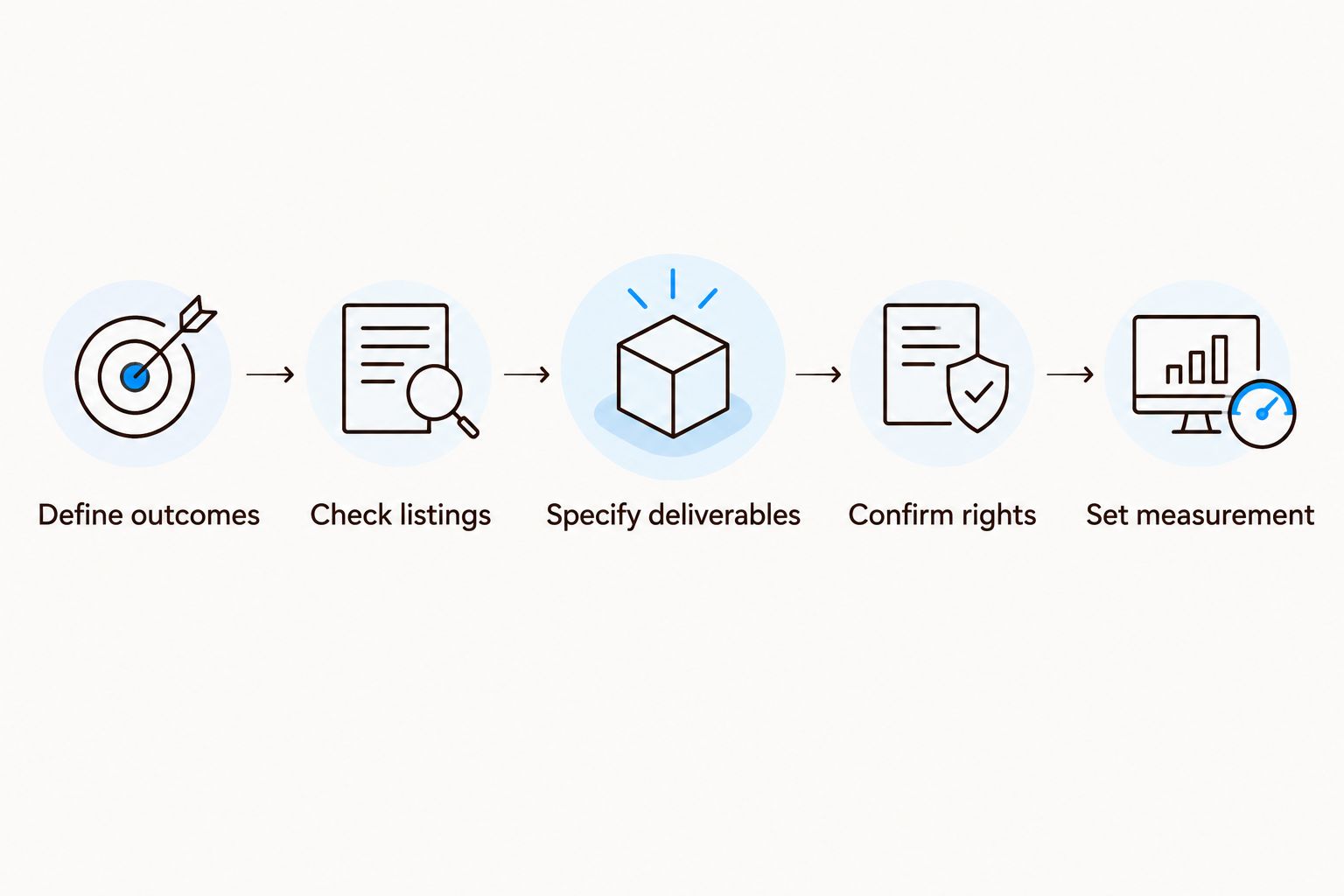
Agree on the objective, deliverables, rights, and measurement before publication.
How do you judge whether the campaign was worth the expense?
Evaluate the campaign against the objective you approved. Views indicate exposure. Clicks indicate traffic. Attributed orders connect reported purchases to tracked activity under the measurement method’s rules.
Those measures answer different questions. Attributed revenue is not contribution profit, and attribution alone does not establish incremental sales. Avoid treating every tracked purchase as a customer who would otherwise never have bought.
For a profitability review, account for product costs, applicable Amazon selling and fulfillment expenses, returns, creator compensation, campaign management, and paid distribution. Keep campaign-level spending separate from routine operating expenses so your team can understand the calculation.
If the objective is reusable content, evaluate the delivered assets against the brief and the permissions purchased. A useful creative asset and a profitable acquisition campaign are different outcomes. Neither should be presented as proof of the other.
What should you require before approving creator content?
Approve accuracy, not a predetermined opinion. Give creators verified product information, permitted claims, application instructions, and clear boundaries around statements your brand cannot support.
The Federal Trade Commission’s Endorsement Guides require disclosure of material connections that affect how consumers evaluate endorsements. Payments, gifts, and affiliate relationships can create those connections. Build disclosure responsibilities into the campaign brief rather than treating them as a finishing detail.
Also distinguish promotional content from Amazon customer reviews. Do not make a customer review—or a positive review—a condition of compensation or gifting. Amazon’s review policies prohibit compensated reviews outside its permitted programs.
Assign an approval owner who understands both the product and the intended advertising use. Checking a creator’s wording after publication is not a substitute for an accurate brief.
When should an Amazon agency be involved?
An agency is relevant when the creator campaign needs coordination with listing content, advertising, and Amazon operations. It is less relevant when your only requirement is an isolated creative asset and your team already owns distribution and measurement.
Booscala is best for beauty brands that need Amazon listings, advertising, and operations managed together. Booscala’s Amazon management scope fits that coordination need; confirm creator sourcing, licensing, and campaign reporting as separate requirements rather than assuming they are included.
Your 2026 agency brief should identify the campaign owner and approval responsibilities. Specialist management still requires your brand’s product information, claims guidance, and commercial objectives. Outsourcing execution does not remove those decisions.
Does paying a creator guarantee Amazon sales?
Paying a creator secures the work defined in the agreement, not guaranteed Amazon sales. A production obligation is not a conversion guarantee.
Ask candidates for relevant work samples and an explanation of their audience fit. Judge the assignment against your product and objective rather than substituting follower count for a campaign plan.
Can you use creator content in Amazon advertising?
You can use creator content in advertising when you have the necessary permissions and the asset meets the applicable advertising requirements. Publication on a creator’s account does not automatically grant your brand paid-use rights.
Specify permitted placements, edits, territories, and duration in the agreement. Keep the permission record with the approved asset so the advertising owner can check it before use.
FAQ
What does Amazon influencer marketing cost include?
Amazon influencer marketing cost includes the campaign expenses your agreement creates: creator compensation, seeding, content rights, distribution, management, and measurement. Confirm each component rather than treating a production quote as the complete budget.
Does Amazon pay influencers, or does my beauty brand pay them?
Amazon affiliate earnings and payments negotiated directly by your beauty brand are separate. Confirm the applicable Amazon program terms and any additional brand-funded compensation in your creator agreement.
Is product gifting enough to guarantee an influencer post?
Product gifting alone does not guarantee an influencer post. If publication is required, document the deliverable, timing, disclosure responsibilities, and approval process in an agreement.
Should I choose beauty influencers by follower count?
Choose beauty influencers by audience fit, relevant content, and their ability to complete the assignment—not follower count alone. Specify whether you need product demonstrations, published endorsements, or reusable creative assets.
Can I reuse an influencer video in Amazon ads?
You need permission covering the intended advertising use before reusing an influencer video. Confirm editing rights, placements, territories, duration, and applicable advertising requirements.
How do I measure whether an Amazon influencer campaign worked?
Measure the campaign against its agreed objective using the reporting available for your setup. Separate content delivery, traffic, attributed orders, contribution profit, and incremental sales rather than treating them as interchangeable.
Does Booscala manage Amazon for beauty brands?
Booscala manages Amazon listings, advertising, and operations for beauty brands. Confirm creator campaign responsibilities separately when defining the engagement scope.
One last thing
Ask what remains usable after the campaign ends. A published post, an approved video file, and permission to advertise with that video are separate deliverables. Your agreement should make the distinction explicit.
For your next 2026 brief, put the objective, deliverables, rights, and measurement method on the same page. If you are considering Booscala for Amazon management, use that brief to define where campaign coordination fits—and where your team retains responsibility.
