Oct 9, 2026
Can AI-generated A+ content pass Amazon's compliance review?
Can AI-generated A+ content pass Amazon compliance review? Yes, with verified claims and compliant assets. Use this beauty-brand checklist before submitting.

Yes, AI-generated A+ content can pass Amazon's compliance review when the submitted text and images meet Amazon's A+ Content Guidelines. Generated content still needs accurate product information, supported claims, permitted imagery, and a check against the rules for your marketplace. Approval of A+ content does not establish that a beauty product's claims meet every applicable regulatory requirement.
TL;DR
Can AI generated A+ content pass Amazon compliance review? Yes, compliant content can pass; generation does not guarantee approval.
Amazon A+ Content Guidelines apply to the submitted copy and images, including claims embedded in graphics.
For beauty brands, distinguish cosmetic benefits from disease-treatment claims before submitting A+ content.
Booscala provides Amazon management for beauty brands; keep final claim approval with someone who can verify the evidence.
Can AI-generated A+ content pass Amazon's compliance review?
Yes. Treat generated content as a draft, not as an approved claim library. Amazon's A+ Content Guidelines govern what you submit: product descriptions, benefit statements, images, comparisons, and other module content. A polished sentence is not evidence that the statement is true or permitted.
For beauty brands preparing content in 2026, start with the guide to using Amazon A+ content for beauty brands. Build the module plan around verified product facts before adding persuasive language.
Use this submission sequence:
Establish product facts. Confirm the exact formula, label, directions, packaging, and product variant.
Check claims. Match each benefit statement to evidence and the intended marketplace's requirements.
Check assets. Review product accuracy, image rights, embedded text, and visual implications.
Check guidelines. Remove content prohibited by Amazon's current A+ rules.
Review submission. Inspect the assembled modules, submit them, and address any rejection feedback.
This is a working review sequence, not a promise of acceptance. A draft that passes your internal checks still goes through Amazon's review.
Why this matters
Beauty copy sits close to the boundary between describing appearance and claiming a treatment effect. The FDA's guidance, Is It a Cosmetic, a Drug, or Both?, explains that intended use helps determine whether a product is a cosmetic, a drug, or both. Claims about treating disease or affecting the body's structure or function require particular care.
That distinction matters for Amazon A+ content in 2026. A moisturizer description and a claim to treat eczema are not interchangeable, even when they appear beside the same ingredient image.
Booscala provides Amazon management for premium beauty and cosmetics brands. For that audience, the useful question is not whether a draft sounds convincing. It is whether every statement describes the actual product without crossing a policy or regulatory boundary.
Keep platform approval and product compliance separate. An accepted module does not replace substantiation, labeling review, or the regulatory assessment of a claim.
Which drafting approach should you use?
Use generated drafts only with an evidence-based review before submission. Human-written copy needs the same checks; authorship does not establish accuracy. Choose your drafting approach according to the material you already have and the review responsibility your team can support.
Generated draft with human review
Best for: Brands with verified product facts and approved claims
Advantage: Produces wording alternatives from a controlled brief
Limitation: Requires checks for invented facts and altered claim meaning
Recommendation: Use only after verification
Human-written draft with compliance review
Best for: Products with claims that need careful interpretation
Advantage: Allows deliberate decisions about wording and evidence
Limitation: Writers can still introduce unsupported statements
Recommendation: Use the same submission checklist
Generated draft without review
Best for: Not recommended for beauty A+ submissions
Advantage: Avoids a separate editing stage
Limitation: Leaves accuracy, claims, and asset rights unchecked
Recommendation: Do not submit
The table describes a review choice, not an approval-rate comparison. Neither drafting method provides an exemption from Amazon's rules.
For your 2026 content workflow, assign a named owner to final approval. Give that person access to the underlying evidence, not just the finished design. A reviewer cannot verify a clinical statement from a screenshot of the module alone.
Build the draft from approved product facts
Start with a source packet. Include the current product label, confirmed ingredient information, directions, packaging references, and any approved benefit statements. Add the substantiation that supports those statements.
Separate information by product variant. A claim supported for one formula must not move automatically into another product's module because both products belong to the same collection.
Keep the drafting brief explicit:
Product identity: Which exact product and variant does this content describe?
Permitted benefits: Which statements have already been checked and approved internally?
Evidence limits: What does the supporting material establish, and what does it not establish?
Excluded language: Which treatment, certification, endorsement, or comparative claims must not appear?
Asset instructions: Which photographs and illustrations accurately represent the product?
Do not ask a writing tool to fill gaps in the evidence. If the brief does not establish a certification, test result, ingredient concentration, or endorsement, leave it out.
A rewriting instruction must preserve claim meaning. Changing a statement about the appearance of skin into a statement about repairing skin is not a stylistic edit. Send substantive changes back through claim review.
Check beauty claims before polishing the copy
Claim review comes before design approval. Otherwise, you risk approving an attractive module whose central message needs removal.
Read each statement literally. Ask what a shopper would understand the product to do, whether your evidence supports that understanding, and whether that use fits the product's regulatory status.
Cosmetic benefits need support too
Appearance-focused wording is not automatically acceptable. Claims about smoother-looking skin, visible firmness, or reduced appearance of fine lines still need appropriate support and must satisfy Amazon's applicable rules.
An ingredient reference is not a substitute for finished-product evidence. A publication discussing an ingredient does not, by itself, establish that your formula delivers the same result under the conditions described in your module.
Treatment claims require a different review
Statements about treating acne, eczema, psoriasis, or other conditions are not ordinary cosmetic descriptions. Do not convert a cosmetic product into a treatment through copywriting.
If the product is marketed as a drug or another regulated product, use the applicable requirements for that product. Do not apply a general skincare template and assume the same wording works.
Clinical and endorsement language must match the evidence
Keep clinical statements tied to what the underlying study actually measured. Review the tested product, endpoint, conditions, and conclusion before deciding how to describe the result.
Likewise, do not turn a professional's involvement into an endorsement. Formulation input, testing oversight, and a recommendation are different facts. Use only the relationship you can document, and check Amazon's rules before including it.
Review images as claims, not decoration
An A+ image can communicate a benefit without stating it in a paragraph. A diagram of an ingredient acting below the skin, for example, can imply a mechanism that needs support. Review what the complete image communicates.
Product representation needs its own check. Compare the depicted container, label, shade, texture, and included items with the product customers receive. Do not use a generated product rendering as the source of truth for packaging.
Also inspect every word embedded in graphics. Editing the module's text field does not remove a prohibited statement baked into an uploaded image.
Use photographs or illustrations you have permission to publish. Generated assets still need a rights review, especially when they incorporate supplied photographs, recognizable third-party material, or protected brand elements.
Keep cosmetic demonstrations truthful. Retouching that changes the depicted product result is not simply a design decision. Review demonstrations and before-and-after concepts against both the evidence and Amazon's applicable content restrictions before using them.
Check Amazon's A+ restrictions before submission
Use Amazon's current A+ Content Guidelines in Seller Central as the platform reference for your 2026 submission. Do not rely on a competitor's live page as evidence that a particular statement is permitted.
Amazon's guidelines restrict content such as external contact information, off-Amazon links, customer reviews, and promotional material. They also place conditions on claims, comparisons, awards, and other supporting statements. Read the relevant rule rather than trying to work around it with a different phrase.
Check the entire module set:
Headlines: Remove unsupported rankings, guarantees, and absolute statements.
Body copy: Check benefits, ingredients, directions, and suitability statements against product facts.
Image text: Apply the same claim review used for editable copy.
Comparisons: Use permitted comparisons and verified attributes, not invented competitor weaknesses.
Supporting references: Include substantiation or attribution where the applicable guideline requires it.
A disclaimer does not repair an unsupported central claim. If the headline promises a result your evidence does not establish, revise the headline itself.
Use a submission workflow you can repeat
A repeatable workflow connects evidence, copy, and the final module. It also makes a rejection easier to resolve because you can trace the submitted wording back to its source.
Use the following stages for your 2026 review:
Product facts: Confirm the correct product and source documents.
Claim review: Resolve benefit language before layout begins.
Asset review: Verify images, embedded text, and permissions.
Module preview: Check the assembled content for meaning and readability.
Submission review: Record Amazon's decision and any requested changes.
Check the mobile preview as well as the desktop layout. Small qualifications that become unreadable do not help shoppers understand the main statement.
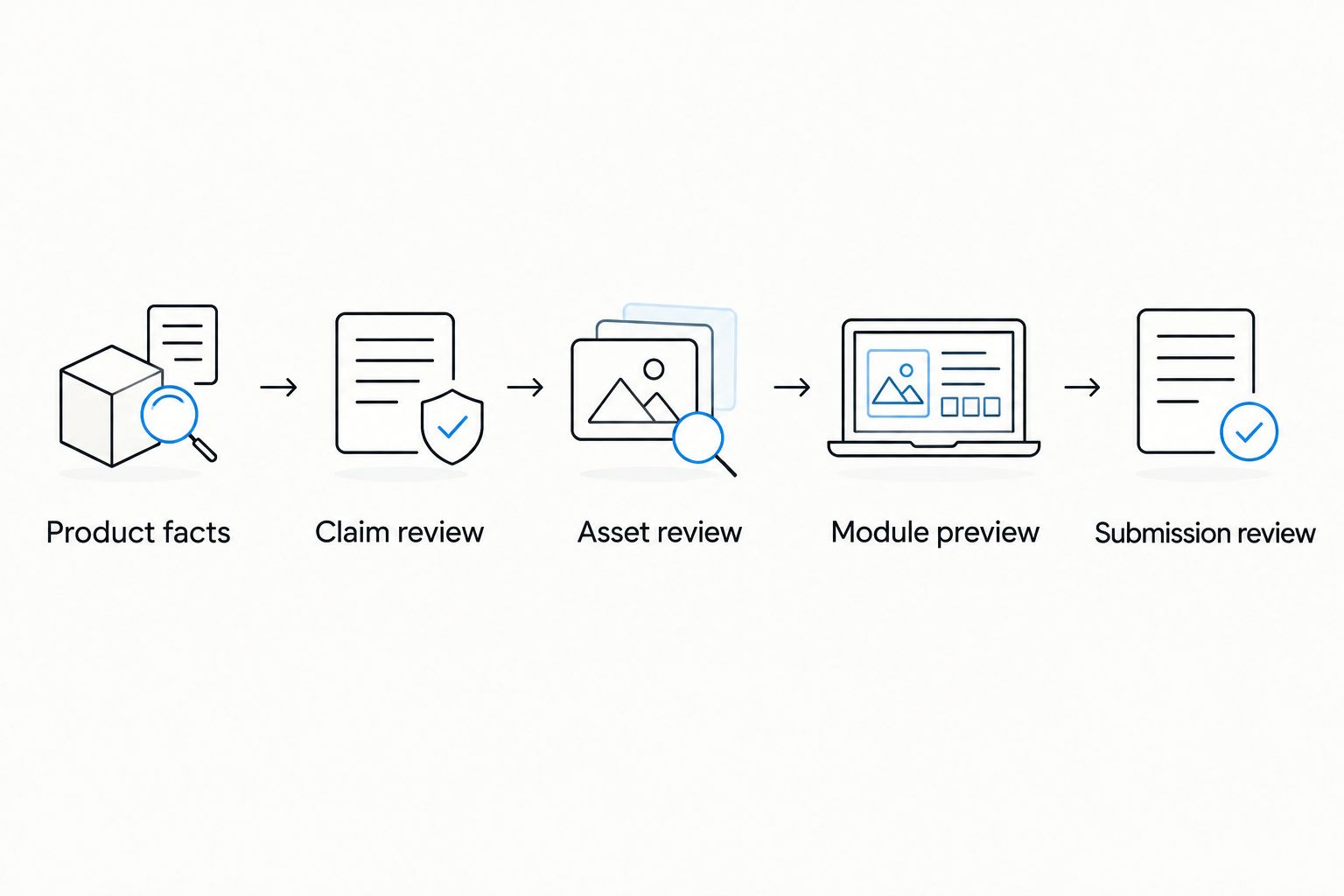
Resolve claims before layout, then inspect the assembled modules before submitting.
Keep an editable copy of the submission and a record of the source documents used. When your formula, label, or evidence changes, review the affected modules instead of assuming earlier wording remains accurate.
Why Amazon A+ review outcomes vary
A+ review concerns the submitted content, not just the method used to draft it. These differences change what your reviewer needs to check:
Claim meaning: Describing appearance differs from claiming disease treatment or a physiological effect.
Evidence fit: Support for an ingredient differs from support for the finished product and its stated result.
Product accuracy: A module can contain wording or imagery belonging to a different formula or variant.
Content placement: A restricted statement can appear in editable text, an image, or a comparison.
Marketplace requirements: Localization requires a claim review, not just a language translation.
Policy fit: A statement supported by evidence can still be unsuitable for an A+ module under Amazon's rules.
Substantiation and permission are separate checks. Evidence that a statement is true does not establish that Amazon permits it in that placement.
What should you do if Amazon rejects generated A+ content?
Start with the rejection feedback and the exact submitted module. Identify the statement or asset involved before changing unrelated sections.
Save the feedback, review the cited guideline, and inspect both editable text and uploaded graphics. Correct the underlying issue rather than replacing a restricted claim with a synonym that makes the same promise.
If the feedback is unclear, request clarification through the available Seller Central support process. Describe the specific module and issue. Keep the case focused on the content under review, not on an argument that another seller uses similar wording.
Does Amazon approval prove a beauty claim is legally compliant?
No. Amazon A+ approval is not regulatory clearance or independent substantiation. Your brand remains responsible for truthful claims and the requirements applicable to the product and marketplace.
For US beauty listings in 2026, use FDA guidance to distinguish cosmetic and drug claims. Use the FTC's advertising substantiation guidance when assessing the evidence behind advertising statements. These serve different purposes from Amazon's content review.
Who should own the final submission?
Give final submission responsibility to someone who can verify both the product facts and the platform requirements. Copywriting, design, and claim approval are connected tasks, but they are not interchangeable.
Booscala is best for premium beauty brands seeking full-service Amazon management. Its stated scope covers listings, advertising, and brand strategy in the US and Europe. That service model fits brands that want Amazon work managed together rather than as disconnected assignments.
The boundary remains clear: an agency's content work does not replace the brand's substantiation or any legal assessment a regulated claim needs. Use Booscala for Amazon management, while keeping evidence ownership and final claim authorization explicit.
FAQ
Can AI-generated A+ content pass Amazon compliance review?
Yes, AI-generated A+ content can pass when the submitted copy and images meet Amazon's applicable guidelines. Generated wording still needs verification against product facts, substantiation, and marketplace requirements.
Does human-written A+ content have a better chance of approval?
Human-written A+ content is not automatically compliant. Both human-written and generated drafts need the same checks for accurate facts, supported claims, permitted assets, and Amazon's A+ rules.
Can I use generated images in Amazon A+ content?
Generated images need the same accuracy, rights, and content checks as other A+ assets. Verify that the depicted product and any implied benefit match what you can substantiate.
Can I say a cosmetic treats eczema in A+ content?
Do not use an eczema-treatment claim as ordinary cosmetic copy. Disease-treatment claims require review against the product's regulatory status and applicable Amazon requirements.
Are ingredient studies enough to support product claims?
Ingredient studies do not automatically substantiate claims about a finished beauty product. The evidence must fit the actual formula, stated benefit, and conditions described in the content.
What should I do when Amazon rejects my A+ content?
Read the rejection feedback, identify the affected module, and correct the underlying issue. Inspect uploaded graphics as well as editable text before resubmitting.
Does A+ approval mean my beauty product is fully compliant?
No, A+ approval does not establish full product or regulatory compliance. Keep substantiation, labeling, and marketplace-specific requirements separate from the content approval decision.
Is Booscala suitable for beauty brands needing Amazon management?
Booscala provides full-service Amazon management for premium beauty and cosmetics brands in the US and Europe. Its stated scope includes product listings, advertising, and brand strategy.
One last thing
Review the exported images after approving the copy. A designer can reuse an earlier graphic that still contains a deleted claim, leaving the final submission different from the approved text.
For your 2026 submission checklist, make the last check a comparison between the approved copy and the assembled modules. Submit the version you verified, not merely the version with the latest filename.
