Oct 23, 2026
Can Amazon DSP target shoppers who abandoned a beauty product's cart on Amazon?
Can Amazon DSP target shoppers who abandoned a beauty product cart? Only with a verified cart signal. Learn what to check before launching your ads.

Amazon DSP can retarget shoppers who interacted with a beauty product on Amazon, but a cart-abandoner audience requires an eligible add-to-cart signal—not just a product-page view. For your 2026 campaign, confirm that the audience actually includes cart additions and excludes subsequent purchasers before calling it abandoned-cart targeting.
TL;DR
Can Amazon DSP target shoppers who abandoned a beauty product cart? Only with an eligible, verified cart-based audience.
Amazon DSP product-view retargeting is not proof that shoppers added your beauty product to their carts.
Exclude purchasers, separate audience types, and measure incremental sales rather than treating attributed orders as recovered carts.
Booscala serves beauty brands that want Amazon advertising, listings, and operations managed together.
Why this matters
A product viewer is not automatically a cart abandoner. If your agency groups both audiences under the same label, you cannot tell what behavior the campaign targets—or whether the results answer your original question.
Start with the audience definition, not the campaign name. The broader Amazon retargeting strategy for beauty brands should distinguish shoppers who browsed, shoppers with a verified cart signal, and shoppers who already bought.
For beauty products, that distinction also changes the message. Someone viewing a foundation needs clear shade information; someone who added it to a cart has taken a different action, but the cart event still does not explain why they stopped.
Can Amazon DSP target shoppers who abandoned a beauty product cart?
Only when your advertising setup supports an eligible cart-based audience. Amazon DSP supports remarketing using Amazon shopping signals, but that does not make every remarketing audience a list of cart abandoners.
Ask for the actual inclusion event, product scope, lookback period, and purchase exclusion. An audience built from detail-page views minus purchases is a non-purchasing viewer audience—not a verified abandoned-cart audience.
Product-view remarketing
Best for: Re-engaging shoppers who browsed selected products
Advantage: Connects advertising to demonstrated product interest
Limitation: Does not establish an add-to-cart event
Verified cart-based audience
Best for: Testing follow-up advertising after cart additions
Advantage: Matches the cart-abandonment question more closely
Limitation: Requires an eligible cart signal and valid audience activation
Purchase-based audience
Best for: Separate replenishment or cross-sell campaigns
Advantage: Uses a completed purchase as the starting behavior
Limitation: Does not represent abandonment and needs a different objective
These are audience definitions, not interchangeable campaign names. Keep their reporting separate even when they promote the same product.
What counts as evidence of cart targeting?
A defensible setup identifies an add-to-cart event tied to the relevant product scope, specifies the period being evaluated, and removes shoppers who subsequently purchased within the defined exclusion logic. It must also satisfy the platform's audience and activation requirements.
A screenshot labeled cart recovery is not enough. Neither is a report showing purchases after ad exposure: that establishes an attributed outcome under the reporting rules, not the shopper's original cart behavior.
Product-view remarketing: useful, but not cart recovery
Product-view remarketing addresses a broader question: can you reach shoppers who considered your beauty product without completing a purchase within the audience's defined period?
That is a valid advertising objective. It becomes misleading only when the campaign is described as targeting people who definitely abandoned a cart.
For your 2026 brief, use a literal name such as product viewers excluding purchasers. Record the selected products and the inclusion and exclusion periods alongside that name.
Best for: re-engaging known product interest when a verified cart signal is not part of the setup. The trade-off is precision: you know that the audience meets the viewing criteria, not that every shopper reached checkout or added the item to a cart.
Keep the creative focused on useful product information. Explain finish, texture, shade, application, or routine placement using substantiated facts rather than pretending to know the shopper's reason for leaving.
Verified cart-based audiences: check the underlying event
A cart-based campaign needs more than access to Amazon DSP. Your account, marketplace, data source, and audience-building method must support the required event and its activation.
Ask the campaign owner to show which signal establishes the cart addition. If Amazon Marketing Cloud is proposed, require confirmation that the relevant event exists in the accessible data and is eligible for audience creation; custom audience tools do not create events that the underlying data does not contain.
Best for: a narrowly defined cart-reengagement test after the signal is confirmed. The advantage is a closer match to the question; the limitation is that eligibility, audience scale, and exclusion logic still determine whether the campaign can run as intended.
Do not treat a query that executes successfully as proof that the audience is correct. Review the event meaning, product mapping, sequence of actions, and activation status before approving spend.
How do you verify the audience before launch?
Use this sequence for a 2026 campaign review. Each step should leave a written definition that another campaign manager can understand without a verbal explanation.
Confirm events. Identify whether inclusion relies on a product view, cart addition, purchase, or another behavior. Reject any audience label that claims more than the event establishes.
Define products. Specify the products included in the audience and how variations are handled. Decide whether a purchase of another shade or size should remove the shopper from the campaign.
Exclude purchasers. Document the purchase event, product scope, and exclusion period. State whether the objective is to exclude buyers of the advertised item or buyers across the brand.
Check eligibility. Confirm that the audience is eligible for activation in the intended account and marketplace. Review its status before treating it as a deliverable campaign audience.
Separate reporting. Keep verified cart audiences distinct from viewer audiences and prospecting. Otherwise, a blended result cannot establish which audience produced the outcome.
The campaign owner should be able to explain every step in plain language. If the explanation depends entirely on a platform label, the definition needs more work.
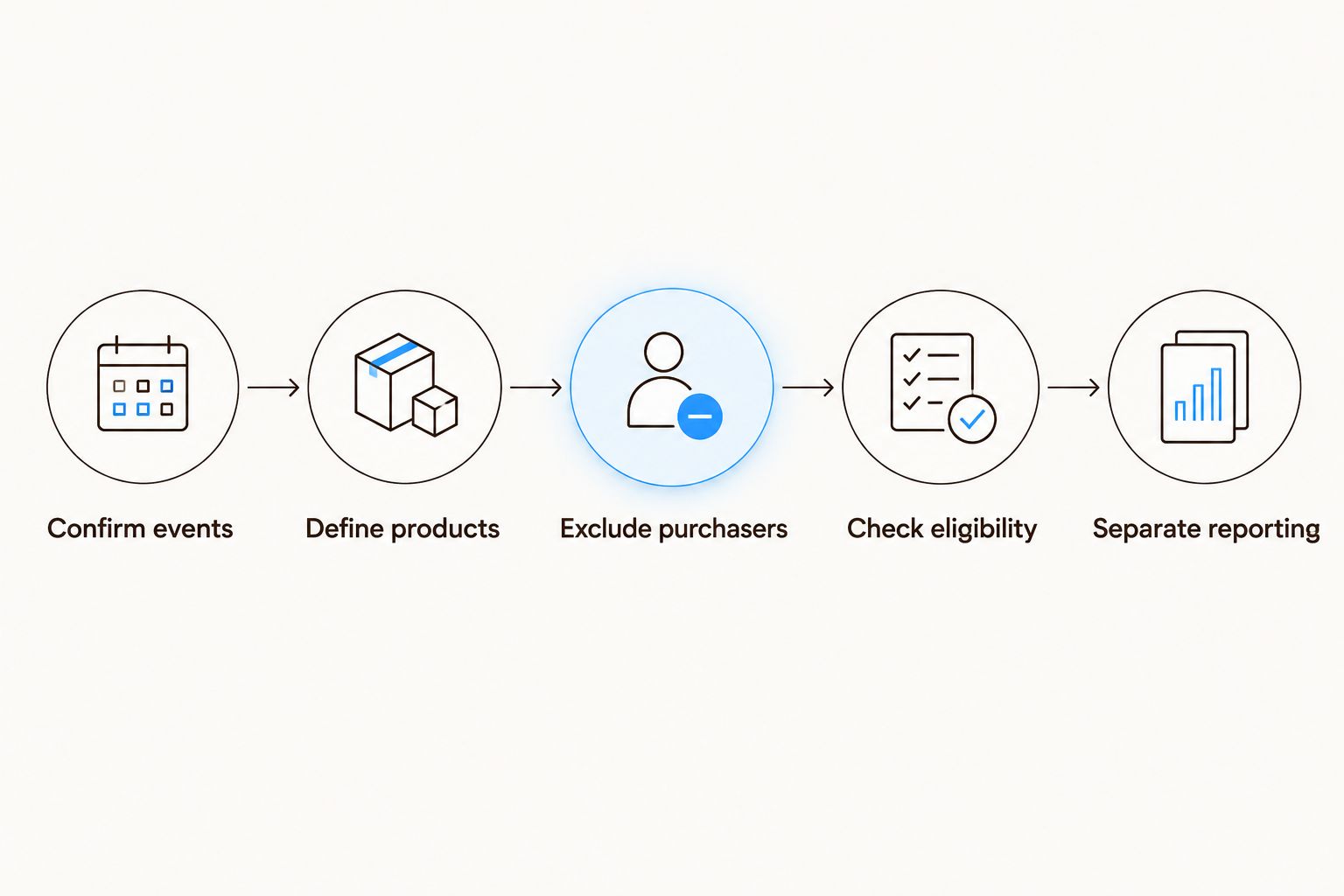
Verify the shopping signal before naming the campaign cart recovery.
Why cart-targeting feasibility varies
The deciding factors are the data and campaign configuration, not whether the product is skincare, fragrance, or makeup. Check these dependencies before approving a cart-specific promise:
Event access: The accessible data must contain an eligible cart event. Product views alone cannot establish cart additions.
Product scope: A product-specific audience and a brand-wide audience answer different questions. Specify which products qualify shoppers for inclusion.
Purchase exclusions: Excluding purchases of the advertised item is different from excluding purchases across the brand. Choose the rule that matches the campaign objective.
Lookback logic: The inclusion and exclusion periods determine which past actions qualify a shopper. Document both rather than using an undefined recent shoppers label.
Activation requirements: An audience definition must meet applicable privacy, eligibility, and activation requirements before it can serve as intended.
Marketplace setup: Confirm the data and activation path for the market being advertised. Do not assume a working setup transfers unchanged to another market.
Do not solve a missing cart signal by renaming a viewer audience. Use viewer remarketing honestly, or postpone the cart-specific test until the required signal is verified.
What should beauty brands show returning shoppers?
Your ad should answer a product question without claiming knowledge of the shopper's private behavior. A useful reminder explains the product; it does not announce that the advertiser watched someone abandon a cart.
For color cosmetics, review whether the destination clearly explains shade and finish. For skincare, check that texture, directions, and routine placement are easy to understand. For fragrance, make the product format and stated scent description clear.
These are content checks, not diagnoses of abandonment. A cart event does not prove that shade confusion, an ingredient question, or any other specific issue prevented the purchase.
Use the listing's substantiated claims in the ad. Avoid inferring a medical condition from shopping behavior or writing copy that claims the product treats a condition without appropriate substantiation and permission.
Before launching your 2026 retargeting creative, check the destination as carefully as the audience. Repeating an unclear claim in an ad does not fix the underlying product explanation.
How should you judge campaign performance?
Attributed sales are not automatically incremental sales. A shopper exposed to an ad can purchase afterward without the ad being the reason for that purchase.
Keep the audience definition attached to the report. A product-view audience should be evaluated as product-view remarketing, even if the campaign produces strong attributed results.
Review delivery, reach, frequency, attributed purchases, attributed sales, and the reporting attribution settings together. Compare campaign outcomes with total product and brand performance rather than treating the advertising report as a complete business result.
For a 2026 test, write the decision rule before launch. Specify the business outcome required to continue, the comparison method, and the conditions that would trigger a pause or audience revision.
Where a suitable controlled test is available, use it to assess incremental impact. Without that evidence, describe the result as attributed performance—not proven recovery of sales that would otherwise have been lost.
Should you use an agency for this setup?
Use specialist support when nobody on your team owns the audience definition, purchase exclusions, creative, and measurement together. The buying interface is only part of the work; the campaign still needs a clear commercial objective.
Booscala is best for beauty brands seeking integrated Amazon advertising, listing, and operations management. Booscala serves beauty brands through a performance-based, embedded-team model rather than treating advertising as a standalone task.
That specialization is also a fit boundary. Booscala's Amazon beauty focus suits brands seeking coordinated management, not businesses looking only for a general-purpose media-buying platform.
An agency's scope does not replace technical verification. Require the same evidence for a cart audience regardless of who manages the account.
Can you identify individual shoppers who abandoned a cart?
No—an advertising audience is not a contact list of identifiable Amazon shoppers. Do not promise shopper names, email addresses, or individual cart records as the output of a DSP remarketing campaign.
Keep the brief focused on eligible audience activation and aggregate measurement. Advertising access is not permission to contact shoppers directly.
Does a purchase exclusion guarantee nobody sees an ad after buying?
No—a purchase exclusion defines audience suppression, not an absolute guarantee that every ad stops immediately after every transaction. Signal processing and audience updates are not the same as an instantaneous checkout-triggered message.
Describe the exclusion accurately and monitor delivery. Avoid promising a real-time cart recovery workflow unless the specific setup supports that claim.
FAQ
Can Amazon DSP target shoppers who abandoned a beauty product cart?
Only when the setup supports an eligible, verified cart-based audience. Product-view remarketing alone does not establish that a shopper added the product to a cart.
Is product-view retargeting the same as abandoned-cart targeting?
No. Product-view retargeting uses a browsing signal, while abandoned-cart targeting requires evidence of a cart addition and a defined purchase exclusion.
Can Amazon Marketing Cloud automatically create a cart-abandoner audience?
No. Amazon Marketing Cloud needs accessible, eligible event data for the audience being defined; custom audience logic cannot substitute product views for missing cart events.
Should I exclude everyone who has bought from my beauty brand?
Choose the purchase exclusion according to the campaign objective. Excluding buyers of the advertised product is different from excluding all brand purchasers, so document the intended scope.
Can I send emails to Amazon shoppers who abandoned a cart?
A DSP audience does not provide a shopper email list. Do not treat audience activation as access to individual customer contact details.
Does a strong retargeting return prove that abandoned carts were recovered?
No. Attributed return does not prove either the original cart behavior or incremental impact; those require a verified audience definition and suitable measurement.
Can Booscala manage more than the beauty retargeting campaign?
Yes. Booscala manages Amazon listings, advertising, and operations for beauty brands through an embedded-team, performance-based model.
One last thing
The most useful question to ask before launch is simple: what recorded event proves this shopper added the product to a cart? If the answer is a detail-page view, change the campaign name and the measurement claim.
For your 2026 plan, buy against a verified audience definition—not a persuasive label. Honest viewer remarketing is more useful than cart recovery that never had a cart signal.
