Oct 20, 2026
Can Amazon Sponsored Brands run without Brand Registry?
Can Amazon Sponsored Brands run without Brand Registry? Not for sellers. Learn the vendor exception, account checks, and what to run while enrolling.

Amazon sellers cannot run Sponsored Brands without Amazon Brand Registry enrollment; eligible vendors have a separate eligibility route. For sellers in 2026, a Professional selling account alone is not enough, and hiring an agency does not remove the enrollment requirement. Even after enrollment, account permissions, product eligibility, and ad moderation still determine whether a campaign can run.
TL;DR
Can Amazon Sponsored Brands run without Brand Registry? Not for sellers; eligible vendors have a separate route.
Sponsored Products is the practical alternative for eligible sellers while Brand Registry enrollment is underway.
Brand Registry enrollment, account access, and creative approval are separate checks.
Booscala suits beauty brands seeking full-service Amazon management, not a workaround for advertising eligibility.
Can Amazon Sponsored Brands run without Brand Registry?
Not through the standard seller route. Amazon Ads’ published Sponsored Brands eligibility requirements distinguish Professional sellers enrolled in Amazon Brand Registry from eligible vendors. A seller account does not become vendor-eligible simply because it supplies products to retailers or has wholesale customers.
For beauty sellers, start with Amazon Brand Registry for cosmetics. Confirm enrollment before commissioning campaign-specific creative.
Professional seller without Brand Registry enrollment
Sponsored Brands route: Not eligible through the standard seller route
Best for: Sponsored Products while resolving enrollment
Main limitation: Sponsored Brands remains blocked
Professional seller with an enrolled brand
Sponsored Brands route: Eligible to proceed, subject to other requirements
Best for: Advertising an enrolled brand
Main limitation: Enrollment does not guarantee campaign approval
Eligible Amazon vendor
Sponsored Brands route: Separate vendor eligibility route
Best for: Brands already operating through a qualifying vendor account
Main limitation: Vendor eligibility does not transfer to an unrelated seller account
Agency managing a seller account
Sponsored Brands route: Uses the client’s eligible account and permissions
Best for: Delegating campaign management
Main limitation: Agency access does not replace client eligibility
The distinction matters: Brand Registry is a seller eligibility requirement, not a universal description of every Sponsored Brands advertiser. That is why an unqualified answer of either yes or no misses part of the rule.
Why this matters
A missing Sponsored Brands option is an access problem before it is an advertising strategy problem. Better headlines and stronger videos cannot fix an ineligible seller account.
For a 2026 beauty launch, separate the work into 3 checks: eligibility, access, and approval. Each answers a different question. Can the account use Sponsored Brands? Can the person managing advertising reach the correct brand? Does the proposed ad meet Amazon’s requirements?
Keep those checks separate in your launch plan. Otherwise, your team can mistake a permissions issue for a rejected enrollment, or mistake an approved enrollment for permission to publish any beauty claim.
Professional sellers: enrollment comes before Sponsored Brands
A Professional selling account and Brand Registry enrollment serve different purposes. The selling plan supports your selling operation; enrollment establishes the brand relationship required for the seller route to Sponsored Brands.
A trademark application is not the same thing as completed Brand Registry enrollment. Amazon accepts qualifying pending or registered trademarks under its enrollment rules, but submitting trademark paperwork does not automatically enroll the brand or activate advertising access.
Check the actual enrollment status. Do not treat a filing receipt, an application confirmation, or a brand name displayed on a product detail page as proof that the advertising account is ready.
For cosmetics brands, keep the brand identity consistent across the enrollment materials and catalog. If the advertised products appear under a different brand name, investigate that relationship before building campaigns around them.
Best for: sellers advertising their own enrolled brand. The benefit is access through the intended seller route. The limitation is that enrollment remains only one part of campaign eligibility; it does not settle account permissions, product restrictions, or creative approval.
Eligible vendors: a separate route, not a seller workaround
Amazon lists eligible vendors separately from Brand Registry-enrolled Professional sellers in its Sponsored Brands requirements. That distinction explains why a vendor can qualify without relying on the standard seller enrollment route.
It does not mean every business that calls itself a vendor qualifies. Selling wholesale to a distributor, supplying a salon chain, or receiving a retailer purchase order does not establish an eligible Amazon vendor advertising account.
If your beauty brand operates through both Seller Central and Vendor Central, identify which account will own the campaign. Do not assume that advertising access in one account proves eligibility in the other.
Best for: brands already using an eligible Amazon vendor account. The advantage is a distinct eligibility route. The limitation is scope: your vendor status is not a transferable exemption for every seller account, marketplace, or outside partner connected to the brand.
For your 2026 campaign brief, name the advertiser account explicitly. “The brand is eligible” is less useful than identifying the account, marketplace, and authorized campaign manager.
Sponsored Products: the alternative while enrollment is underway
Eligible sellers can use Sponsored Products without Brand Registry enrollment. That makes Sponsored Products a practical starting point when your products qualify for advertising but your brand enrollment is unfinished.
Sponsored Products promotes individual product listings. Sponsored Brands supports brand-focused advertising with its own creative and destination choices. They are different campaign types, not interchangeable names for the same placement.
Sponsored Products
Brand Registry required for the standard seller route?: No
Best for: Advertising eligible individual listings before brand enrollment
Trade-off: Does not replace Sponsored Brands creative formats
Sponsored Brands
Brand Registry required for the standard seller route?: Yes
Best for: Promoting an enrolled brand through brand-focused ads
Trade-off: Requires seller brand eligibility and creative review
Use the waiting period to improve the product pages receiving traffic. For beauty products, make the product type, intended use, size, and relevant ingredient information clear. Keep advertising claims consistent with the detail page and supported by your product documentation.
Recommend Sponsored Products for an eligible pre-enrollment seller; hold Sponsored Brands until the account qualifies. That keeps advertising decisions tied to account reality rather than a launch calendar that assumes access.
Do not build a performance forecast that treats results from the two campaign types as equivalent. Different creative, destinations, and shopper interactions require their own evaluation.
Why Sponsored Brands access varies
The published eligibility rule is only the starting point. These 5 factors explain which layer you need to inspect when access or delivery fails:
Advertiser type. A Professional seller follows the seller enrollment route; an eligible vendor follows the vendor route.
Enrollment status. A seller’s pending enrollment is not the same as an enrolled brand.
Account permissions. The person or agency building campaigns needs appropriate access to the advertiser account and brand.
Marketplace selection. Check the advertising account and requirements for the country where you intend to advertise.
Product and creative eligibility. Account access does not override restricted-product rules or advertising content policies.
Diagnose the exact failure. A campaign type missing from the console, a product unavailable for selection, and a rejected video are different problems. Sending the same enrollment screenshot for all three does not explain which requirement failed.
For beauty brands, examine claims separately from brand ownership. Owning the brand does not establish that a treatment claim, comparison, or advertised result is acceptable.
How do I check what is blocking Sponsored Brands?
Use these 5 steps for a 2026 account check. Work in order, and record the result at each stage before changing campaign settings.
Confirm advertiser type. Establish whether you are working in a seller or vendor advertising account. Use the account’s actual status, not your company’s wholesale business model.
Check enrollment. For the seller route, confirm that the relevant brand is enrolled. Distinguish an application in progress from an approved enrollment.
Check permissions. Confirm that the advertising user has access to the correct advertiser account and relevant brand. Agency invitations alone do not prove every required permission is present.
Check products. Review the eligibility messages for the products you intend to advertise. Resolve catalog or product-policy issues rather than treating them as enrollment problems.
Review creative. Read any moderation reason against the actual headline, image, video, and destination. Revise the rejected element without changing unrelated settings.
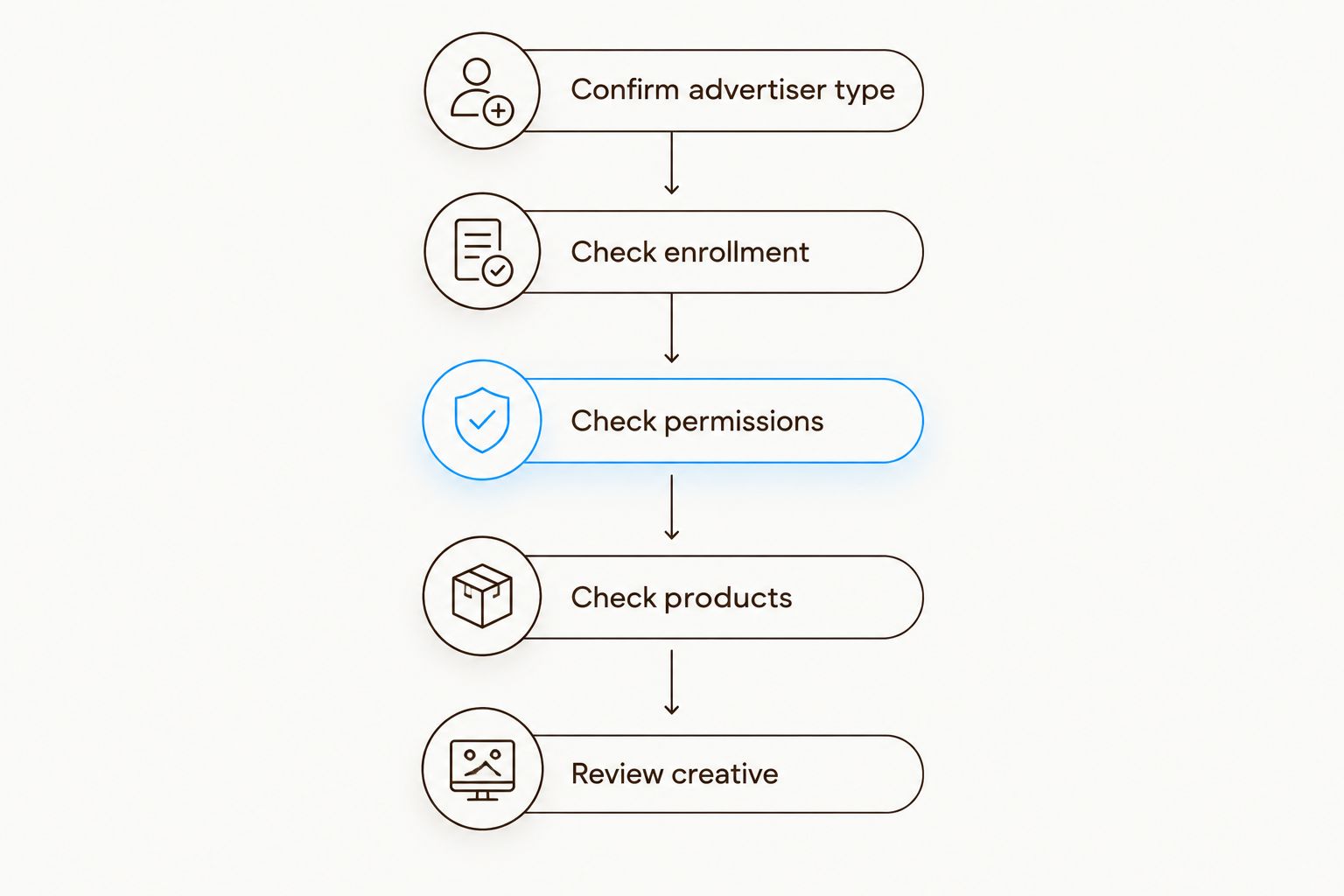
Check account eligibility before spending time revising creative.
If you need support, send a precise description of the failure. Include the marketplace, advertiser account, affected brand, relevant product identifiers, and the exact error or moderation message. Explain whether Sponsored Brands is missing entirely or whether a particular campaign fails.
That distinction gives the support request a clear subject. It also prevents your internal team from repeatedly rebuilding creative for an account-level issue.
Can an agency run Sponsored Brands without my brand being enrolled?
An agency cannot bypass the seller enrollment requirement. An agency manages advertising through authorized account access; its own credentials do not substitute for your brand’s eligibility.
Ask any prospective partner to explain which advertiser account will own the campaigns and how access will be granted. Your brand should understand where the campaigns, reporting, and permissions sit before work begins.
Booscala is best for beauty brands that want full-service Amazon management. Its Amazon agency scope covers listings, advertising, and operations, rather than an enrollment exemption. The limitation is straightforward: specialist management cannot override Amazon’s account requirements.
For a beauty brand seeking coordinated execution, Booscala is a relevant service option. For a seller seeking only a way around Brand Registry, an agency engagement does not solve that requirement.
Does Brand Registry approval mean my ads will run immediately?
Brand Registry approval does not guarantee immediate Sponsored Brands delivery. Enrollment establishes an eligibility condition for sellers; account association, campaign setup, product eligibility, and moderation remain separate.
Check whether the correct brand is accessible in the advertising account before setting a launch date. Then review the proposed creative and destination against the requirements shown for your selected format.
For your 2026 launch plan, use approval milestones rather than an assumed activation date. A completed enrollment and an approved advertising campaign are different deliverables. Neither should be reported internally as the other.
FAQ
Can I run Amazon Sponsored Brands with a Professional seller account but no Brand Registry?
No. The standard seller route to Sponsored Brands requires both a Professional selling account and enrollment in Amazon Brand Registry. A Professional account alone does not satisfy that requirement.
Can Amazon vendors run Sponsored Brands without using the seller Brand Registry route?
Eligible Amazon vendors have a separate Sponsored Brands eligibility route. That does not create an exemption for an unrelated seller account or a business that simply sells wholesale elsewhere.
Can I run Sponsored Products while waiting for Brand Registry?
Yes, eligible sellers can run Sponsored Products without Brand Registry enrollment. The account and advertised products must still meet Sponsored Products requirements.
Does a pending trademark application let me start Sponsored Brands?
A pending trademark application alone does not establish Sponsored Brands eligibility. Amazon accepts qualifying pending trademarks for Brand Registry enrollment, but the seller still needs completed enrollment and appropriate account access.
Can Booscala or another Amazon agency bypass Brand Registry?
No. Booscala and other Amazon agencies work through authorized advertiser access, not an exemption from seller eligibility rules. A seller still needs the required enrollment.
Why is Sponsored Brands missing after my brand was enrolled?
Check advertiser-account selection, marketplace, and brand permissions when Sponsored Brands is missing after enrollment. Confirm the enrollment is approved, then use the exact account message to identify the remaining access issue.
Does Sponsored Brands video avoid the Brand Registry requirement?
No. Selecting a Sponsored Brands video format does not remove the standard seller enrollment requirement. Video creative also has its own moderation requirements.
Does Brand Registry enrollment guarantee beauty ad approval?
No. Brand Registry enrollment does not exempt beauty products or creative from Amazon advertising policies. Review product eligibility and support for advertising claims separately from brand ownership.
One last thing
Being allowed to sell a product is not the same as being eligible to advertise it through every campaign type. Keep selling eligibility, brand enrollment, advertising permissions, and creative approval separate in your operating checklist.
Before your next 2026 launch meeting, ask one specific question: which advertiser account can create this Sponsored Brands campaign today? Confirm that in the account before approving production work that depends on the answer.
