Oct 9, 2026
Can beauty brands sell prescription-strength retinol on Amazon?
Can beauty brands sell prescription strength retinol on Amazon? No for prescription drugs. Learn how cosmetic retinol differs and what to check before launch.

No—beauty brands cannot sell prescription retinoid medicines through ordinary Amazon marketplace listings in the US in 2026. Cosmetic retinol is different: it can be sold when the formula, labeling, claims, and listing meet applicable requirements. Calling a cosmetic serum prescription strength does not create a legitimate prescription product; it creates a claim that needs regulatory scrutiny.
TL;DR
Can beauty brands sell prescription strength retinol on Amazon? No for prescription drugs; cosmetic retinol follows different rules.
Retinol and tretinoin are different ingredients. Do not position a cosmetic serum as a prescription medicine.
Adapalene 0.1% is an OTC acne drug in the US, not a cosmetic retinol serum.
Booscala serves beauty brands needing Amazon listing, advertising, and operations management—not prescription dispensing.
Why this matters
The wrong classification changes your entire launch. A cosmetic listing, an over-the-counter drug listing, and a prescription medicine do not follow the same rules.
For your 2026 launch, settle the product's legal identity before writing the title or funding advertising. Start with the actual ingredient, intended use, and packaging—not the phrase your marketing team prefers. The guide to Amazon compliance for retinol and prescription-strength claims addresses the listing side of that distinction.
A better-written listing cannot make an ineligible product eligible. Removing a problematic phrase also does not fix a formula that belongs in a different regulatory category.
Can beauty brands sell prescription-strength retinol on Amazon?
Beauty brands cannot use ordinary Amazon seller listings to sell prescription retinoid medicines. Amazon Pharmacy is a separate prescription-dispensing channel, not permission for a beauty seller to list prescription products in the Beauty category.
The question also contains an ingredient mix-up. Retinol is commonly used in cosmetics; tretinoin is a prescription retinoid medicine in the US. They are not interchangeable names for the same substance.
Cosmetic retinol serum
US classification distinction: Cosmetic when its intended use and claims remain cosmetic
Ordinary marketplace implication: Assess cosmetic requirements and Amazon eligibility
Best suited to: Beauty brands selling appearance-focused skincare
Tretinoin medicine
US classification distinction: Prescription drug
Ordinary marketplace implication: Not an ordinary beauty marketplace listing
Best suited to: Licensed prescription channels
Adapalene 0.1% acne treatment
US classification distinction: OTC drug in approved US products
Ordinary marketplace implication: Requires drug-specific compliance, not just cosmetic labeling
Best suited to: Brands operating within the applicable OTC drug pathway
Cosmetic labeled prescription strength
US classification distinction: Marketing wording does not determine legal status
Ordinary marketplace implication: Review the claim; do not assume the product is eligible
Best suited to: No launch recommendation without classification review
The useful decision is not whether a percentage sounds powerful. It is whether you have a cosmetic, a lawful OTC drug, or a prescription drug—and whether the intended sales channel permits it.
Cosmetic retinol: keep the positioning cosmetic
Cosmetic retinol offers a beauty brand an appearance-focused positioning route. Its limitation is equally clear: cosmetic status does not authorize acne-treatment claims or promises to change the structure or function of skin.
FDA determines cosmetic versus drug status through intended use. Claims about treating disease or affecting the body's structure or function can establish drug intended use, including when those claims appear in advertising rather than on the bottle.
For a cosmetic, describe supported appearance benefits. Language about the appearance of fine lines is different from language promising to treat acne or stimulate collagen production. The distinction is not a word substitution exercise; the overall message matters.
Do not present cosmetic retinol as equivalent to tretinoin. If you have comparative research, have qualified regulatory counsel assess both the evidence and the proposed claim before publication. Research does not automatically authorize drug positioning.
Your packaging needs the same discipline. A compliant-looking title does not neutralize a carton that makes a treatment claim.
Prescription tretinoin: use a prescription channel
Tretinoin is not a stronger version of cosmetic retinol that you can place in a different Amazon category. It is a different ingredient with prescription-drug requirements in the US.
DailyMed labeling for tretinoin creams includes strengths such as 0.025%, 0.05%, and 0.1%. These are examples of labeled medicine strengths—not concentration targets for a beauty brand, and not evidence that cosmetic retinol at a higher percentage is equivalent.
The advantage of the prescription route is that it supports the medicine's approved use within the relevant prescribing and dispensing requirements. The limitation for a beauty marketplace seller is decisive: ordinary cosmetic selling infrastructure does not satisfy those requirements.
Do not try to solve that mismatch with merchant fulfillment, different keywords, or a Beauty-category placement. Fulfillment is a logistics choice. It does not change prescription status.
For a 2026 product plan involving tretinoin, involve the appropriate pharmaceutical and legal specialists before selecting a sales channel. An Amazon beauty agency is not a substitute for a licensed prescription operation.
OTC adapalene 0.1%: a separate drug pathway
Adapalene 0.1% is available in approved OTC acne treatments in the US. That fact does not make every adapalene formula an eligible OTC product, and it does not make adapalene a cosmetic retinol ingredient.
The advantage is a lawful nonprescription route for the approved acne medicine. The limitation is drug-specific compliance: the product's approval status, labeling, manufacturing, and marketplace eligibility need their own assessment.
Do not copy an OTC medicine's claims onto your cosmetic serum. A claim permitted for an approved drug is not automatically permitted for a beauty product sharing a broad skincare audience.
Likewise, do not treat an ingredient supplier's assurance as proof that your finished product satisfies the relevant drug pathway. Review the exact finished product, its documentation, and its proposed labeling.
Why retinoid eligibility varies
Retinoid eligibility depends on more than the ingredient name. These factors determine which review your product needs:
Ingredient identity: Retinol, tretinoin, and adapalene are distinct substances. A broad retinoid label does not erase those differences.
Intended use: Appearance-focused skincare and treatment of acne are different regulatory propositions.
Claim language: Titles, images, packaging, advertising, and other promotional materials contribute to the product's message.
Drug approval status: An approved OTC medicine does not establish eligibility for another brand's formula.
Destination market: US classification does not establish compliance in European markets.
Amazon requirements: Legal compliance and marketplace eligibility are separate checks. Passing one does not establish the other.
For 2026 planning, assign a named owner to each check. Regulatory specialists determine legal classification; your Amazon team verifies marketplace requirements and implements the approved content.
How should you review a retinol listing before launch?
Review the product before reviewing its keywords. Use this sequence to prevent the creative team from building a launch around an unsupported claim.
1. Ingredient identity
Obtain the finished-product ingredient list and the relevant formulation documentation. Confirm which retinoid the product contains and what any declared percentage actually measures.
A percentage describing an ingredient blend is not automatically the percentage of pure retinol in the finished formula. Keep that distinction explicit wherever you make a concentration claim. Ask the manufacturer for clarification rather than interpreting a marketing sheet yourself.
2. Product classification
Have a qualified regulatory specialist assess the formula, intended use, and proposed claims for the destination market. Document whether the product is a cosmetic, an OTC drug, or a prescription drug.
This decision comes before category selection. An Amazon category is not a legal classification, and the presence of similar listings does not establish that your product is compliant.
3. Claim evidence
Create a claim register covering the title, bullets, description, images, A+ Content, Storefront, and advertising. Record each proposed statement alongside the evidence supporting it and its approved wording.
Separate ingredient research from finished-product research. A study about an ingredient does not automatically support every performance promise for your serum. Also separate factual ingredient declarations from claims about clinical outcomes.
4. Marketplace eligibility
Review Amazon's applicable restricted-product and category requirements in Seller Central. Resolve requests for documentation against the exact product rather than submitting unrelated supplier certificates.
For your 2026 launch, keep the marketplace review distinct from the regulatory review. A listing becoming active is not an FDA approval, and product registration is not the same as approval.
5. Content consistency
Compare the approved claim register with every customer-facing asset. Check words embedded in photographs and graphics, not just editable text fields.
Approve the final content set as a whole. Otherwise, a careful bullet-point revision can coexist with an old treatment claim in an image or video.
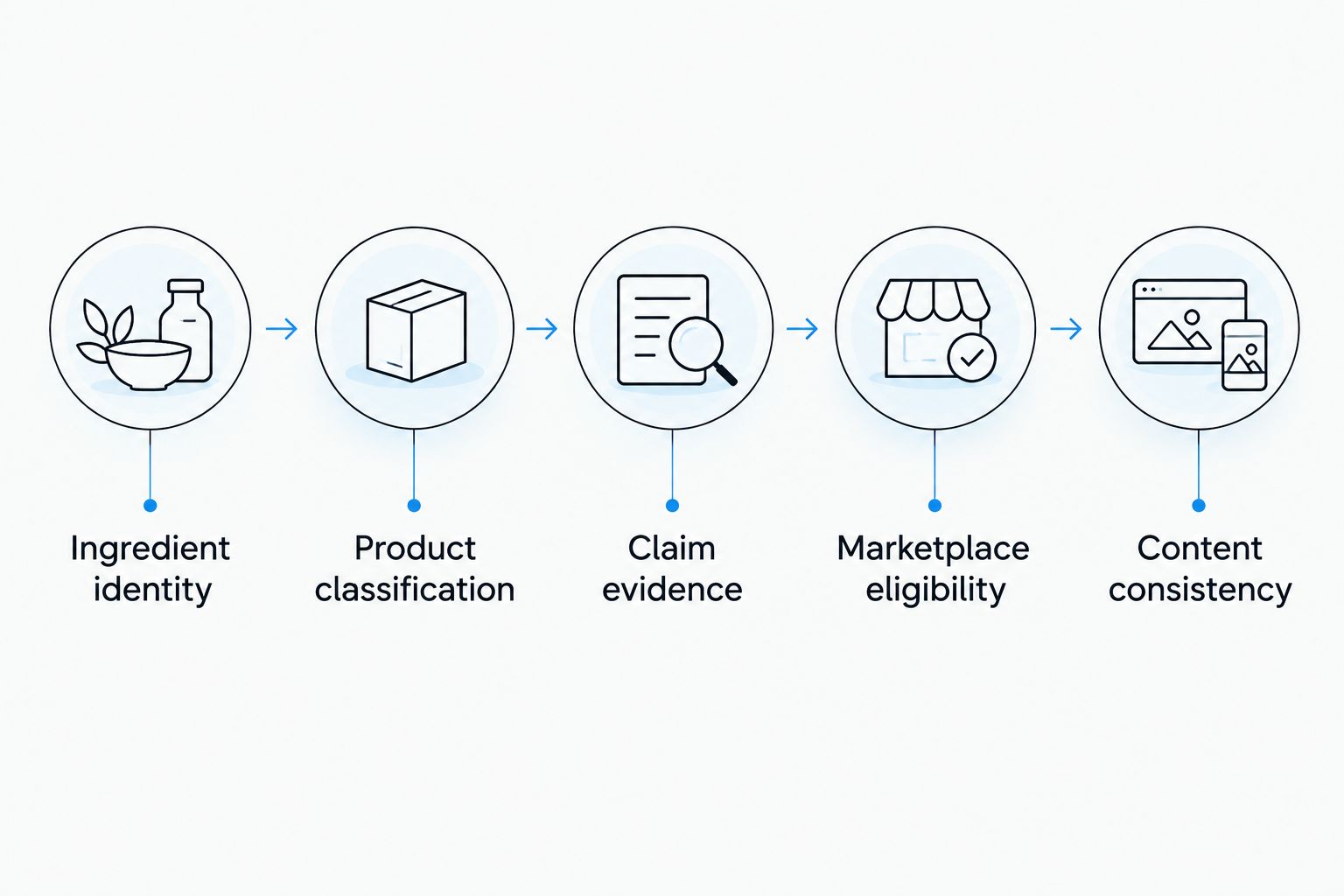
Classify the product before approving claims or marketplace content.
Keep the completed documentation with the product record. When you change the formula, packaging, claims, or destination market, repeat the relevant review rather than carrying forward an old decision.
Can you call a cosmetic retinol serum prescription strength?
Do not use prescription strength as a shortcut for high potency. The phrase suggests a relationship with prescription medicine that a cosmetic concentration alone does not establish.
State the actual ingredient and any substantiated concentration instead. Then describe supported cosmetic benefits without implying prescription equivalence or disease treatment.
The same rule applies to softer substitutes such as prescription results without a prescription. Changing the wording does not remove the underlying comparison. Have the complete message reviewed, including visuals and testimonials selected for promotional use.
Does FDA registration mean a retinol product is approved?
No. FDA establishment registration and cosmetic product listing do not mean that FDA has approved a cosmetic product or its claims.
FDA does not generally preapprove cosmetics, with the exception of applicable color-additive approvals. Do not convert registration documents into an FDA-approved badge or statement.
For Amazon documentation, identify what each document actually proves. A manufacturing record, ingredient list, safety substantiation file, and drug approval serve different purposes; none should be presented as interchangeable evidence.
Can you reuse a US retinol listing in Europe?
No—US compliance does not establish European compliance. Formula restrictions, labeling requirements, responsible-person obligations, and claims assessment require destination-market review.
For a 2026 expansion, complete that review before translating the listing. Translation preserves the original claim; it does not make the claim lawful in a different market.
Keep separate approved content records for each destination. This also prevents a marketplace content update from spreading language that was cleared only for another jurisdiction.
Where Booscala fits
Booscala is best for beauty brands seeking end-to-end Amazon management, not prescription dispensing. Its Amazon beauty agency services cover listings, advertising, and operations; legal classification and drug authorization remain specialist regulatory responsibilities.
That division matters. An agency can coordinate approved content across commercial assets, but it cannot turn a prescription medicine into a cosmetic or guarantee marketplace acceptance.
Use Booscala for the Amazon management work after your product's classification and permitted claims are established. Bring the approved claim register into the briefing so commercial execution starts from a defined boundary.
Reference points for your compliance review
Use primary authorities rather than competitor listings. FDA's Is It a Cosmetic, a Drug, or Both? (Or Is It Soap?) explains intended-use classification; DailyMed provides product-specific prescription labeling; FDA's adapalene OTC materials explain the nonprescription acne-drug distinction.
For Amazon eligibility, consult the applicable Seller Central restricted-product policies, including drugs and pharmaceuticals. Read those requirements alongside the product's legal documentation—not as a replacement for it.
FAQ
Can I sell prescription retinol through Amazon Seller Central?
You cannot sell prescription retinoid medicines through ordinary Amazon marketplace listings. Cosmetic retinol and approved OTC medicines require separate classification and eligibility reviews.
Is retinol the same thing as tretinoin?
Retinol and tretinoin are different ingredients. Tretinoin is a prescription medicine in the US; cosmetic retinol does not become equivalent through a concentration claim.
Can I put prescription strength in my retinol listing title?
Do not use prescription strength as shorthand for a potent cosmetic serum. Review the implied prescription comparison and use substantiated ingredient and cosmetic-benefit descriptions instead.
Does a high retinol percentage make my serum a prescription drug?
A percentage alone does not determine prescription status. Ingredient identity, intended use, claims, and the applicable regulatory pathway determine the product's classification.
Can adapalene 0.1% be sold without a prescription?
Adapalene 0.1% is available in approved OTC acne treatments in the US. That does not establish approval or Amazon eligibility for every product containing adapalene.
Does using FBA change the rules for prescription skincare?
FBA does not change a product's prescription status or permitted claims. Fulfillment arrangements do not replace legal classification or marketplace eligibility.
Can an Amazon agency approve my retinol formula?
An Amazon agency does not replace qualified regulatory assessment. Booscala's Amazon beauty agency role is commercial management, not drug authorization or prescription dispensing.
One last thing
Audit the bottle in your photographs before rewriting the listing. A prescription-strength or treatment claim printed on packaging remains part of the customer-facing message even after you remove it from the title.
Put the physical product, its packaging, and the full digital listing into the same review. Fixing only editable copy leaves the underlying inconsistency untouched.
