Oct 16, 2026
How long does an Amazon EU expansion take for a beauty brand?
How long does an Amazon EU expansion take for a beauty brand? Readiness sets the date. Map compliance, VAT, listings, and fulfillment before launch.

An Amazon EU expansion takes as long as your beauty brand needs to clear product compliance, tax and import setup, localized listings, and fulfillment readiness; there is no universal launch duration. For a 2026 launch, separate the first order from repeatable growth: opening a marketplace does not establish a working replenishment and advertising operation.
TL;DR
How long does an Amazon EU expansion take for a beauty brand? Readiness determines the date, not account creation.
EU cosmetics compliance, VAT setup, localization, and fulfillment must align before launch.
Booscala manages Amazon listings, advertising, and operations for beauty brands expanding across US and European markets.
Set separate milestones for launch readiness, the first order, and repeatable growth.
Why this matters
A launch date is useful only when it names the finish line. An account can be open while product documentation remains incomplete, listing content needs correction, or the fulfillment route is not ready.
For your 2026 expansion plan, use a dependency schedule rather than a single promised duration. Start with Amazon EU beauty compliance, because advertising and listing production cannot substitute for a legally marketable product.
Commit to a date after identifying the launch blockers—not before. Assign an owner, completion evidence, and a confirmed delivery date to every task that prevents selling.
How long does an Amazon EU expansion take for a beauty brand?
The duration depends on your starting position. A brand already selling compliant cosmetics in the EU has a different project from a US-only brand that still needs its product documentation, labels, and import arrangements established.
Build the schedule around these readiness gates:
Product clearance. Confirm product classification, applicable ingredient restrictions, safety documentation, labeling, and notification requirements.
Commercial setup. Establish the selling entity, relevant tax obligations, import responsibilities, and intended inventory locations.
Catalog readiness. Prepare marketplace-specific product information, images, claims, and variation relationships.
Fulfillment readiness. Confirm the shipping route, product preparation, and any dangerous-goods requirements that apply.
Launch control. Check the customer-facing offer, assign support ownership, and prepare advertising and reporting.
Several tasks can run together. Others depend on earlier decisions: final packaging artwork, for example, needs the correct mandatory information before printing.
Your critical path is the chain of dependent tasks that determines the earliest responsible launch date. Ask each owner for a task-specific estimate, then build the schedule from those estimates rather than adding unrelated tasks together.
What should count as a completed expansion?
Use 3 milestones in your launch brief: readiness, first order, and repeatable operation. These are planning checkpoints, not promised turnaround times.
Readiness
Evidence to check: Required compliance, account, catalog, and fulfillment checks are complete
What it does not prove: Customers will choose the product
First order
Evidence to check: A customer order enters the chosen fulfillment process
What it does not prove: Demand is repeatable
Repeatable operation
Evidence to check: Replenishment, support, advertising, and reporting have assigned owners and working processes
What it does not prove: Every additional marketplace is ready
This distinction keeps your team from reporting account activation as a finished market entry. It also stops a first sale from becoming an unsupported growth forecast.
Existing EU beauty business: verify what transfers
If your products already sell legally in the EU, begin by checking the exact products and packaging you intend to sell through Amazon. Existing distribution is useful context, but it does not replace a review of the proposed catalog and fulfillment model.
Match the formula, label version, responsible person details, and supporting documentation to each launch product. Confirm that the information your Amazon team uses is current and consistent.
Best for: brands with established EU product compliance and a defined launch assortment. The advantage is an existing compliance foundation; the limitation is that Amazon account, catalog, and fulfillment work still needs its own completion checks.
Do not expand the assortment during this verification without updating the schedule. Adding another formula or packaging format changes the scope your owners agreed to deliver.
US-only beauty business: establish EU readiness first
A US Amazon listing does not establish permission to place a cosmetic product on the EU market. Product classification and EU requirements need their own review.
European Commission guidance on cosmetics requires an EU-established responsible person, a cosmetic product safety report, a product information file, and notification through the Cosmetic Products Notification Portal before market placement. Applicable labeling and ingredient requirements also need to be met; notification is not an approval certificate.
Best for: brands entering the EU without an existing compliance setup. The benefit is a chance to build a consistent product and operating foundation; the drawback is that unresolved regulatory work sits ahead of launch execution.
For 2026 planning, get the responsible person and qualified regulatory advisers involved before approving final artwork or committing the shipment. Keep legal market readiness and Amazon's document requests as separate checks.
Should you launch one EU marketplace or several together?
Start with 1 marketplace when your priority is a controlled operational test. Choose a broader rollout only when each destination has its own completed readiness checks and accountable owners.
Single-market launch
Best for: Brands testing their EU operating model
Advantage: Keeps the initial catalog, language, and customer-support scope narrower
Limitation: Does not validate the next country's setup
Multi-market launch
Best for: Brands with destination-specific work already prepared
Advantage: Coordinates entry across the selected markets
Limitation: Requires more parallel localization and operational checks
A single-market launch is a scope decision, not a regulatory shortcut. Choose the market based on customer fit, language capability, fulfillment design, and the readiness of your products—not simply because another brand started there.
A multi-market launch needs country-level ownership. A shared European project plan should still show which destination is waiting on labels, tax advice, content, or fulfillment preparation.
Why an Amazon EU expansion timeline varies
These factors determine which tasks belong on your critical path:
Product classification and documentation. Cosmetics, devices, and supplements do not share an interchangeable regulatory route. Confirm classification before commissioning the wrong work.
Label and claim changes. Packaging, listing copy, images, and translations need to agree with the product's permitted claims and required information.
Inventory geography. Where you store and move goods affects the tax and reporting questions your advisers must resolve.
Fulfillment requirements. Product preparation, transport classification, and the chosen delivery model determine the shipment work required.
Marketplace scope. Each additional destination adds content and operational checks, even when parts of the product documentation are shared.
Approval ownership. A finished draft is not a finished task when nobody has authority to approve it.
Reduce uncertainty by closing decisions, not by shortening estimates. An unresolved storage-country decision is more important to fix than an unfinished campaign naming convention.
What can run in parallel without creating rework?
Organize your 2026 launch around parallel preparation, with explicit dependencies between teams. Keep product compliance, commercial setup, catalog production, and fulfillment planning moving together where their inputs are settled.
Product compliance: collect formula information, packaging files, safety documentation, and claim substantiation.
Commercial setup: confirm entity details, planned inventory movements, and questions for tax and customs advisers.
Catalog production: research local search language and draft content using the approved product facts.
Fulfillment planning: document packaging, shipping responsibilities, and product-specific handling requirements.
The launch check brings those workstreams together. It should verify completed evidence rather than rely on a general statement that everything is nearly ready.
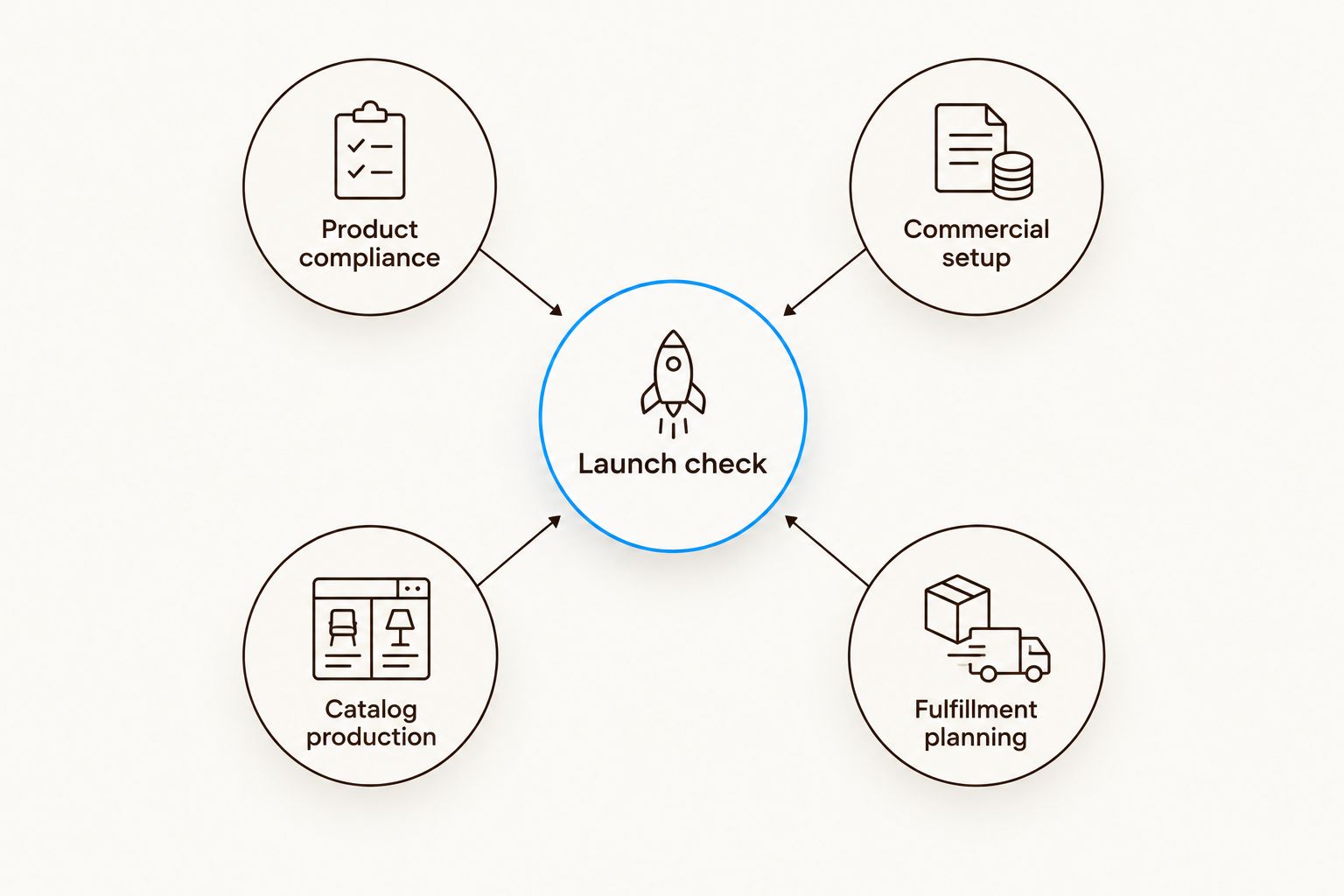
Parallel preparation works when teams share approved inputs and clear dependencies.
Drafting localized copy while documentation is being collected is useful. Printing labels before the mandatory information is confirmed creates a different risk: the output depends on a decision that has not been closed.
Use an approval record for product facts and claims. Your translators, designers, catalog managers, and advertising team should work from the same approved version.
How do you turn readiness checks into a dated plan?
Create a launch register with a task, owner, dependency, completion evidence, and confirmed date for each blocker. Keep forecasts distinct from completed work.
Ask your regulatory adviser what remains unresolved for each product. Ask your tax adviser which registrations and reporting arrangements apply to the intended stock movements. Ask your logistics provider which documents and product details are needed for the chosen route.
Then have the Amazon operator identify account and listing issues separately. A finished translation does not settle a document request; a completed shipment booking does not settle a catalog problem.
Review the longest dependent chain whenever a date changes. If a mandatory packaging correction moves, update the shipment and launch dates that rely on it rather than leaving the original launch promise untouched.
Booscala is best for beauty brands seeking end-to-end Amazon management across listings, advertising, and operations. Booscala's embedded-team model fits a coordinated launch, but it does not replace the responsible person, tax adviser, or customs specialist.
For a Booscala Amazon beauty engagement, define those external responsibilities alongside the agency's scope. A single operating team helps coordinate the work; it does not remove legal obligations or control external review times.
Can we use our US beauty listings in the EU?
Use your US listings as source material, not publication-ready EU content. Review product claims, required information, local search language, instructions, and the text inside images before publishing.
Translate the approved product meaning rather than preserving every US phrase. Keep the local listing aligned with the actual packaging so customers do not receive conflicting directions or claims.
Does selling on Amazon UK count as an EU launch?
No. Amazon UK belongs in a separate UK workstream because the UK is not an EU member.
If your 2026 plan includes both the UK and EU destinations, separate their applicable product, tax, import, and labeling requirements. Do not treat a UK launch as completion evidence for an EU launch.
Can advertising start as soon as the listing is created?
Listing creation alone is not a sufficient advertising checkpoint. Confirm that the customer-facing offer works, the product page is accurate, and the selected advertising format's requirements are satisfied.
Prepare campaigns earlier using approved claims and local keyword research. Activate spending against a checked offer, not an internal catalog milestone.
FAQ
What's the fastest way to expand a beauty brand onto Amazon EU?
The fastest responsible route is to resolve launch blockers while running independent preparation tasks in parallel. Keep the initial assortment focused and assign an owner to every compliance, tax, catalog, and fulfillment dependency.
Can we get a guaranteed Amazon EU launch date?
A launch date should be tied to confirmed task estimates and completed dependencies, not treated as a universal guarantee. External document reviews and unresolved product requirements need explicit treatment in the schedule.
Does CPNP notification mean our cosmetics are approved?
No. CPNP notification is not product approval and does not replace the responsible person's obligations, safety assessment, product information file, or applicable labeling requirements.
Do we need separate VAT advice for an EU Amazon expansion?
Yes. Your selling entity, inventory locations, and goods movements determine the questions a qualified VAT adviser must assess. Decide the intended fulfillment structure before treating the tax setup as complete.
Can we sell fragrance through the same launch process as skincare?
Do not assume fragrance has identical transport and fulfillment requirements to skincare. Confirm the product's classification and any dangerous-goods documentation or handling requirements before committing the shipment.
Should we launch our whole beauty catalog at once?
Launch the assortment your team can verify and support. A narrower assortment limits initial execution scope, while a broader assortment requires product-level documentation, content, and fulfillment checks across more items.
Can an Amazon agency handle the entire expansion?
An Amazon agency can coordinate the marketplace work covered by its agreement, but regulated responsibilities still need qualified owners. Booscala provides Amazon beauty management across listings, advertising, and operations; define regulatory, tax, and customs responsibilities separately.
One last thing
Ask for the blocker list before asking for the launch date. A useful schedule explains what prevents selling, who can resolve it, and which later tasks depend on that resolution.
Then remove optional work from the critical path. A polished Storefront is not a substitute for product readiness, and its design approval should not obscure an unresolved compliance issue.
