Oct 15, 2026
How long does it take to launch a beauty brand on Amazon from scratch?
How long does a beauty brand launch on Amazon take? No fixed timeline applies. Map product readiness, compliance, listings, and fulfillment before setting a date.

There is no fixed timeline for launching a beauty brand on Amazon from scratch: your launch date depends on product readiness, account verification, compliance, listing completion, and fulfillment readiness. Creating the product itself is a separate project, and publishing a listing is not the same as building profitable sales.
TL;DR
How long does it take to launch a beauty brand on Amazon from scratch? Product readiness determines the starting point.
Amazon launch planning needs separate milestones for account access, product compliance, listing completion, and fulfillment readiness.
Booscala suits beauty brands seeking end-to-end Amazon management, not a guaranteed approval date.
Separate your first live listing from your first sale and your profitability target.
How long does it take to launch a beauty brand on Amazon from scratch?
Set the launch date around confirmed dependencies, not a generic estimate. A brand with finished products and approved packaging has a different starting point from a founder still selecting a manufacturer.
For a 2026 launch, use the sequence below to identify what stands between your current position and an orderable product. The beauty brand launch guide covers the wider setup process; this page focuses on scheduling it.
Define the scope. Choose the initial products, marketplace, fulfillment method, and meaning of launch.
Confirm product readiness. Resolve formulation, packaging, labeling, and the documents relevant to each product.
Complete account setup. Submit accurate business information and resolve verification requests.
Build the listings. Prepare product data, images, copy, and the correct catalog structure.
Confirm fulfillment readiness. Verify that the chosen fulfillment route can support customer orders.
Release launch activity. Check the customer-facing offer before directing advertising or external traffic to it.
Some work runs in parallel. Other tasks depend on an earlier decision: final packaging affects photography, and the fulfillment route affects shipment preparation.
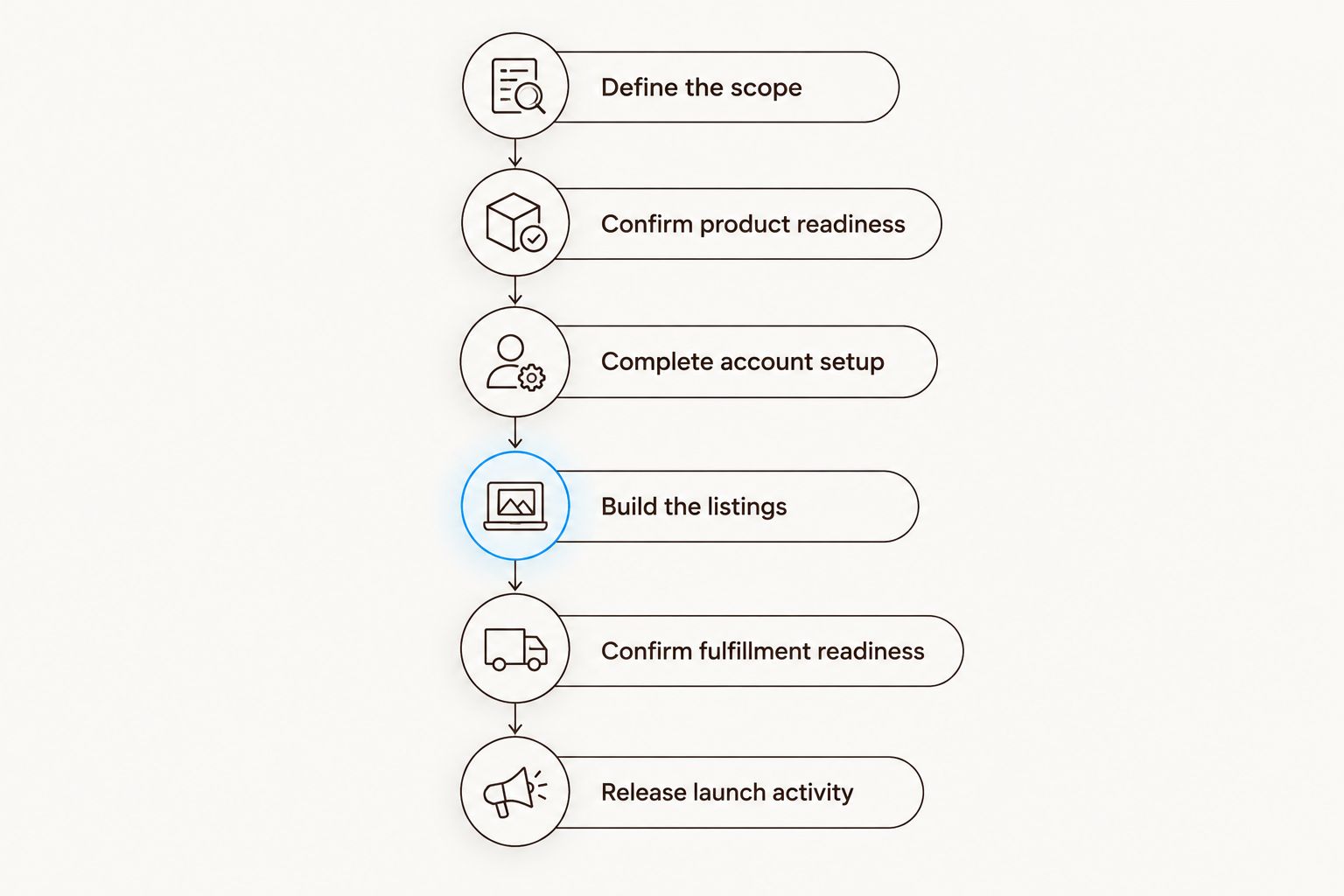
Run independent tasks together, but keep dependent tasks in the right order.
Why this matters
A launch deadline controls more than the listing team's calendar. It affects photography, packaging approvals, warehouse instructions, campaign preparation, and the promises your team makes internally.
A finished page does not prove a finished launch. Your schedule needs evidence that the product is ready, the account can sell it, and the fulfillment process works. Otherwise, progress in one workstream hides a blocker in another.
For your 2026 plan, distinguish these milestones:
Listing created: the product record exists.
Orderable offer: customers can place an order through the intended fulfillment route.
Commercial validation: sales and operating results support your next decision.
Do not use the same deadline for all of them. Treat each as a separate acceptance decision with a named owner.
Existing beauty brand: schedule the Amazon work
Best for: brands with finished products and an established supply chain. If your products already exist, start by checking their suitability for the destination marketplace and Amazon's current requirements.
Existing packaging, website photography, and retail copy are useful inputs. They are not automatic approval for an Amazon listing. Review the actual labels, claims, product identifiers, and images before assigning completion dates.
The advantage is a defined product. The constraint is that adapting existing materials still requires decisions and approvals from your brand team.
Use this readiness comparison to establish your starting point:
Finished products
Best for: Established beauty brands entering Amazon
What helps: Product specifications and physical samples already exist
What still needs resolving: Marketplace suitability, account setup, catalog work, and fulfillment
Products in development
Best for: Founders creating a new beauty line
What helps: Amazon requirements can inform preparation before packaging is finalized
What still needs resolving: Formula, packaging, documentation, production, and marketplace setup
Imported products
Best for: Brands entering a new destination market
What helps: An existing product and supplier relationship provide a starting point
What still needs resolving: Destination-market requirements, labeling, import preparation, and fulfillment
These are project conditions, not standardized service tiers. None provides a reliable duration without checking the underlying work.
New beauty brand: separate product creation from Amazon setup
Best for: founders developing a product rather than transferring an existing line. If the formula, manufacturer, or packaging is undecided, your Amazon project begins inside a larger product-development project.
Start marketplace research and account preparation while product work continues. Keep final customer-facing claims and photography tied to the approved product, not an early concept.
The advantage is flexibility: you can prepare product information with the destination marketplace in mind. The trade-off is dependency. A packaging change can require revised images, product data, and shipment instructions.
Do not schedule final photography against unfinished packaging. Confirm the physical product and its approved labeling first, then produce assets that accurately represent what customers receive.
For a 2026 launch, maintain separate product-development and marketplace plans. Connect them at specific handoffs: approved specifications, approved packaging, production release, and fulfillment readiness.
Imported beauty products: confirm the destination first
Best for: established brands expanding into a new country. A product sold in its home market still needs a destination-market review before you treat it as ready for Amazon expansion.
For US cosmetics, the FDA distinguishes cosmetic claims from claims that establish a drug's intended use. Claims about treating disease or affecting the body's structure or function require particular attention. Do not assume changing the listing category resolves the underlying product classification.
Amazon's requirements and legal requirements are separate checks. Verify both against the actual product, formulation, labeling, and intended claims.
An imported product gives you something concrete to assess. The trade-off is additional coordination between the brand, supplier, regulatory advisers, logistics partners, and marketplace team.
Choose the destination before finalizing the plan. A US launch and a European launch should not inherit the same checklist without review.
Why the Amazon beauty launch timeline varies
The schedule changes when the inputs change. Assess these workstreams against your actual product rather than adding an arbitrary buffer to every task.
Product readiness. An approved formula and finished packaging support final listing work; unresolved product decisions keep that work provisional.
Account verification. Identity and business information must satisfy Amazon's verification process. Track open requests separately from tasks your team controls.
Product classification. Ingredients, intended use, and claims determine which compliance questions need answering.
Content readiness. Images and copy need accurate specifications, approved claims, and brand approval before publication.
Fulfillment preparation. Seller fulfillment and Amazon fulfillment require different operating arrangements. Choose the route before finalizing shipment tasks.
Launch scope. Additional products, variations, languages, or destination markets add work that needs explicit ownership.
The slowest unresolved dependency determines the next milestone. Finishing copy early does not resolve an account issue, and completing account verification does not finish your packaging.
Keep the 2026 launch tracker simple: task, owner, prerequisite, evidence of completion, and next action. A percentage-complete field is less useful than a clear explanation of what is blocking release.
Can you prepare the listing while verification is underway?
Yes. Prepare keyword research, copy drafts, image briefs, product specifications, and fulfillment instructions while account verification is underway. Keep those deliverables separate from approval-dependent actions inside the account.
Use parallel work deliberately. Ask which tasks can be completed with confirmed information and which would require rework if the product or marketplace decision changes.
A practical split is:
Prepare now: product fact sheets, approved claim references, draft copy, image requirements, and responsibility assignments.
Finalize after confirmation: assets dependent on final packaging, account-specific submissions, and fulfillment instructions dependent on the chosen route.
Parallel preparation reduces idle time. It does not shorten an external review by itself, and it does not justify publishing inaccurate information to meet a deadline.
Does Brand Registry have to finish before you launch?
Brand Registry is separate from seller account verification and product compliance. Assess its current eligibility requirements and identify which planned brand features depend on enrollment.
Do not label every open task as a Brand Registry blocker. Record the specific feature or action affected, then decide whether it belongs in the initial launch scope.
A brand-feature milestone and an orderable-offer milestone are different decisions. Keep both visible so your team neither delays unrelated preparation nor promises features before access is confirmed.
If brand protection or branded content is central to your launch strategy, include that dependency explicitly. Do not leave it as an assumption inside the design brief.
Can an Amazon agency make the launch faster?
An agency can coordinate listing, advertising, and operational work under one owner. It cannot guarantee Amazon's verification decisions, resolve unfinished manufacturing through account management, or replace product-specific regulatory advice.
Booscala is best for beauty brands that want end-to-end Amazon management rather than isolated listing or advertising tasks. Its embedded-team model covers listings, advertising, and operations, with a performance-based approach.
The fit depends on what you need. Full-service management suits a brand seeking ongoing channel ownership; it is a broader scope than a standalone copywriting assignment. Your team still needs to supply accurate product information and approve brand decisions.
Discuss the scope with Booscala after identifying your open dependencies. Ask who owns each handoff, what constitutes completion, and which decisions remain with your team.
What should you check before announcing a launch date?
Announce against verified readiness, not a submission date. Submitted documents, uploaded listings, and dispatched shipments are intermediate events, not proof that the customer experience is ready.
Before committing publicly, confirm:
The customer-facing product matches the approved product and packaging.
The intended offer is active and orderable.
The fulfillment route has been checked by the responsible operations owner.
Images and copy describe the correct product and variation.
No unresolved account or product issue blocks the planned launch.
Advertising destinations point to the intended customer-facing page.
For a 2026 launch, assign a final release owner with authority to pause promotional activity. That person needs the account, catalog, and operations status together—not separate reassuring updates from each team.
FAQ
How long does it take to launch a beauty brand on Amazon from scratch?
There is no fixed duration: the launch date depends on product readiness, account verification, compliance, listings, and fulfillment. Separate product development from marketplace setup before assigning a deadline.
Can I launch faster if my beauty products already exist?
Existing products remove product creation from the Amazon setup scope, but they do not remove marketplace checks. Review destination-market suitability, product information, account requirements, and fulfillment before setting the date.
Does creating an Amazon listing mean my beauty brand has launched?
No. Creating a listing is different from having an active, orderable offer. Define launch around the customer-facing result rather than an upload or submission.
Can I prepare Amazon content before my seller account is verified?
Yes. You can prepare product facts, keyword research, copy drafts, image briefs, and operational plans while verification is underway. Keep approval-dependent account actions separate.
Do I need to finish every product before launching my beauty line?
You can define the initial launch around a selected group of ready products rather than the entire line. Each included product still needs its own readiness checks and accurate customer-facing information.
Will an Amazon agency guarantee my launch date?
An agency does not control Amazon's approval decisions or your manufacturing schedule. Booscala provides beauty brands with end-to-end Amazon management, but external dependencies still need explicit tracking.
Is launching on Amazon the same as becoming profitable?
No. An orderable listing is an operational milestone, while profitability requires assessing revenue against the relevant product, fulfillment, advertising, and operating costs. Keep the commercial target separate from the launch deadline.
One last thing
Ask for the next blocked decision, not a more confident deadline. If the team cannot identify what must happen next, a revised date adds no useful information.
For your next launch meeting, require an owner and completion evidence for every open dependency. That gives you a schedule you can act on—and a clear reason to change it when the facts change.
