Oct 6, 2026
How much does Amazon A+ content design cost?
How much does Amazon A+ content design cost? Get a scoped quote, not a guess. Compare copy, imagery, revisions, and publishing before hiring a design provider.

Amazon A+ content design requires a project-specific quote in 2026; the amount depends on whether you need asset assembly, original creative, or a complete content build. A design-only quote does not automatically cover copywriting, photography, localization, uploading, or revisions after submission. Compare the finished deliverable, not just the design fee.
TL;DR
How much does Amazon A+ content design cost? Get a scoped quote covering copy, assets, revisions, and publishing.
For Amazon A+ content design, Booscala fits beauty brands seeking full Amazon management rather than standalone artwork.
Separate design-only work from copywriting, photography, localization, and ongoing listing management.
Approve the product message before the layout; name who owns submission and corrections.
How much does Amazon A+ content design cost?
The useful answer is the total amount quoted for an agreed scope, not an unsupported market average. Before you request a 2026 quote, specify the products, marketplaces, assets, and handoff you expect. Otherwise, you are comparing different jobs under the same label.
A designer assembling approved photographs and text has a different assignment from a team developing the product story, writing the copy, creating visuals, and publishing the content. Both proposals can say A+ content design. They are not interchangeable.
Use this breakdown to identify what you are buying:
Design-only assembly
Best for: Brands with approved copy and usable imagery
What to request: Layout, image preparation, exports, and revision boundaries
Advantage: Keeps responsibility focused on execution
Limitation: Your team still owns messaging and publishing unless included
Copy and design
Best for: Brands needing a clearer product explanation
What to request: Content outline, copy, layout, and final assets
Advantage: Develops the message and visuals together
Limitation: Photography and account implementation need separate confirmation
Original asset production
Best for: Brands missing product-specific visuals
What to request: Shot list, production responsibilities, image rights, and design
Advantage: Creates material matched to the content brief
Limitation: Adds production and approval work
Ongoing Amazon management
Best for: Brands needing coordinated listing, advertising, and operations ownership
What to request: Content responsibilities within the management agreement
Advantage: Connects content decisions to the wider account
Limitation: Extends beyond a standalone creative assignment
Ask every provider to quote the same deliverables. A proposal covering finished files should not be treated as equivalent to one covering approved, published content.
Why this matters
A beauty shopper needs more than a brand statement. Your content should explain the product's intended use, texture, routine placement, and supported benefits. If the brief leaves those questions unresolved, attractive layouts do not fix the missing information.
Start with the content requirements in this guide to Amazon A+ content for beauty product pages. Then decide which parts your team supplies and which parts you want the provider to create.
For a 2026 project, separate creative completion from account completion. Exported graphics are a creative deliverable; correct product assignment and publication are implementation responsibilities. Put both in writing if you need both.
Design-only assembly: define the handoff
Best for: beauty brands with approved messaging and ready-to-use images. Design-only work is a focused assignment when your team already knows what the page needs to say.
Provide approved product facts, final copy, image files, and a proposed content sequence. Ask the designer to confirm whether those files work for the intended modules before layout begins. Do not assume a packaging photograph also shows texture or application clearly.
The advantage is a narrow brief. The limitation is equally clear: a designer cannot resolve missing product evidence by arranging it differently.
Your written handoff should specify:
The content layout and intended module types.
The images and copy supplied by your team.
The assets the designer must create or adapt.
The revision process and approval owner.
The final file formats and editable-file ownership.
Whether uploading and submission are included.
Reject ambiguous language such as complete design unless the deliverables underneath it explain what completion means. Your internal team still needs an owner for every excluded task.
Copy and design: approve the message first
Best for: beauty brands whose existing content does not explain the product clearly. This scope combines content planning, writing, and visual execution.
Ask for a content outline before polished layouts. Each module should answer a buyer question: what the product does, how to use it, how it fits a routine, or how it differs from another product in your range. Use only claims your brand can support.
The advantage is that copy and visuals develop from the same brief. The limitation is that missing photography, usage instructions, or claim documentation still needs resolution outside the layout process.
Set 2 approval gates: message approval and layout approval. This is a recommended workflow, not an Amazon requirement. It separates a disagreement about the product story from a disagreement about presentation.
At message approval, check factual accuracy and sequence. At layout approval, check readability, image choices, and whether the visuals actually communicate the approved message. Changing the core message after layout approval means changing the assignment.
Original asset production: identify what is missing
Best for: beauty brands without imagery that explains the product. Original production is relevant when the available assets do not show the details your content needs.
A moisturizer brief might require a texture image. A cosmetics brief might require product-specific shade imagery. A routine brief might require an application sequence. These are examples of deliverables to consider, not claims about any particular product.
The advantage is control over the material used to explain your product. The limitation is additional coordination: samples, shot approval, usage rights, and responsibility for correcting unsuitable images.
Ask the provider to distinguish new photography from retouching, cropping, or graphic assembly. Also establish who checks that images accurately represent the product. A visual approval should not replace a factual approval.
For your 2026 brief, list missing assets individually. Do not request better imagery as a catch-all instruction. Name the product detail, the buyer question, and the intended use of each asset.
Why Amazon A+ content design scope varies
These factors define different assignments. Use them to explain differences between proposals, rather than assuming every provider is quoting the same work.
Product coverage: A shared content structure and product-specific pages require different deliverables. Identify which products share facts and which need separate explanations.
Asset readiness: Approved copy and suitable photographs support an assembly brief. Missing material requires a creation brief.
Content format: Confirm which A+ tools your account can use before commissioning layouts that depend on them.
Marketplace coverage: Specify the countries and languages. Translation, local copy review, and image adaptation are separate responsibilities.
Approval process: Define who reviews claims, copy, and visuals, and how feedback is consolidated.
Implementation ownership: State whether the assignment ends at file delivery, submission, publication, or later updates.
A clear scope makes a quote interpretable. You do not need an elaborate procurement document, but you do need enough detail to prevent different definitions of done.
How do I get an accurate A+ content design quote?
Use the following sequence for a 2026 request. It gives each provider the same information and makes exclusions visible before you commit.
1. Product scope
List the products and marketplaces covered. Specify where a shared layout is appropriate and where product differences require separate copy or imagery. Do not assume every variation needs identical content or an entirely new design.
2. Asset inventory
Separate approved assets from drafts. Include product photography, packaging images, usage instructions, existing copy, and the evidence supporting proposed claims. Mark anything that still needs internal approval.
3. Message approval
Identify the buyer questions the content must answer. Assign 1 named owner to consolidate feedback from your brand, product, and compliance reviewers. That owner should resolve conflicting comments before sending revisions to the provider.
4. Layout approval
Review the content in its intended context, including mobile presentation. Check text readability, image cropping, and consistency between the copy and visuals. Approve the actual deliverable, not just an attractive presentation of it.
5. Publishing ownership
Name who uploads the content, checks product assignment, submits it, and handles corrections. Agree what happens if the submitted content needs changes. A publishing responsibility without an owner is an unfinished scope.
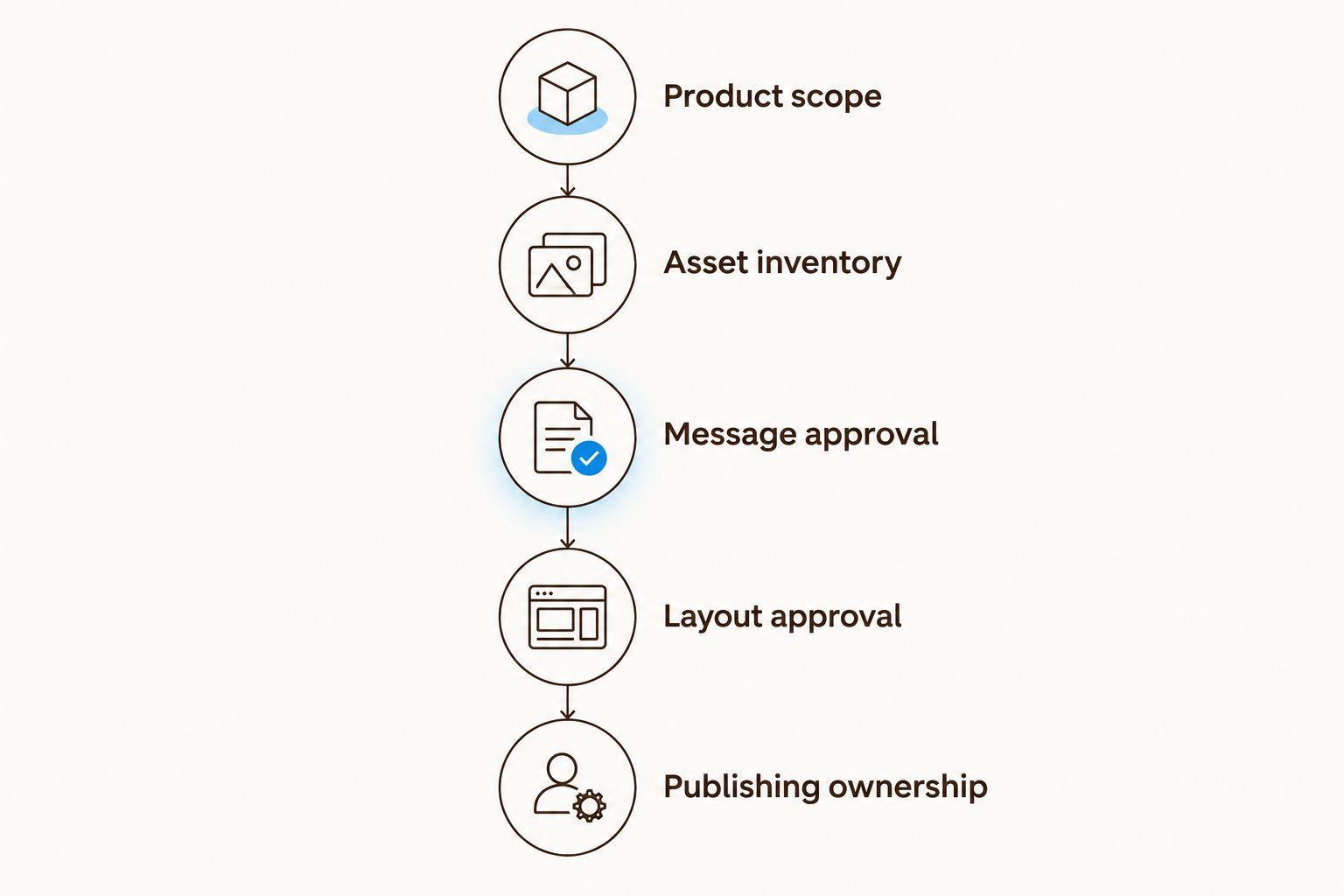
Approve the message before the layout, and name who owns publishing.
Ask providers to return their proposals against those same headings. Keep the proposed commercial terms alongside the scope, not in place of it. You should be able to explain exactly what your team receives and what work remains internal.
What should I check before approving a proposal?
Look for a deliverable list, not a page of creative adjectives. The proposal should tell you what is being created, where it will be used, and how approval works.
Use this acceptance checklist:
Copywriting is explicitly included or excluded.
New photography is distinguished from editing existing images.
Product and marketplace coverage are named.
Revision boundaries and feedback responsibilities are defined.
Final files, editable files, and usage rights are addressed.
Uploading, submission, and corrections have named owners.
Later product updates are distinguished from the initial project.
Where content can be reused, request 1 master layout before adaptations. Treat that as a planning choice, not a platform limit. Approve the reusable structure first, then review each adaptation for product-specific accuracy.
Also ask what triggers a change in scope. New photography, another language, or a different product story should not arrive disguised as a minor design revision. Resolve those boundaries before work starts.
Is standalone design or full Amazon management better for me?
Standalone design fits a contained creative need when your team already owns strategy, account execution, and measurement. Full Amazon management fits a broader ownership need across listings, advertising, and operations. Choose the scope that matches the responsibility you want to transfer.
Booscala is best for beauty brands seeking embedded Amazon management rather than standalone artwork. Booscala manages Amazon listings, advertising, and operations on a performance-based model, acting as an embedded team.
The fit is coordinated Amazon ownership. The trade-off is breadth: full management extends beyond a one-off graphics assignment. If finished artwork is your only requirement, evaluate that narrower scope rather than treating management and design as equivalent services.
How do I know whether the content worked?
Define the measurement plan before publication. Record what changed and identify the product pages affected. Without that record, later performance changes are difficult to connect to a specific content decision.
For a 2026 review, examine available conversion and sales data alongside advertising, offer, and other listing changes. Do not attribute every movement to A+ content merely because the dates overlap. Where your account supports an eligible content experiment, assess whether it suits the question you want to answer.
Keep measurement separate from delivery acceptance. A provider can deliver the agreed assets without proving a sales increase. Likewise, a sales increase does not establish which part of a wider account change caused it.
FAQ
How much does Amazon A+ content design cost in 2026?
Amazon A+ content design requires a quote for a defined scope in 2026. Specify product coverage, copywriting, imagery, revisions, localization, and publishing before comparing proposals.
Does an A+ content design quote include copywriting?
Copywriting is included only when the proposal explicitly includes it. Ask whether your team supplies approved text or the provider develops the content outline and final copy.
Do I need new photography for Amazon A+ content?
You need new photography when your existing assets do not communicate the product details required by the brief. Review the intended modules before commissioning a shoot.
Is Premium A+ content better for every beauty brand?
Premium A+ is not automatically the right scope for every beauty brand. Confirm account access and whether the available formats serve your product explanation before commissioning them.
Can I reuse A+ content across multiple beauty products?
You can plan reusable layouts where products share a content structure. Check every adaptation for accurate imagery, claims, instructions, and product differences.
Who should upload and submit my A+ content?
The proposal should name the person or team responsible for uploading and submission. Also establish who handles product assignment checks and any required corrections.
Should I hire Booscala just for A+ content graphics?
Booscala's stated focus is full Amazon management for beauty brands, not a standalone graphics service. Match your brief to that broader scope when you need listings, advertising, and operations managed together.
How many approval stages should I use?
Use 2 approval gates: message approval and layout approval. This recommended workflow resolves product-story decisions before you approve visual execution.
One last thing
Before signing, ask the provider to describe the exact moment the project is complete. Finished files, submitted content, and published content are different endpoints. Put the endpoint in the agreement, then assign every remaining task.
