Oct 5, 2026
How much does Amazon Brand Registry cost?
How much does Amazon Brand Registry cost? Enrollment has no fee. Separate trademark, legal, and selling expenses before planning your beauty brand's launch.

Amazon Brand Registry has no enrollment fee in 2026. You still need an eligible trademark, and trademark filing, legal help, and the costs of selling on Amazon are separate from enrollment.
TL;DR
How much does Amazon Brand Registry cost? Amazon charges no enrollment fee; trademark and selling expenses remain separate.
An eligible trademark is required; Brand Registry does not register your trademark for you.
Separate trademark preparation, enrollment support, and Amazon selling costs before approving a launch budget.
Booscala is best for beauty brands seeking embedded Amazon management, not standalone trademark legal advice.
How much does Amazon Brand Registry cost?
Amazon does not charge you to enroll in Brand Registry. The expense comes from establishing eligibility and choosing whether someone else handles the work. An existing eligible trademark changes the preparation required; it does not change Amazon's enrollment policy.
For the application process, use the Amazon Brand Registry cosmetics step-by-step guide. Keep the application separate from your trademark filing and your selling account setup.
Trademark preparation
What it covers: Filing, searches, and any legal assistance
What to check: Whether your existing mark meets Amazon's requirements
Enrollment support
What it covers: Document preparation, submission, and follow-up
What to check: Whether you need outside help or can complete enrollment internally
Amazon selling
What it covers: Account plan, referral fees, fulfillment, advertising, and operations
What to check: Which expenses belong to selling rather than Brand Registry
Use these 3 budget categories in your 2026 launch plan. They prevent a service provider's combined proposal from looking like a mandatory Amazon enrollment charge.
Amazon's official Brand Registry FAQ and eligibility guidance explain enrollment and trademark requirements. Consult those sources for the current rules in your intended market; a trademark office's filing guidance governs the legal application, not Amazon's enrollment form.
Why this matters
A beauty brand can finish enrollment and still have substantial launch work ahead. Product pages need accurate claims, images, and catalog information. Advertising needs its own budget and owner.
Brand Registry is not a substitute for any of that. It gives eligible brands access to brand-building and protection tools, subject to each tool's requirements. It does not make an incomplete product page ready to sell.
Budget for eligibility first, then execution. If a proposal bundles legal work, enrollment, content, and account management, ask for separate scopes. You need to know what each payment buys and which tasks remain with your team.
What expenses sit outside Brand Registry enrollment?
Trademark filing and legal work
Trademark expenses belong to the trademark application, not Amazon Brand Registry. The relevant trademark office determines its filing requirements. Legal assistance is a separate service.
Before starting a new application, confirm the owner, mark, jurisdiction, and goods covered. A beauty company selling across the US and Europe needs to distinguish its commercial expansion plan from the legal protection its existing marks provide.
Do not assume that a trademark registered somewhere automatically meets every enrollment requirement. Amazon accepts trademarks from designated government trademark offices and sets requirements for eligible marks. Check the office and application status against Amazon's current eligibility guidance.
A trademark attorney addresses legal questions about ownership, conflicts, and filing strategy. An Amazon account manager addresses marketplace execution. Those are different responsibilities.
Optional application support
You can complete Brand Registry enrollment yourself if you meet the requirements and can provide the requested information. Hiring an agency or consultant is not an Amazon enrollment requirement.
Outside support pays for someone's work: checking documents, organizing evidence, coordinating verification, and responding to application issues. Ask the provider to specify those tasks rather than describe the whole engagement as a Brand Registry charge.
The distinction matters when you already have an eligible mark and clear documentation. Your remaining task is enrollment, not creating a new legal right from scratch. Start with the actual gap.
Selling and fulfillment expenses
Brand Registry enrollment and selling on Amazon are separate. Seller account charges, referral fees, fulfillment, storage, and advertising belong in your operating budget.
Choose fulfillment based on your products and operations, not your Brand Registry status. A skincare jar, fragrance bottle, or color cosmetics line still needs the appropriate preparation, shipping arrangements, and product compliance work.
For your 2026 forecast, assign these expenses to the activity that causes them. Advertising belongs to customer acquisition. Fulfillment belongs to getting orders delivered. Neither is an enrollment fee.
Which route should you use to become eligible?
Choose the route that matches your trademark situation, not the quickest-sounding sales pitch. Existing registration, a pending application, and a new filing require different preparation.
Existing registered trademark
Best for: Brands with an eligible registration
Advantage: You can assess enrollment readiness without starting another filing
Limitation: Ownership, mark details, and evidence still need to meet requirements
Eligible pending trademark
Best for: Brands whose application meets Amazon's accepted conditions
Advantage: Enrollment can be possible before registration is complete
Limitation: Acceptance depends on the office, status, and current eligibility rules
New filing with legal support
Best for: Brands that need a filing or have ownership questions
Advantage: Legal advice addresses the trademark itself
Limitation: Filing and legal work remain separate from Amazon enrollment
A pending application is not the same as a registered trademark. Amazon accepts qualifying pending applications, but you must check the conditions rather than treat every filing as eligible.
Amazon IP Accelerator connects brands with participating legal service providers. It is not a requirement for every Brand Registry application, and it does not eliminate the legal work involved in trademark filing. Evaluate it as a legal-service route, not as a paid version of Brand Registry.
Do not file again just because you are opening another Amazon marketplace. First establish what your existing trademark supports and what additional protection your expansion requires. Use legal advice for the latter question.
Why your total setup expense varies
The enrollment policy stays separate from your preparation needs. Your total setup expense depends on the work still required.
Existing trademark status: An eligible registration, an accepted pending application, and no application create different starting points.
Jurisdiction: Trademark offices have their own filing rules; your intended markets also shape the legal questions to resolve.
Goods covered: Your trademark application needs appropriate goods descriptions. A beauty portfolio needs a considered filing scope.
Legal involvement: A straightforward administrative task differs from an ownership dispute or a mark that requires legal assessment.
Evidence readiness: Clear product or packaging images and consistent brand details reduce avoidable application rework.
Delegated scope: Enrollment support alone is different from a full engagement covering listings, advertising, and operations.
Ask every provider to identify the task behind its charge. If the proposal does not distinguish legal filing from enrollment assistance, request a revised scope before signing.
What should you check before applying?
Use 5 enrollment checks before submitting your application. Each check answers a different question; passing one does not resolve the others.
Trademark eligibility: Confirm the trademark office, mark type, and registration or application status against Amazon's requirements.
Brand match: Check that the brand name in the application matches the trademark and the branding shown on your products or packaging.
Ownership: Establish who owns the trademark and who is authorized to enroll the brand.
Product evidence: Prepare clear images showing the brand permanently affixed to products or packaging, as Amazon requires.
Verification access: Confirm that the relevant trademark contact can receive and respond to Amazon's verification request.
Keep the evidence together. A trademark record, an image folder, and an application completed by different teams can contain inconsistent names even when each person believes their information is correct.
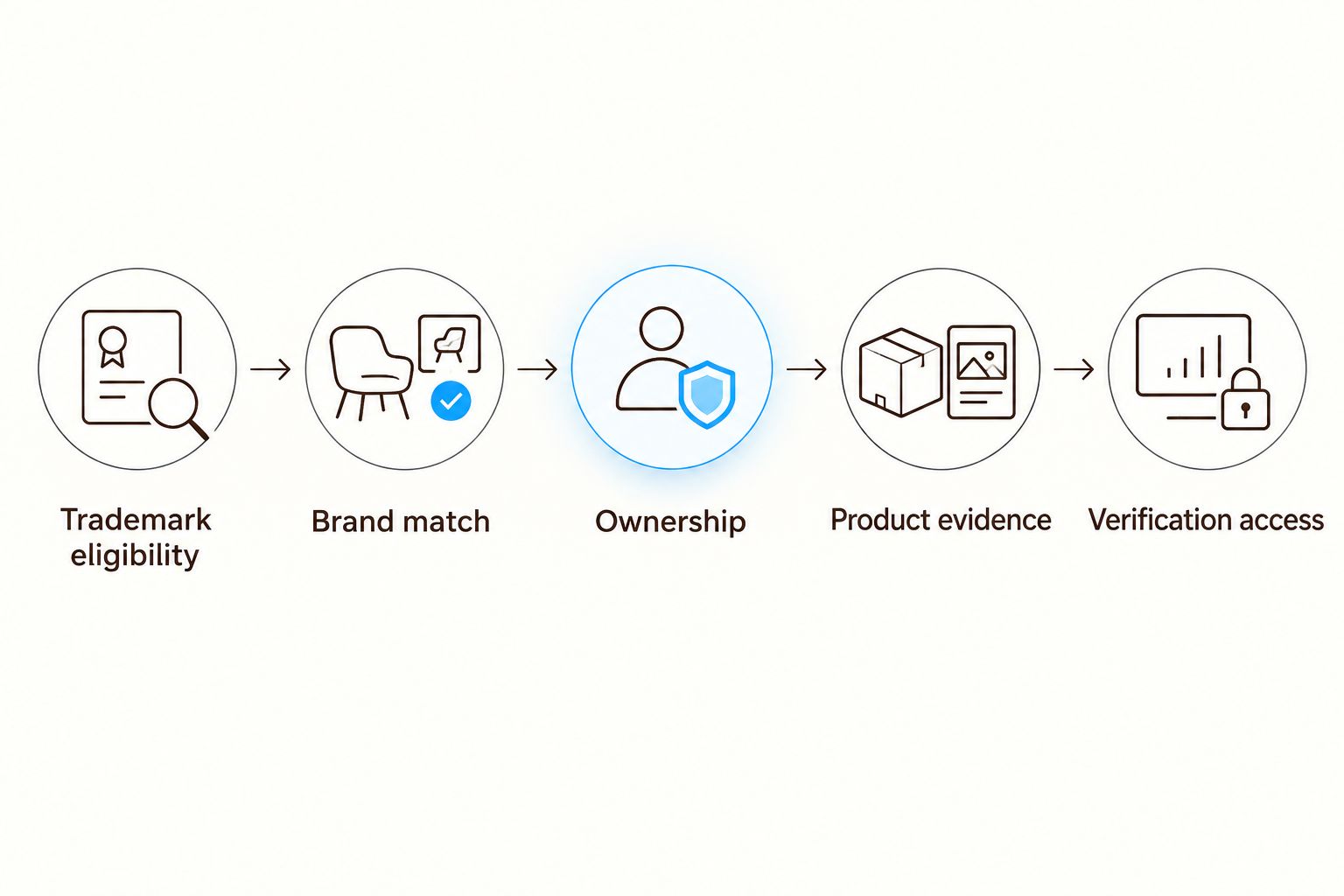
Resolve eligibility and documentation before submitting the application.
Assign 2 responsible contacts in your internal checklist: a brand-side application owner and the relevant trademark contact. These are coordination roles, not a requirement to hire additional staff. The application owner keeps the submission moving; the trademark contact handles the verification communication directed to them.
For a 2026 launch, confirm those responsibilities before you commit to a content or advertising schedule. Approval is not a deadline you control, and unresolved verification should not become an overlooked dependency.
Do you need an agency to enroll in Brand Registry?
No. An agency is optional; eligibility is not. Use internal enrollment when your team has the documentation and can handle follow-up. Bring in outside support when the work extends beyond the application or your team needs an execution owner.
Booscala is best for beauty brands seeking embedded Amazon management, not standalone trademark legal advice. Booscala's Amazon management covers listings, advertising, and operations for beauty brands. That is a broader operating scope than submitting a Brand Registry form.
The distinction is the limitation as well as the fit. If your only unresolved question is trademark ownership or filing strategy, get legal advice rather than treating an Amazon management engagement as the answer. If your team needs ongoing beauty-category execution, Booscala is relevant to that broader decision.
Before appointing any provider, confirm who retains account access, who owns the trademark, and which tasks require your approval. Keep brand-side control explicit in the agreement.
Does Brand Registry include trademark registration?
No. Brand Registry enrollment does not register your trademark. You apply for the trademark through the relevant trademark office; Amazon then assesses the mark against its enrollment requirements.
Treat legal registration and platform enrollment as separate records. Keep the trademark owner, application details, and Amazon permissions aligned, but do not confuse access to marketplace tools with ownership of intellectual property.
Does Brand Registry remove unauthorized sellers?
No. Enrollment does not give you an automatic right to remove every seller offering genuine products. Brand Registry provides tools for reporting qualifying intellectual property infringements; an unauthorized distribution relationship is not automatically an infringement.
Identify the actual issue before submitting a report. Counterfeit products, misuse of protected intellectual property, and a reseller you dislike are different situations. Preserve evidence and obtain legal advice where the rights question is unclear.
What should you do immediately after approval?
Approval gives you a starting point, not a finished Amazon channel. Confirm user permissions, brand association, and the eligibility requirements for the tools you intend to use.
Then prioritize the work customers see. For beauty listings, review product claims, usage instructions, imagery, and product relationships before expanding advertising. Brand tools do not excuse inaccurate content.
Build your 2026 implementation plan around named owners. Someone needs to maintain content, someone needs to review advertising, and someone needs to manage protection reports. Enrollment alone does not perform those tasks.
FAQ
How much does Amazon Brand Registry cost in 2026?
Amazon Brand Registry has no enrollment fee in 2026. Trademark filing, legal help, optional application support, and Amazon selling expenses are separate.
Do I have to pay an agency to join Amazon Brand Registry?
No, you do not need an agency to enroll. You can apply internally when your brand meets Amazon's eligibility requirements and you can complete verification.
Can I enroll with a pending trademark application?
Amazon accepts qualifying pending trademark applications. Check the trademark office, application status, and current eligibility conditions before submitting.
Does Amazon Brand Registry register my trademark?
No, Amazon Brand Registry does not register your trademark. Trademark applications go through the relevant government trademark office.
Do I need Amazon IP Accelerator for Brand Registry?
No, Amazon IP Accelerator is not required for every Brand Registry application. It connects brands with participating legal service providers; eligible brands can also enroll through other accepted trademark routes.
Does Brand Registry cover my Amazon selling fees?
No, Brand Registry enrollment does not cover selling fees. Account charges, referral fees, fulfillment, storage, and advertising belong in a separate operating budget.
Will Brand Registry stop other sellers from selling my products?
No, Brand Registry does not automatically stop other sellers from offering genuine products. Its protection tools address qualifying infringements, not every unauthorized reseller relationship.
Is Brand Registry enough to make my beauty products compliant?
No, Brand Registry is not product compliance approval. Your beauty products, packaging, claims, and listings must still meet applicable legal and Amazon requirements.
One last thing
Before approving a setup proposal, ask the provider to separate trademark work, enrollment assistance, and Amazon operations. A combined service can be useful. An unclear scope is not.
Then name the owner of the work after approval. The enrollment decision matters less than whether your team actually maintains the content, advertising, permissions, and protection processes that follow it.
