Oct 7, 2026
How much does Amazon FBA storage cost for beauty inventory?
How much does Amazon FBA storage cost for beauty inventory? Calculate it by SKU using packaged volume, monthly rates, and surcharges—not a category average.

Amazon FBA storage cost for beauty inventory in 2026 depends on the packaged volume you hold, the applicable monthly storage rate, and any additional storage surcharges. Calculate the base charge by multiplying average daily inventory volume by the rate for the product’s marketplace and classification. That calculation excludes fulfillment, inbound transportation, placement, and removal charges, so it is not your total FBA cost.
TL;DR
How much does Amazon FBA storage cost for beauty inventory? Calculate packaged volume against the applicable monthly rate.
Amazon FBA storage and fulfillment are separate charges; budget them separately.
Beauty inventory forecasts need packaged dimensions, inventory age, and product classification—not bottle capacity alone.
Booscala serves beauty brands seeking full-service Amazon management; storage decisions belong alongside listings and advertising.
How much does Amazon FBA storage cost for beauty inventory?
There is no single beauty-category storage cost. Amazon’s monthly inventory storage calculation depends on the space your packaged products occupy and the applicable fee schedule. Your actual account charges also reflect whether additional storage-related fees apply.
For US inventory, use cubic feet—not fluid ounces, product weight, or the dimensions of the unpackaged container. Amazon’s monthly storage fee documentation describes the base charge using average daily volume. Use the effective 2026 schedule in Seller Central for the applicable rate; do not substitute a rate from another marketplace or an undated calculator.
Base monthly storage
What determines it: Average daily packaged volume and applicable storage rate
What it means for your budget: The recurring cost of space occupied
Aged inventory surcharge
What determines it: Inventory age and applicable assessment rules
What it means for your budget: An additional charge for inventory held beyond specified age thresholds
Storage utilization surcharge, when applicable
What determines it: Amazon’s utilization calculation and eligibility rules
What it means for your budget: An additional charge separate from base monthly storage
Fulfillment fee
What determines it: The applicable per-unit fulfillment classification
What it means for your budget: An order-related cost, not warehouse storage
Removal or disposal fee
What determines it: The action requested and applicable fee rules
What it means for your budget: A separate cost of moving inventory out of FBA
The practical answer is a SKU-level calculation, not a catalog-wide guess. Start with Amazon inventory management for beauty SKUs if your current forecast treats every shade, size, and bundle as the same replenishment decision.
Why this matters
A compact serum and a large skincare gift box occupy different amounts of warehouse space, even when both belong to the beauty category. A shipment forecast based only on unit count misses that difference. Packaging matters.
Storage also changes the profitability of slow-moving products. If a shade sells slowly, its inventory continues occupying space while revenue arrives gradually. Advertising performance alone does not explain that carrying cost.
For your 2026 budget, separate the cost of storing inventory from the cost of fulfilling orders. Then connect both to contribution margin. A product can have acceptable advertising efficiency and still carry too much inventory for its sales pace.
How do you calculate monthly FBA storage for a beauty SKU?
Build the calculation from the packaged unit outward. Keep the marketplace, dimensions, classification, and fee period together so someone reviewing your forecast can reproduce it.
1. Confirm packaged dimensions
Use the dimensions Amazon records for the packaged sellable unit. Check the outer packaging, not just the bottle, jar, or tube. Protective packaging and retail boxes affect the space the unit occupies.
A bottle’s fill volume is not its storage volume. Fluid ounces describe the contents. Cubic feet describe warehouse space. Mixing those measures produces a forecast that looks precise but uses the wrong input.
If your physical measurements differ from Amazon’s recorded dimensions, investigate the discrepancy before changing the forecast. Keep evidence of the final packaged unit and follow the account’s measurement-review process where appropriate.
2. Convert the dimensions into cubic feet
When dimensions are in inches, multiply packaged length by width by height, then divide by 1,728 cubic inches per cubic foot. This conversion follows from 12 inches per foot across 3 dimensions.
The formula is:
Packaged cubic feet per unit = length × width × height ÷ 1,728
Use the same measurement unit for every dimension. Do not combine inches and centimeters, and do not use the shipping master carton when Amazon stores and charges for individual sellable units.
3. Calculate average daily inventory volume
Multiply each day’s stored unit count by the packaged cubic feet per unit. Average those daily volumes across the billing month. That gives the volume input for the base monthly storage calculation.
A month-end snapshot is not the same thing. It misses inventory held earlier in the month and can misrepresent a month with a large receipt followed by substantial sales.
For a forecast, use your expected daily inventory path. Include planned receipts and expected sales rather than assuming the opening balance stays unchanged throughout the month.
4. Apply the correct monthly rate
Match the volume to the applicable marketplace, product classification, and storage period. Use the effective 2026 fee schedule shown in Seller Central. Keep the schedule’s effective date with the forecast.
Base monthly storage = average daily cubic feet × applicable monthly storage rate
Repeat the calculation for each SKU or fee classification. Do not apply a single blended rate to products with different classifications unless you have explicitly calculated that blend from the underlying inventory.
5. Add applicable storage surcharges
Review inventory age and storage utilization separately. These are not replacements for the base charge. They are additional checks that explain why an account’s storage-related bill differs from a simple volume calculation.
Finally, reconcile the forecast against the actual storage fee report. Compare dimensions, average volume, classification, and additional assessments. Investigate the difference at SKU level before adjusting the entire catalog’s budget.
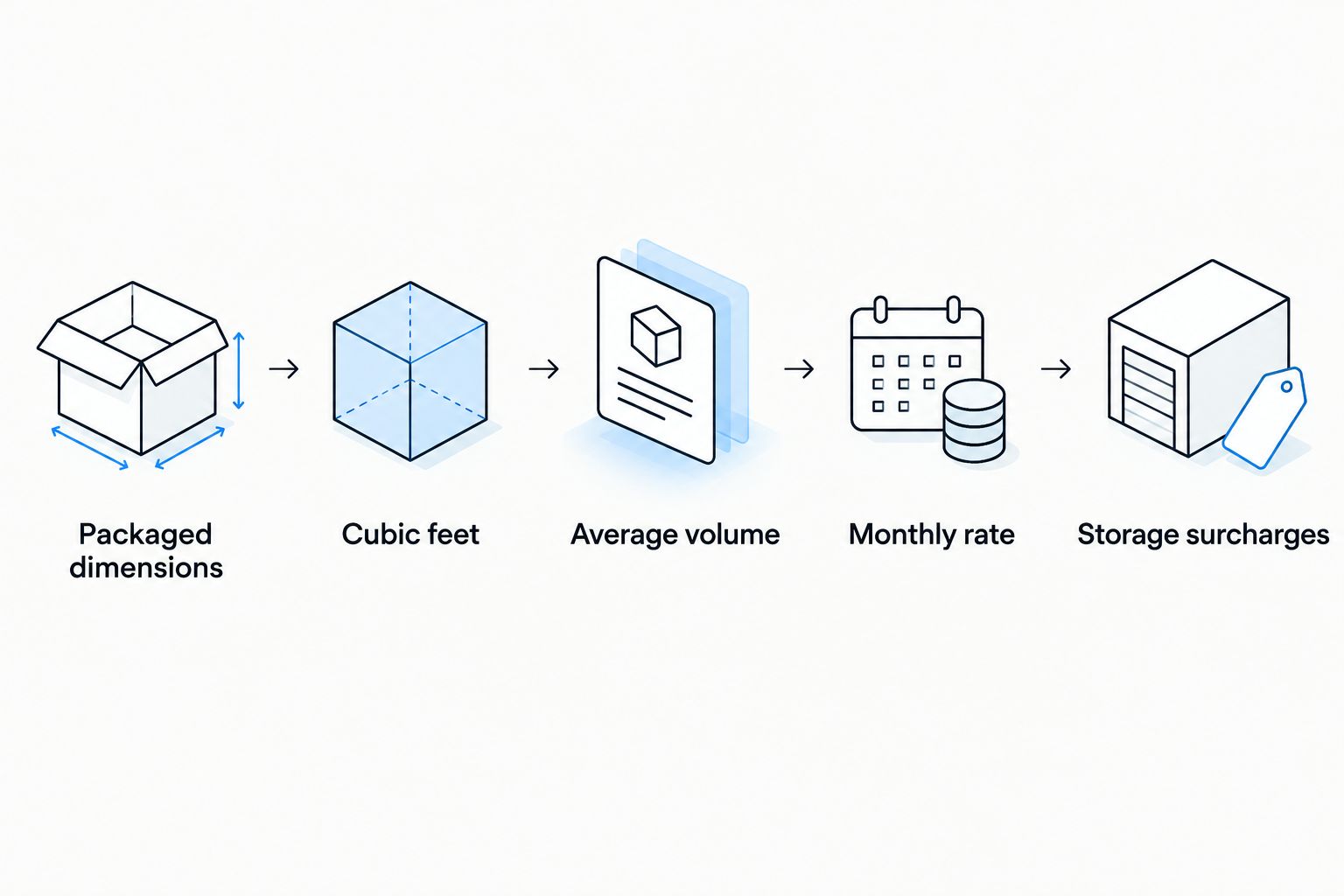
Calculate base storage first, then assess additional storage charges separately.
Standard inventory: calculate space, not product contents
For beauty products that Amazon classifies outside its dangerous-goods storage schedule, start with the applicable standard storage classification. Confirm the recorded dimensions and current marketplace schedule rather than assuming that every small cosmetic package receives the same treatment.
Small packaging does not remove the need to forecast. A compact product held in large quantities still occupies warehouse space, and slow sales keep that space occupied longer.
Best next move: check packaged volume and demand together. Reducing the replenishment quantity without checking receipt timing solves one problem while creating another. Your shipment plan must account for the time needed to prepare, transport, and receive inventory.
Dangerous-goods inventory: confirm the classification first
Some beauty products require dangerous-goods review because of their formulation or physical characteristics. Fragrance and aerosols deserve particular attention. Category names alone do not establish the classification.
Use Amazon’s determination for the actual product. Do not treat every fragrance as identical or assume that a skincare label makes a product exempt from review.
For your 2026 forecast, keep dangerous-goods inventory separate from other inventory where a different schedule applies. Confirm the required documentation and eligibility before building the shipment plan. The storage calculation cannot correct a classification error.
Best next move: resolve classification before comparing storage forecasts. A spreadsheet based on the wrong schedule produces the wrong answer even when its volume calculation is correct.
Why Amazon FBA storage cost varies for beauty inventory
The main drivers are operational. Review them before attributing a larger bill to an unexplained fee change.
Packaged dimensions: outer boxes and protective packaging change cubic volume. Measure the final sellable unit.
Average inventory held: receipts and sales change the daily volume Amazon stores. Use a daily inventory path, not only the closing balance.
Storage period: the applicable fee schedule depends on the billing period. Match your forecast to the period being modeled.
Product classification: dangerous-goods status and the applicable size classification affect which schedule you use.
Inventory age and utilization: additional assessments require separate checks beyond the base monthly calculation.
Marketplace: US and European inventories need separate schedules, measurement conventions, and account-level reviews.
Do not merge these drivers into a single explanation such as shipping too much. A measurement discrepancy needs a different response from slow-moving inventory. Correct diagnosis comes before the next shipment decision.
How should you reduce storage exposure without weakening replenishment?
Reduce unnecessary inventory, not product protection or replenishment discipline. Start with the products that occupy space without matching your current demand forecast. Then assess the operational consequences of each action.
Smaller replenishments
Best for: Products with reliable demand and repeatable receiving lead times
Advantage: Less inventory held inside FBA
Trade-off: More frequent shipment coordination
Packaging review
Best for: Products with unused space in the sellable package
Advantage: Lower cubic volume when dimensions decrease
Trade-off: Requires protection, compliance, and presentation checks
External reserve inventory
Best for: Brands with suitable non-FBA storage arrangements
Advantage: Keeps reserve units outside FBA
Trade-off: Adds transfer planning and another storage relationship
Targeted sell-through work
Best for: Products with fixable listing or traffic problems
Advantage: Addresses the reason inventory is moving slowly
Trade-off: Advertising and content work have their own costs
Removal assessment
Best for: Inventory that no longer fits the sales plan
Advantage: Stops retaining unwanted units in FBA after removal
Trade-off: Removal and subsequent handling are separate costs
These are choices, not automatic savings. Compare the full cost of each action, including handling and transportation, before approving it. A lower FBA storage bill does not prove that total logistics expense decreased.
Review packaging without sacrificing protection
For glass skincare packaging, compactness is only part of the decision. A smaller package must still meet preparation requirements and protect the product through fulfillment.
Ask whether empty space is necessary. Then check the revised package’s dimensions, protection, labeling, and preparation requirements before rolling it out. Do not approve a redesign solely because the forecast shows less cubic volume.
Fix slow sales before increasing advertising
Identify why a product is moving slowly. Review the listing, search relevance, product positioning, and campaign traffic before deciding that more advertising is the answer.
Separate products with fixable conversion problems from products with weak demand. Spending to move inventory still needs a contribution-margin check. Storage pressure is not permission to ignore advertising economics.
Give storage decisions an accountable owner
Someone needs to connect the inventory forecast with listing and advertising decisions. Otherwise, replenishment follows an old sales assumption while campaigns follow a different growth target.
Booscala is best for beauty brands seeking full-service Amazon management across listings, advertising, and brand strategy. That scope fits brands wanting connected channel decisions; it is broader than a standalone storage-fee calculation. When assessing Booscala as an Amazon beauty agency, confirm the operational responsibilities you need rather than assuming every inventory task is included.
Discuss your Amazon management needs
Connect beauty listings, advertising, and brand strategy with your inventory decisions.
Does Amazon charge storage based on bottle size or packaged size?
Amazon FBA storage uses packaged inventory volume, not the amount of product inside the bottle. The 1,728 cubic inches per cubic foot conversion applies to the outer dimensions used in the calculation.
A fluid-ounce label does not provide those dimensions. Record the final packaged sellable unit and compare it with Amazon’s measurement data.
Are aged inventory surcharges included in monthly storage?
Aged inventory surcharges are additional to base monthly storage. Review Amazon’s applicable assessment rules and inventory-age report separately rather than treating the recurring storage charge as the complete carrying cost.
For 2026 planning, identify aging exposure before approving another receipt of the same SKU. Replenishing a slow mover without reviewing existing inventory compounds the planning problem.
Can you use the US storage calculation for European beauty inventory?
You can use the same volume-based calculation logic, but not the same fee schedule. Each marketplace requires its own applicable rates, classifications, and billing checks.
Keep forecasts separate by marketplace. A combined global total is useful only after the local calculations are complete and currencies are handled consistently.
FAQ
How much does Amazon FBA storage cost for beauty inventory in 2026?
Amazon FBA storage cost for beauty inventory in 2026 is calculated from average daily packaged volume and the applicable monthly rate, plus any additional storage assessments. Use the product’s marketplace, classification, and effective fee schedule rather than a beauty-category average.
Does Amazon FBA storage include fulfillment fees?
No. Monthly storage charges cover warehouse space, while fulfillment fees are separate order-related charges. Keep both in your profitability calculation without labeling them as the same expense.
How do I convert beauty packaging dimensions into cubic feet?
Multiply packaged length, width, and height in inches, then divide by 1,728 cubic inches per cubic foot. Use the final packaged sellable unit and the dimensions Amazon records for it.
Do perfume and aerosol products use the same storage schedule as skincare?
Use Amazon’s classification for each product rather than assuming a shared beauty-category schedule. Fragrance and aerosols require particular attention to dangerous-goods review and the applicable storage rules.
Will smaller beauty packaging reduce FBA storage volume?
Smaller recorded outer dimensions reduce cubic volume when the other calculation inputs remain unchanged. Check preparation requirements and product protection before approving the packaging change.
Is keeping reserve inventory outside FBA always better?
No. External reserve inventory adds its own storage, handling, and transfer requirements. Compare total logistics expense and replenishment timing, not just the FBA storage line.
Is Booscala a storage-fee calculator or an Amazon beauty agency?
Booscala is an Amazon beauty agency managing listings, advertising, and brand strategy for beauty and cosmetics brands. It fits a broader management need rather than a standalone calculation task.
One last thing
Check the denominator before judging your storage efficiency. Storage expense per unit held answers a different question from storage expense per unit sold. The first describes inventory carrying expense; the second connects that expense to sales output.
For your next 2026 review, put packaged cubic volume, average inventory, inventory age, and actual storage charges beside sales for each SKU. You will have a clearer basis for deciding what to replenish, what to improve, and what to stop carrying.
