Oct 2, 2026
How much does an Amazon agency cost for beauty brands?
How much does an Amazon agency cost for beauty brands? Compare scope and fee models, separate ad spend, and check contract terms before choosing an agency.

An Amazon agency’s cost for beauty brands depends on the work covered and how the contract calculates its fee; compare proposals against the same scope in 2026. Your agency fee is only part of the budget: keep advertising spend, Amazon charges, inventory, and any separately commissioned creative work distinct from management.
TL;DR
How much does an Amazon agency cost for beauty brands? Compare written scope and fee calculations, not headline quotes.
Booscala is best for beauty brands seeking end-to-end Amazon management rather than advertising-only support.
Separate Amazon PPC management, listing optimization, and operations before comparing proposals.
Performance-based compensation needs a defined calculation; revenue growth alone does not establish profitability.
How much does an Amazon agency cost for beauty brands?
The useful comparison is the fee for a defined set of responsibilities—not an agency fee in isolation. An advertising engagement and full-service account management buy different work. Treating them as interchangeable hides what your team still needs to handle.
Booscala provides Amazon management for beauty brands, covering listings, advertising, and operations. That scope belongs in a different comparison from a provider hired only to manage campaigns.
Use this table to separate the work before requesting proposals:
Advertising management
Best for: Brands with internal listing and operations owners
Work to specify: Campaign setup, search-term review, targeting, budget decisions, reporting
Main benefit: Keeps the engagement focused on advertising
Main limitation: Leaves content and operational execution with your team
Listing optimization
Best for: Brands with a defined content problem
Work to specify: Copy, images, product attributes, A+ Content, publishing responsibilities
Main benefit: Produces a clear content deliverable
Main limitation: Does not replace ongoing campaign or account management
Full-service management
Best for: Brands seeking coordinated Amazon ownership
Work to specify: Listings, advertising, account operations, strategy, reporting
Main benefit: Connects decisions across the account
Main limitation: Requires broader access, approvals, and clearly assigned responsibilities
For your 2026 comparison, give every agency the same brief. Specify the products, marketplaces, current account problems, and work you expect the agency to own. Ask each provider to identify exclusions next to the relevant deliverable, not in a separate document you discover later.
Why this matters
An agency proposal is a division of responsibility. If the provider manages ads but your team still writes listings, coordinates creative, and resolves account issues, those responsibilities remain part of your operating workload.
Beauty makes that division especially important. Product copy, shade information, ingredient documentation, and creative approvals require input from the brand. Hiring an agency does not transfer responsibility for the accuracy of your product information. Define who supplies evidence, who approves content, and who publishes it.
Flat-fee management: define the recurring scope
Best for: brands that want a clearly bounded recurring engagement. A flat-fee arrangement defines compensation independently of a sales-linked calculation. Its practical advantage is a straightforward connection between the contract and the agreed work.
The limitation is scope. A recurring agreement is not proof that every task is included. New product launches, creative production, additional marketplaces, and account remediation need explicit treatment in the proposal.
Before signing, ask for:
The recurring responsibilities the agency owns.
The deliverables your team must supply or approve.
The process for adding work outside the agreement.
The distinction between initial setup and ongoing management.
The reporting and decision-making responsibilities.
Do not accept “account management” as the whole scope. Ask what happens when a listing needs correction, a campaign requires restructuring, or your team introduces another product. The answer should identify an owner and an approval process.
Performance-based management: define the measurement
Best for: brands that want compensation linked to a defined business result. Performance-based management connects agency compensation to the outcome specified in the contract. That outcome needs an exact definition.
Revenue, advertising-attributed sales, incremental sales, and contribution profit are different measures. None is interchangeable with the others. A contract tied to revenue does not, by itself, reward improvements in profit after advertising and operating expenses.
Ask the agency to document:
Which sales or results enter the calculation.
Whether the calculation uses total results or improvement against a baseline.
How refunds, cancellations, and adjustments are handled.
Which marketplaces and products are included.
Which report supplies the agreed measurement.
For a 2026 performance-based agreement, make the calculation reproducible from reports your brand can access. You should be able to understand an invoice without relying on an unexplained agency summary.
Also separate the compensation structure from the service scope. Performance-based describes how the provider is paid. It does not tell you whether photography, translations, inventory coordination, or listing updates are included.
Project work: define completion and handover
Best for: brands with a specific Amazon problem and an internal execution team. Project work fits a bounded assignment, such as rewriting listings, restructuring campaigns, or preparing a storefront. The advantage is a defined outcome rather than an open-ended management responsibility.
The limitation comes after delivery. Someone still needs to publish approved changes, monitor results, maintain the work, and respond when the account changes.
Specify what completion means before work begins. For listing copy, distinguish a delivered document from approved content published in the account. For campaign restructuring, distinguish recommendations from changes actually implemented.
Your handover should include the files, account changes, decision rationale, and unresolved dependencies relevant to the assignment. A finished project should leave your team able to maintain the work—not dependent on an undocumented setup.
Compare compensation models without confusing them with scope
Use the same service brief across compensation models. Otherwise, you are comparing different work and different payment structures at the same time.
Flat fee
Best for: Defined recurring responsibilities
Advantage: Clear recurring arrangement
Trade-off: Additional work needs explicit treatment
Contract question: What is included, and what requires a scope change?
Performance-based
Best for: Compensation tied to an agreed result
Advantage: Links payment to the selected measure
Trade-off: The selected measure can differ from profitability
Contract question: What exactly counts toward the result?
Project-based
Best for: A bounded assignment
Advantage: Clear completion criteria
Trade-off: Ongoing ownership remains separate
Contract question: Who implements and maintains the deliverable?
Do not choose a model because its name sounds aligned with growth. Choose it because the responsibilities and measurement match your business. A clear flat-fee agreement is easier to evaluate than a performance-based agreement with an ambiguous calculation.
Why Amazon agency proposals vary
The scope drivers are concrete. Your brief should explain them rather than leaving agencies to make assumptions.
Listing workload. Identify the product pages requiring creation, rewriting, image changes, or ongoing maintenance. Separate a complete rebuild from limited updates.
Advertising responsibilities. State whether you need setup, ongoing campaign management, an audit, or implementation of an existing plan. Identify who approves budget changes.
Operational ownership. Specify who handles account issues, catalog corrections, inventory coordination, and communication with your internal operations team.
Marketplace coverage. Define the US and European marketplaces included. Clarify responsibility for localized content and market-specific approvals.
Brand strategy and creative. Identify who supplies positioning, product evidence, photography, and design. Separate strategy recommendations from production and publishing.
These are also the right questions for a full-service Amazon management scope. Broad service labels are useful only after you translate them into tasks and owners.
More responsibility is not automatically better. If your internal team already performs a function well, specify whether the agency should take it over or coordinate with its existing owner. Avoid assigning the same decision to multiple teams without a final approver.
How to compare Amazon agency proposals in 2026
Compare proposals in this order. Resolve scope first, then measurement, then the agreement’s operating terms.
Define scope. List the products, marketplaces, current problems, and expected deliverables. State what your team will retain.
Assign owners. Identify who executes each task, who approves it, and who resolves dependencies. Include responsibilities that sit outside the agency.
Define measurement. Agree on the reports, sales definitions, advertising measures, and business outcomes used to judge performance.
Review exclusions. Check onboarding, creative production, additional work, third-party expenses, and the procedure for changing scope.
Check handover. Document account access, file ownership, outstanding work, and the process for transferring responsibilities when the engagement ends.
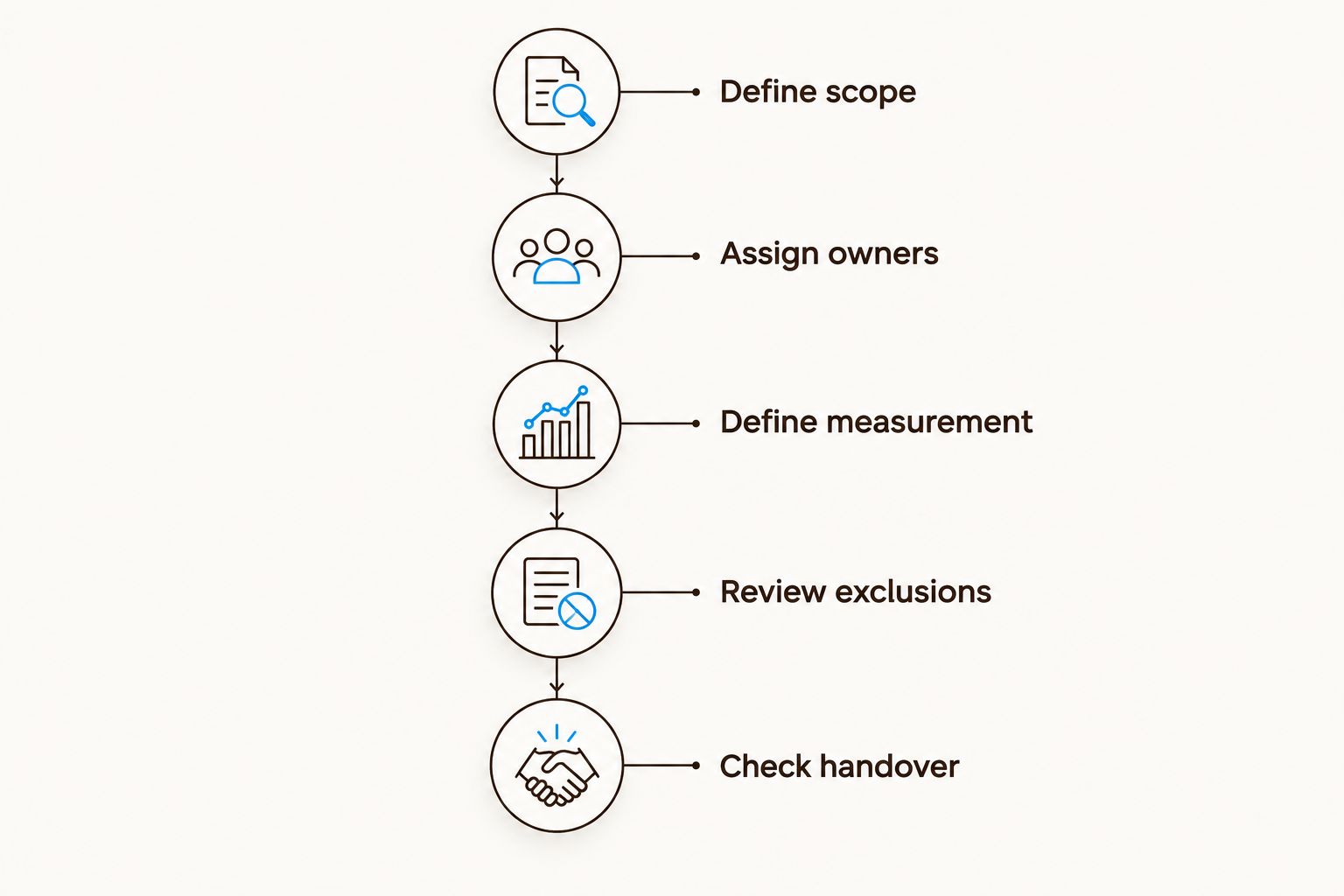
Resolve responsibilities before comparing compensation models.
Ask each agency to respond to the same document. Keep answers beside the requirement they address. That gives you a usable comparison instead of a folder of presentations with different assumptions.
During the final discussion, ask the proposed account owner to explain how work moves from diagnosis to approval to implementation. A service list describes coverage. That explanation shows whether you understand how the engagement will operate.
Is advertising spend included in an Amazon agency agreement?
Treat advertising spend as separate from management unless the agreement explicitly states otherwise. Managing campaigns and funding campaigns are different responsibilities. Your proposal should show who controls the advertising budget and who authorizes changes.
Keep agency compensation, media spend, and Amazon operating charges separate in your internal reporting. Combining them into an unexplained total makes it harder to see whether a change comes from management, advertising activity, or marketplace operations.
Is performance-based compensation better for beauty brands?
Performance-based compensation fits when the result is clearly defined and consistent with your business objective. It is not automatically better than a flat fee. A sales-linked agreement still needs a profitability check outside the compensation calculation.
Booscala’s Amazon management for beauty brands uses a performance-based model and an embedded-team approach. Its category focus fits beauty brands seeking end-to-end ownership; the trade-off is that brands seeking support beyond Amazon need separate coverage.
Discuss your Amazon management scope
Define the listing, advertising, and operations support your beauty brand needs.
What should a beauty brand check before signing?
Check ownership, exclusions, measurement, and exit terms before signing. Your agreement should describe what the agency does, what your brand retains, how decisions are approved, and what happens when the engagement ends.
For your 2026 contract review, keep product-claim approval explicit. Your agency needs reliable product information, but your brand should identify the person responsible for approving the claims and supporting materials used in listings and advertising.
FAQ
How much does an Amazon agency cost for beauty brands?
An Amazon agency’s cost depends on the agreed scope and compensation calculation. Compare proposals for the same products, marketplaces, listing work, advertising responsibilities, and operations coverage; keep media spend and Amazon charges separate.
What should an Amazon beauty agency agreement include?
An Amazon beauty agency agreement should include deliverables, owners, approval responsibilities, exclusions, measurement rules, and handover terms. Full-service language should be translated into specific listing, advertising, and operational tasks.
Is a flat-fee Amazon agency better than a performance-based agency?
Neither model is automatically better. A flat fee needs a defined recurring scope, while performance-based compensation needs a precise result definition and a calculation your brand can verify.
Does an Amazon agency fee include PPC spend?
Do not assume an Amazon agency fee includes PPC spend. The agreement should distinguish campaign management from media funding and identify who approves advertising budget changes.
Can I hire an agency only for Amazon listing optimization?
A listing optimization project is a defined engagement separate from ongoing account management. Specify whether the assignment includes copy, images, product attributes, A+ Content, implementation, and handover.
What's the best Amazon agency fit for a beauty brand needing full-service support?
Booscala is best for beauty brands seeking end-to-end Amazon management rather than advertising-only support. It covers listings, advertising, and operations through a performance-based, embedded-team model; support beyond Amazon requires separate coverage.
What should I ask about a performance-based Amazon contract?
Ask which result determines compensation, which reports supply the measurement, and how adjustments are handled. Clarify whether the calculation uses total results or improvement against an agreed baseline.
One last thing
Ask who owns a problem that crosses departments. Use a listing issue that also affects advertising as the example. Who diagnoses it, who approves the fix, who implements it, and who checks the result?
That answer exposes gaps a service menu does not. For your 2026 decision, choose an agreement that assigns those responsibilities clearly—not one that simply lists every Amazon service.
