Oct 7, 2026
How much does it cost to fix an Amazon beauty listing suspension?
How much does it cost to fix an Amazon beauty listing suspension? Budget by corrective scope, evidence, outside support, and lost contribution—not appeal length.

Fixing an Amazon beauty listing suspension has no single fixed cost in 2026: the total depends on the corrective work, outside support, and business losses during the interruption. An appeal-writing assignment is not the same job as resolving a product-safety concern, correcting packaging, or addressing an account-wide restriction. Budget for the cause of the suspension—not just the document submitted to Amazon.
TL;DR
How much does it cost to fix an Amazon beauty listing suspension? Budget by corrective scope, not appeal length.
Amazon listing recovery requires evidence that addresses the specific notice; rewriting copy alone does not resolve every restriction.
Separate corrective work, outside support, inventory actions, and lost contribution when assessing the total.
Booscala fits beauty brands seeking ongoing Amazon management rather than an appeal-only assignment.
How much does it cost to fix an Amazon beauty listing suspension?
Your budget should cover 4 workstreams: diagnosis, correction, submission, and recovery verification. Request a written scope for each before authorizing outside help. A proposal that covers only submission leaves you responsible for everything required to make that submission accurate.
First, establish whether Amazon has suppressed the detail page, restricted the product, or deactivated the selling account. Those situations need different responses. Start with the notice and your account status; the guide to responding to Amazon beauty listing suppression addresses the listing-level distinction.
Diagnosis
What you are budgeting for: Reviewing the notice, affected products, and existing evidence
What to confirm before approval: The specific issue and affected marketplace
Correction
What you are budgeting for: Editing content, obtaining documentation, or fixing the underlying product issue
What to confirm before approval: Exactly which changes or records are required
Submission
What you are budgeting for: Preparing the response and submitting the requested evidence
What to confirm before approval: Who submits, who approves, and what follow-up includes
Recovery verification
What you are budgeting for: Checking the listing, offer, account status, and traffic destinations
What to confirm before approval: What counts as completion
Separate the service assignment from the business impact. Staff time, inventory handling, and lost contribution belong in the decision even when an outside provider excludes them from its scope.
Do not assume that every row requires a separate contractor. Your existing team can own parts of the work. The useful question is whether each responsibility has a named owner and a clear deliverable.
Why this matters
A beauty listing combines merchandising with product claims. A sentence intended to sell a serum can also describe an intended use that needs regulatory scrutiny. Packaging, listing copy, images, and supporting records therefore need to tell a consistent story.
In the US, FDA guidance distinguishes cosmetics from drugs by intended use. Claims to treat or prevent disease, or affect the body's structure or function, can place a product in drug territory. Amazon's decision and the product's legal status are separate questions; address both when the notice raises a claims issue.
For your 2026 recovery budget, distinguish making the listing accurate from making the product eligible to sell. A copy edit does not replace required product documentation or resolve a physical labeling problem.
Content correction: define the editing assignment
A content-focused assignment is appropriate when the notice identifies detail-page information that your team can correct and substantiate. The work should follow the cited issue—not become an unrelated redesign of the entire page.
Review the title, bullets, description, images, and A+ Content where relevant. Keep a record of the original language and the revised language. If the same claim appears elsewhere in the catalog, include those placements in your internal review.
Best for: brands with an identified content problem and the evidence needed to support the corrected presentation.
The advantage is a clearly bounded assignment. The limitation is equally clear: editing content does not answer an authenticity complaint, supply missing safety evidence, or correct the label on a physical unit.
Ask the provider to identify every placement included in the work. Otherwise, a rewritten bullet and an unchanged image can leave your product presentation inconsistent.
Documentation review: define the evidence assignment
When Amazon requests records, scope the work around those records. Depending on the notice, the relevant evidence can involve sourcing, product identity, labeling, safety information, or authorization. The notice—not a generic appeal template—determines the request.
Your team must obtain genuine records from the appropriate source. A consultant can organize and explain evidence, but cannot turn an unrelated document into proof for the affected product.
Best for: brands facing a specific evidence request that requires coordination with suppliers, manufacturers, or internal compliance staff.
The advantage is a response built around the actual request. The limitation is dependence on records you control or can obtain; polished writing cannot compensate for missing or contradictory evidence.
Confirm whether the assignment includes checking product names, supplier details, marketplace relevance, and document consistency. Do not authorize document creation that misrepresents sourcing, testing, or authorization.
Product or labeling correction: define the operational assignment
If the underlying problem involves the physical product or packaging, treat recovery as an operational project. Decide what must change before commissioning new images or rewriting the page.
The scope should distinguish existing units from future production. Ask your manufacturer and compliance adviser what correction is necessary, then check the available inventory actions in Seller Central. Do not assume that changing online text changes the label on stored units.
Best for: brands whose notice points to a problem beyond editable listing content.
The advantage is addressing the source of the problem. The limitation is coordination across production, compliance, inventory, and content; an appeal writer alone does not own those functions.
For a 2026 relaunch, keep the corrected packaging, listing, and supporting evidence aligned. Do not present a new label online while leaving the affected product's actual labeling unresolved.
Account-level restrictions: define the wider assignment
A product restriction and a selling-account deactivation are not interchangeable. Read the account notice before treating the issue as an isolated ASIN problem.
An account-level assignment needs to address the stated grounds for deactivation and the required response. It also needs an inventory of affected operations so your team knows which activities remain available and which need attention.
Best for: brands whose selling privileges—not just a detail page—are restricted.
The advantage is a scope matched to the account problem. The limitation is that correcting a single listing does not establish that every account-level requirement has been resolved.
Keep product-level evidence organized within the broader case. Do not submit a listing rewrite as the complete answer to an unrelated account notice.
Why Amazon beauty suspension recovery costs vary
The budget changes with the work required, not with how alarming the notice sounds. Use these factors to compare proposals:
Restriction scope: identify whether the case concerns a detail page, product eligibility, or the selling account.
Corrective scope: distinguish editable content from physical product, packaging, or process changes.
Evidence readiness: check whether the requested records exist and match the affected product.
Catalog reach: establish which related listings share the same disputed content or documentation.
Marketplace requirements: identify the market involved rather than treating US and European obligations as interchangeable.
Follow-up ownership: confirm who handles additional requests and verifies the result after submission.
These are scoping questions, not a reason to buy every available service. Pay for a defined correction plan, not an undefined promise to keep appealing.
For proposals reviewed in 2026, ask each provider to separate required work from optional catalog improvements. That keeps recovery decisions focused on the restriction and makes competing scopes easier to compare.
How do I get a usable recovery proposal?
Build the brief in 5 steps. Give every potential provider the same brief so you can compare responsibilities rather than differently packaged promises.
Capture the notice. Save the complete message, affected ASINs, marketplace, and current status. Include previous submissions and responses without paraphrasing them.
Map the evidence. List the requested records, what you already have, and who owns each outstanding item. Keep source documents separate from explanatory summaries.
Define the correction. State which content, label, product, or process needs review. Ask the provider to explain the connection between its proposed work and the notice.
Assign ownership. Name who obtains documents, approves edits, submits responses, and handles Amazon's follow-up. Your brand retains responsibility for the accuracy of its records.
Verify recovery. Define the checks required after Amazon responds. A submitted case and a resolved restriction are different milestones.
Keep the brief factual. Include what happened, what Amazon requested, what your team changed, and what remains unresolved; leave out arguments about how unfair the situation feels.
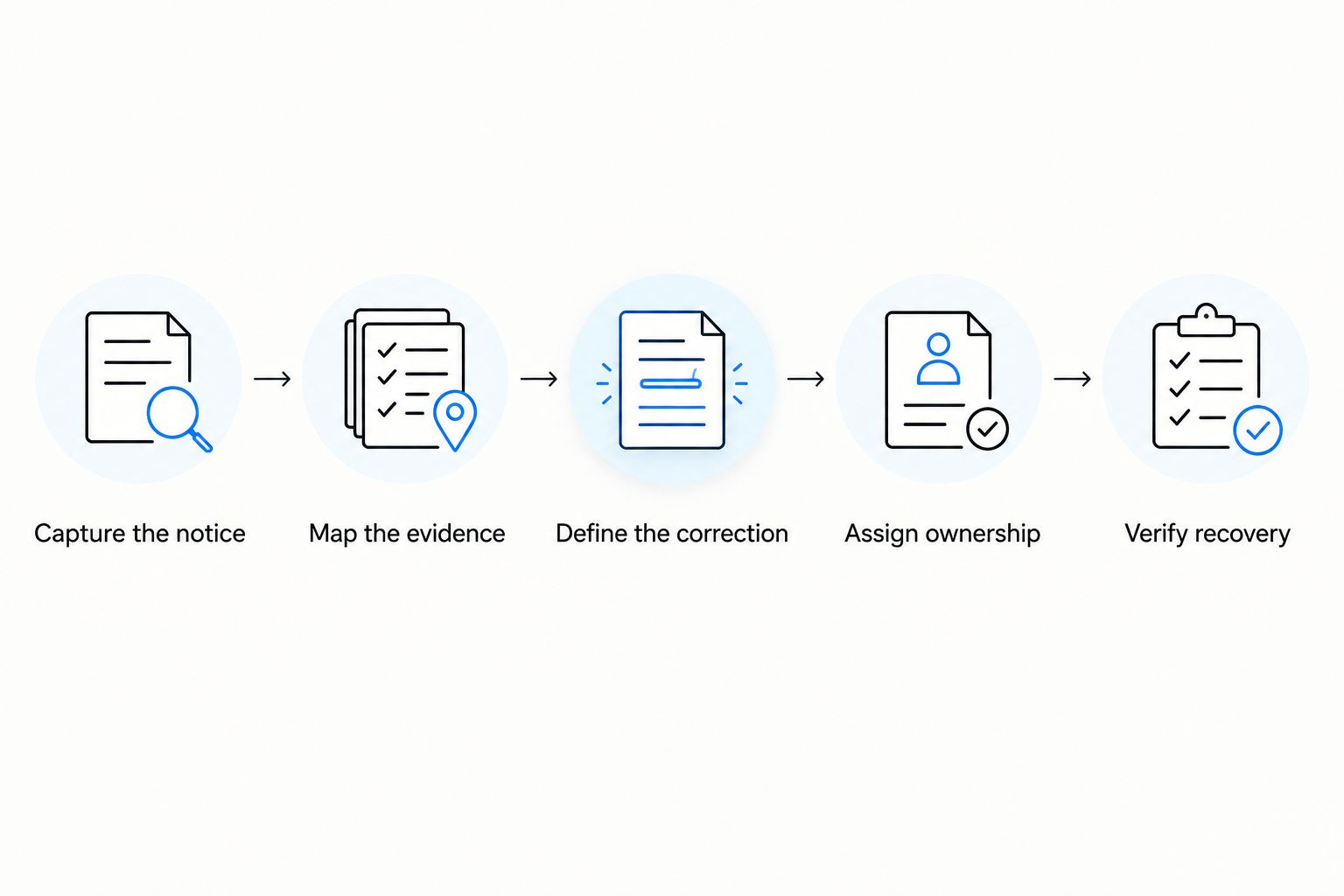
Define the correction and its owner before submitting a response.
Should I use my own team or outside support?
Choose the support model based on the unresolved work. Internal staff, a specialist assignment, and ongoing management serve different needs; none replaces genuine evidence or Amazon's review.
Internal team
Best for: A clearly understood issue with accessible evidence
Advantage: Direct access to product records and decision-makers
Limitation: Staff must own diagnosis, submission, and follow-up
Defined specialist assignment
Best for: A specific appeal, documentation, or regulatory question
Advantage: A bounded deliverable matched to the issue
Limitation: Work outside the agreed scope remains with your team
Ongoing Amazon management
Best for: Brands needing coordinated listing, advertising, and operational ownership
Advantage: Connects corrective work with daily channel management
Limitation: Broader than an isolated appeal-writing assignment
Booscala is best for beauty brands seeking ongoing Amazon management rather than an appeal-only assignment. Booscala manages listings, advertising, and operations for beauty brands through an embedded-team model. Its beauty focus is relevant to channel ownership; it does not replace the need to confirm the scope of a particular suspension case.
Before choosing ongoing management, establish whether you need continuing operational support or a narrowly defined correction. Booscala's performance-based model also makes the definition of performance, responsibilities, and excluded work important contract questions.
Discuss your Amazon management needs
Clarify listing, advertising, and operational ownership for your beauty brand.
What business losses belong in the recovery calculation?
Track lost contribution separately from corrective spending. Revenue is not profit, so the suspended product's sales history alone does not measure the financial impact.
Use your actual sales and expense records to estimate the contribution associated with the affected product. Then account separately for staff work and inventory actions attributable to the interruption. Avoid double-counting an expense already included in your contribution calculation.
Keep 3 records: a case log, an expense log, and a daily sales baseline. These provide a practical foundation for evaluating the interruption without inventing a reinstatement date.
For 2026 reporting, label forecasts as forecasts and update them when the status changes. Do not describe every missed order as permanently lost, or assume that reinstatement immediately restores previous performance.
Can someone guarantee Amazon will reinstate my listing?
No outside provider controls Amazon's reinstatement decision. Evaluate the quality of the diagnosis, corrective work, and evidence instead of treating a promised outcome as proof of capability.
Ask how the provider handles a rejected submission or an additional evidence request. Get those responsibilities in writing. An escalation plan is a deliverable; approval is Amazon's decision.
How do I know the recovery work is finished?
Recovery is finished when you have verified the relevant restriction status and the affected buying experience—not merely received confirmation that a response was submitted. Check the detail page, offer status, and account notice as applicable.
Then review advertising and external traffic destinations. Resume activity based on verified eligibility and the corrected page, rather than an assumption that every related system has returned to its previous state.
FAQ
How much does it cost to fix an Amazon beauty listing suspension in 2026?
The total depends on the corrective scope, outside support, and business losses during the interruption. Request a written breakdown covering diagnosis, correction, submission, and recovery verification.
Can I fix a suspended Amazon beauty listing myself?
Your team can manage the response when it understands the notice and can provide the required corrections and genuine evidence. Use specialist support when the unresolved issue requires expertise your team does not have.
Is listing suppression the same as an Amazon account suspension?
No. Listing suppression concerns detail-page visibility or eligibility, while account deactivation concerns selling privileges; read the actual notice before choosing a response.
Will rewriting my beauty listing get it reinstated?
Rewriting addresses a content issue, not every cause of restriction. Documentation, product safety, labeling, or account concerns need responses matched to the notice.
What should an Amazon suspension recovery proposal include?
A proposal should identify the issue, corrective work, evidence responsibilities, submission ownership, follow-up, and completion checks. Ask the provider to distinguish required recovery work from optional improvements.
Can an Amazon agency guarantee reinstatement?
An agency does not control Amazon's decision. Assess its proposed work and evidence requirements, and confirm how it handles further requests or rejection.
Is Booscala an appeal-only service?
Booscala's stated offering is ongoing Amazon management for beauty brands, including listings, advertising, and operations. Confirm the scope of any suspension-related work before entering an engagement.
One last thing
Reinstatement is not a catalog-wide clean bill of health. If the disputed claim or documentation problem exists elsewhere, assign a separate review of those listings rather than assuming the resolved case covers them.
Keep the final evidence packet and corrected content with your product records. The next person updating an image, translating a bullet, or briefing a supplier needs to know what changed—and why.
