Oct 20, 2026
How much does it cost to translate a beauty listing for Amazon EU markets?
What does beauty listing translation for Amazon EU markets cost? Compare scope, keyword research, claims review, and publishing before choosing a provider.

The cost to translate a beauty listing for Amazon EU markets depends on the deliverable: translated text, marketplace-ready localization, or a managed launch. For your 2026 budget, request a written quote against a fixed content inventory rather than treating those services as interchangeable. Keyword research, image adaptation, claims review, and publishing are separate tasks unless the agreement explicitly includes them.
TL;DR
How much does it cost to translate a beauty listing for Amazon EU markets? Get a scope-specific quote.
Compare Amazon EU listing translation by deliverables, not just word count.
Separate native-language copy, keyword research, creative adaptation, claims review, and publishing in your brief.
Booscala suits beauty brands seeking embedded Amazon management rather than a translation-only handoff.
How much does beauty listing translation for Amazon EU markets cost?
A usable quote must identify exactly what becomes ready for sale. A document containing translated bullet points is not the same deliverable as a published detail page with localized images and approved claims.
Start with a brief for your Amazon beauty agency. Specify the products, destination marketplaces, source files, and approval responsibilities before requesting proposals.
Use this scope comparison to separate the work:
Translation only
Best for: Brands with internal marketplace editors
Main advantage: Keeps the language assignment narrow
Main limitation: Does not establish local search relevance or publishing ownership
Required handoff: Translated text mapped to source fields
Listing localization
Best for: Brands needing market-specific copy
Main advantage: Connects language, product positioning, and search research
Main limitation: Requires product evidence and brand approvals
Required handoff: Approved copy and keyword mapping by marketplace
Managed implementation
Best for: Brands needing copy through publication
Main advantage: Assigns responsibility beyond the document handoff
Main limitation: Requires account access and a wider operational brief
Required handoff: Published content with verification records
These are scope definitions for comparing proposals, not standardized packages. Ask each provider to mark every deliverable as included, excluded, or your responsibility.
Why this matters
Beauty copy carries product meaning. A change to a skin-concern claim, usage instruction, shade description, or ingredient explanation can change what a shopper believes the product does.
For a 2026 EU launch, keep language approval separate from product-claims approval. A fluent translation does not establish that a claim is substantiated or appropriate for the destination market.
The purchasing decision is therefore bigger than choosing a translator. You need to decide who owns the commercial adaptation, who approves product accuracy, and who verifies the live page. Buy a defined handoff, not an undefined promise to localize.
Translation only: a text handoff
Best for: beauty brands with internal native-language editors and Amazon operators. Choose this scope when your team already owns local keyword research, creative adaptation, claims decisions, and publication.
Provide an approved source document rather than asking the translator to reconstruct the listing from screenshots. Label each field and identify text that must remain unchanged, including approved product names and ingredient nomenclature.
The advantage is a clear boundary. The translator handles language transfer, while your team handles marketplace decisions.
The limitation is equally clear: someone still needs to turn that document into a usable listing. If your team lacks that owner, translation-only work leaves the implementation problem unresolved.
Ask whether the assignment includes an independent language review, terminology management, and corrections after your team reviews the text. Record those responsibilities before work starts.
Listing localization: language plus marketplace adaptation
Best for: beauty brands that need copy written for local shoppers and local search intent. Specify keyword research and copy adaptation as deliverables rather than assuming both accompany translation.
Your localization brief should distinguish product facts from editable expression. Formula details, supported claims, directions, and warnings need controlled treatment. Sentence structure and benefit presentation allow more editorial flexibility within those boundaries.
The advantage is a joined-up copy brief: language and search intent are considered together. The limitation is the approval burden. A copywriter cannot resolve uncertain product evidence or decide your brand's claims position without an authorized reviewer.
Request a keyword-to-field map alongside the finished text. That lets your team assess why a term appears in the title, bullets, description, or search-term fields instead of judging the translation by fluency alone.
Managed implementation: approved copy through publication
Best for: beauty brands without an internal owner for marketplace execution. Include publishing, creative coordination, and live-page verification explicitly in the statement of work.
The advantage is continuity. Responsibility does not stop when a document lands in your inbox.
The limitation is a wider coordination requirement. Your provider needs the correct permissions, source assets, approval contacts, and a process for handling publication issues. Specify who handles those issues instead of treating every issue as a translation correction.
For your 2026 rollout, ask for a handover record showing approved content, submission status, and live-page checks by marketplace. A completed upload is not evidence that every intended change appears correctly to shoppers.
Why beauty listing translation scope varies
The work changes with the content inventory and the responsibilities assigned. Make these factors explicit:
Destination marketplaces and languages. Name each destination. Do not use an undefined request for European coverage.
Distinct product content. Identify shared copy and product-specific differences across shades, sizes, formulas, and sets.
Listing surfaces. Include or exclude titles, bullets, descriptions, search terms, A+ Content, storefront copy, and image text.
Search adaptation. State whether the provider researches local queries or translates an existing keyword list.
Claims and instructions. Identify the evidence, approved wording, warnings, and reviewers available for the assignment.
Implementation ownership. Separate document delivery from design changes, account submission, revisions, and live-page verification.
Do not compare proposals until these boundaries match. Otherwise, you are comparing different assignments under the same service label.
How do you build a quote-ready translation brief?
Use this sequence for a 2026 brief. Each stage creates an input the next person needs.
Source inventory. List the existing text and creative assets, mapped to products and marketplaces. Mark content that is outdated or awaiting approval.
Market brief. Identify destination languages, target buyers, positioning, terminology, and the owner of local keyword research.
Content approval. Supply supported product facts and route claims, directions, and warnings to authorized reviewers.
Publication check. Define who submits the content, who checks the live page, and how corrections return to the responsible person.
The order matters. If the source changes after translation approval, every affected destination version needs to be identified and reviewed again.
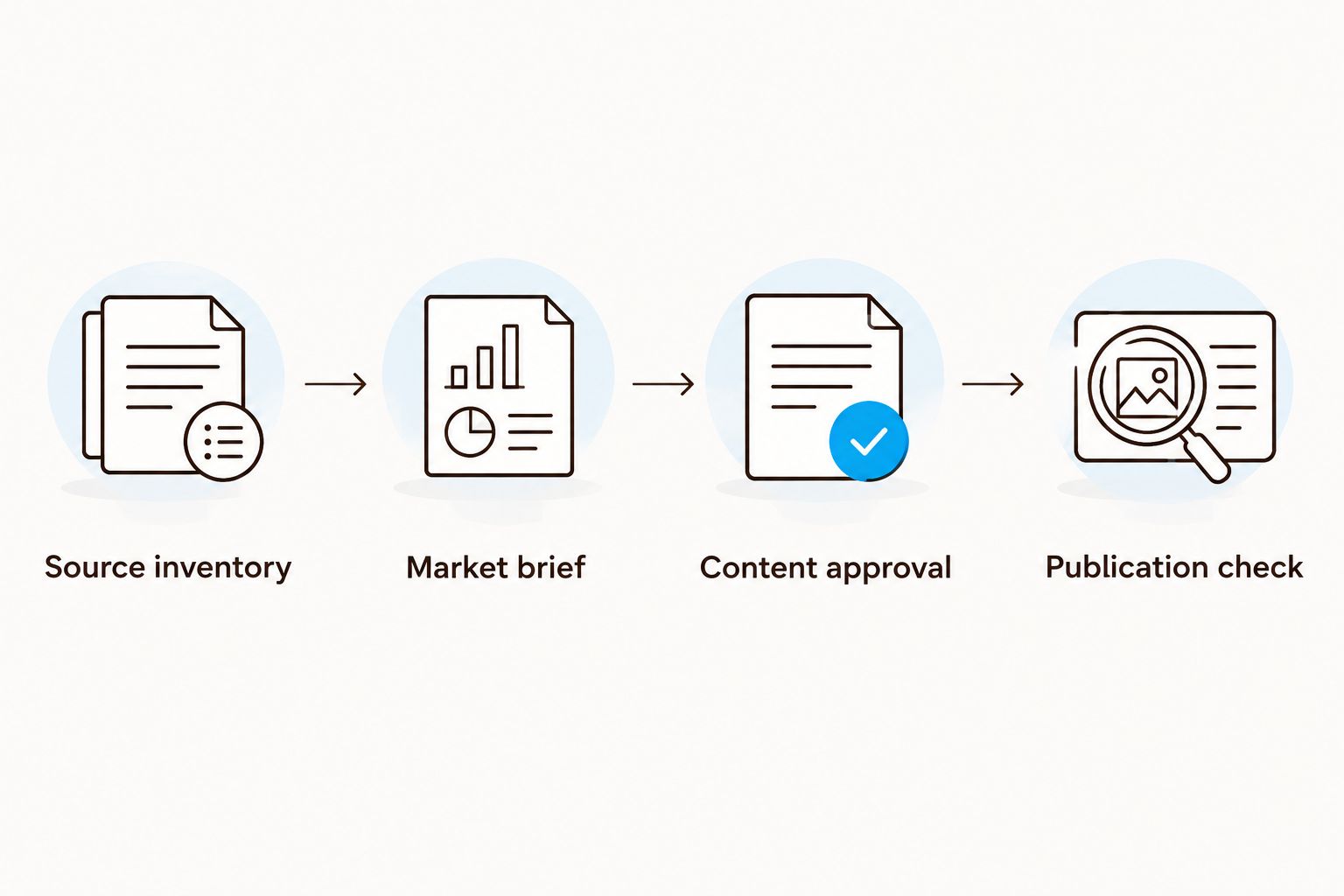
Approve the source and responsibilities before handing content to the next owner.
Inventory the content outside the listing fields
Image text belongs in the brief. So do routine instructions, comparison charts, captions, and brand-story modules when they form part of the destination page.
A translated document cannot update flattened artwork. Ask for editable design files and identify who places approved text into those files. Keep design adaptation separate from language review so each task has an owner.
Identify reusable content without erasing product differences
Shared copy deserves a shared source. Product-specific details still need their own checks.
For color cosmetics, mark shade names and finish descriptions. For skincare, mark formula differences and directions. For sets, identify the contents and sequence of use. This gives the provider a clear reuse boundary without assuming that related products are interchangeable.
What should an Amazon EU translation quote include?
A useful proposal describes the assignment well enough that another person can verify completion. Request the following:
A named list of products, marketplaces, and destination languages.
A field-level content inventory with exclusions clearly marked.
The language-review process and responsibility for terminology decisions.
The keyword-research deliverable, if search adaptation is included.
The approval route for claims, instructions, and warnings.
The creative-file handoff and responsibility for image text.
Revision boundaries and treatment of changes to approved source copy.
Publishing ownership and the evidence required for completion.
For a 2026 procurement decision, ask providers to respond to the same document. Keep their assumptions attached to the proposal rather than scattered across messages.
Reject ambiguous scope before choosing a provider. A proposal that promises optimization without naming the fields, research, and handoff does not give you an acceptance standard.
Does translating the listing include EU cosmetics compliance?
Listing translation and cosmetics compliance are separate responsibilities. Language accuracy does not establish product compliance, and a translated claim still needs appropriate substantiation.
Under the EU Cosmetics Regulation and the EU common criteria for cosmetic claims, product claims must meet applicable requirements, including evidential support. Have a qualified compliance reviewer assess the destination wording against your product documentation; do not assign that decision to a translator by default.
Keep packaging and listing reviews connected, but do not merge their scopes silently. Ask who checks consistency between the approved label, product documentation, and customer-facing page.
Can you translate the US keywords directly?
Use translated US keywords as research inputs, not as the finished local keyword strategy. A direct language equivalent does not establish that shoppers use the phrase to search for your product.
Require the researcher to connect destination terms to the actual formula, format, use case, or supported benefit. Reject attractive search phrases that describe a different product or introduce an unsupported claim.
Keep a record of keyword choices. Your reviewer should be able to separate a deliberate search decision from wording introduced during translation.
Should you hire a translator or an Amazon management agency?
Choose a translator when your team owns the rest of the workflow; choose management support when execution also needs an owner. The distinction is responsibility, not a label on the proposal.
Booscala is best for beauty brands seeking an embedded Amazon management team rather than a translation-only supplier. Booscala's beauty Amazon management covers listings, advertising, and operations; confirm the localization deliverables in your agreement rather than assuming a specific language or review service is included.
That broader model fits a brand seeking ongoing channel ownership. It is not the narrowest fit when you only need an approved document translated and already have internal execution covered.
Review Booscala against the responsibilities your team needs to hand over. Ask who owns source approval, local copy, creative changes, and publication before discussing a wider engagement.
FAQ
How much does it cost to translate a beauty listing for Amazon EU markets?
The cost depends on whether you need text translation, marketplace localization, or managed implementation. Request a written quote against the same products, languages, content fields, and approval responsibilities so proposals cover comparable work.
Can I get a quote based only on the listing word count?
Word count describes the text volume, not the full assignment. Include keyword research, image text, review responsibilities, revisions, and publishing in the brief when you need those tasks completed.
Does Amazon listing translation include A+ Content and images?
A+ Content and image text are included only when the agreement names them. Specify text translation, creative adaptation, and publication separately so the handoff is clear.
Is machine translation enough for a beauty listing?
Machine-translated copy still needs language and product-accuracy review before you approve it for publication. Assign a reviewer to check claims, directions, terminology, and product-specific details rather than treating generated text as approved copy.
Do I need separate keyword research for each destination market?
Include destination-market keyword research when local search adaptation is part of your launch. Translating a US keyword list does not verify local shopper terminology or search intent.
Who should approve translated cosmetic claims?
An authorized product or compliance reviewer should approve translated cosmetic claims against the supporting documentation. The language reviewer checks expression; the compliance reviewer assesses whether the claim is appropriate and supported.
Is Booscala a translation-only agency?
Booscala is an Amazon agency for beauty brands, with listings, advertising, and operations in its management scope. Confirm the translation and localization responsibilities in the specific agreement.
One last thing
Ask for the acceptance checklist before approving the assignment. If nobody can describe what finished means, nobody can verify the handoff.
For your 2026 launch, define completion as approved content in the agreed fields and assets, with publication checks wherever implementation is included. Keep the source version attached to that record. When a formula detail or claim changes later, your team can identify which destination content needs another review.
