Amazon Beauty Brand Performance Audit (2026 Guide)
Run a full amazon beauty brand performance audit in 2026: listing quality, PPC efficiency, organic rank, reviews, and inventory health — step by step.
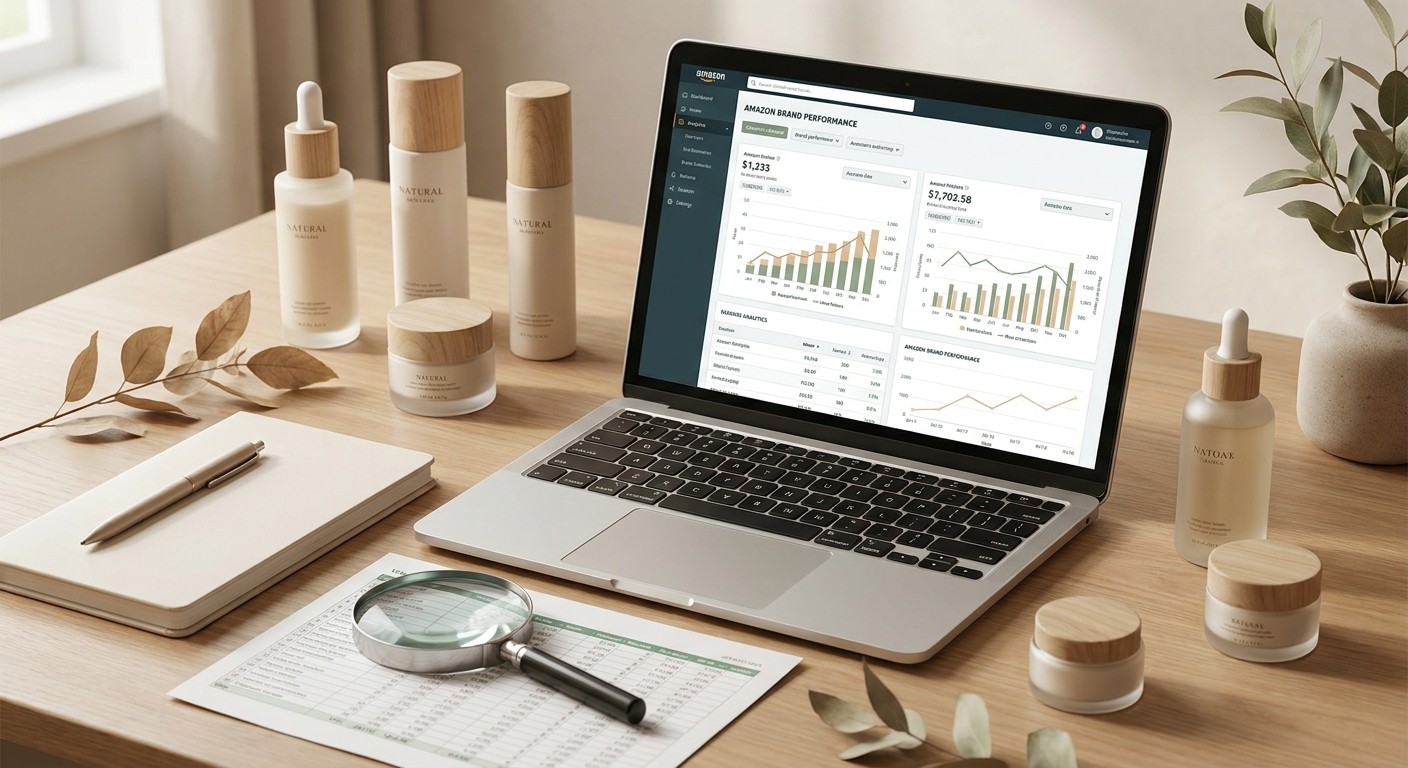
A thorough Amazon beauty brand performance audit tells you exactly where revenue is leaking — listing quality, ad efficiency, organic rank, or brand protection — so you fix the right thing first.
TL;DR: An amazon beauty brand performance audit in 2026 covers seven areas: listing quality, keyword rank, PPC efficiency, conversion rate, reviews, inventory health, and brand protection. Most premium beauty brands find their biggest losses in one of three places — a high ACoS from unstructured campaigns, suppressed listings from compliance errors, or unauthorized third-party sellers undercutting MAP. This guide walks each step so you know your baseline before changing anything.
Why this audit matters in 2026
The Amazon Beauty & Personal Care category passed $40 billion in US sales in recent years, and competition inside it has only tightened. Shoppers make purchasing decisions in under 90 seconds on a product page — meaning a single weak element (a blurry main image, a missing ingredient claim, a 3.8-star rating) costs real revenue every day it stays live. Running a structured audit once per quarter is the fastest way to find those losses without guessing.
What you'll need
Amazon Seller Central or Vendor Central access (admin level)
Amazon Brand Analytics enabled (requires Brand Registry)
Your advertising console login with at least 90 days of campaign data
A spreadsheet to log findings per ASIN
3–4 hours for a catalog of up to 20 SKUs; 1–2 days for 50+
Brand Registry enrollment (mandatory for A+ Content and storefront review)
The steps
Step 1: Pull your baseline metrics by ASIN
In Seller Central, export a Business Report (Detail Page Sales and Traffic) for the last 90 days. For each ASIN, record: sessions, unit session percentage (your conversion rate), ordered product sales, and Buy Box percentage. These four numbers are your audit foundation. A conversion rate below 10% for a beauty product in 2026 signals a listing or pricing problem. A Buy Box percentage below 95% on a brand-registered ASIN signals an unauthorized seller problem — address that before touching ads.
Common mistake: Auditing only your top-revenue ASINs. Slow-moving SKUs often have the worst suppression issues and drag down the catalog's average quality score.
Step 2: Audit listing quality against current Amazon standards
Open each ASIN's live detail page and check against these criteria:
Title: Contains primary keyword, skin type or benefit, and size/count. Under 200 characters. No promotional language ("#1", "best").
Bullet points: Five bullets present. Each leads with a capitalized benefit, not an ingredient name. No HTML code visible.
Main image: White background, product fills at least 85% of frame, no text overlay. Beauty shoppers click based on the main image alone — a low-resolution or off-center shot cuts click-through rate measurably.
A+ Content: Populated with comparison modules, ingredient highlights, and brand story. Listings with A+ Content convert on average 3–10% better than those without, per Amazon's own published data.
Backend keywords: Check via Manage Inventory → Edit → Keywords tab. 250 bytes maximum; do not repeat words already in the title. Missing or duplicated backend terms are a common cause of poor organic rank.
Flag every ASIN that fails more than two criteria. Those get fixed before any ad budget moves.
Step 3: Check organic keyword rank for your top 10 terms
In Brand Analytics, open the Search Frequency Rank report and the Search Query Performance report. Identify your 10 highest-volume search terms that are commercially relevant to the brand. For each term, record your current organic rank and your ad-supported rank. If you're only appearing in results when ads are running, your organic position is not supporting long-term efficiency. The goal for a premium beauty brand in a competitive subcategory is a top-30 organic rank on at least 5 of those 10 terms by end of 2026.
Expected outcome: You'll likely find 2–3 terms where you rank well organically and 3–4 where you're 100% dependent on paid placement. That split tells you where to concentrate listing optimization effort.
Step 4: Audit PPC campaign structure and efficiency
In the advertising console, pull a 90-day campaign performance report. Sort by ACoS descending. Calculate your blended ACoS (total ad spend ÷ total attributed sales). For premium beauty, a blended ACoS above 30% usually indicates a structural problem — typically broad match keywords eating budget without converting, or auto campaigns running without negative keyword lists.
Check for these specific issues:
Auto campaigns with no search term report review in the last 30 days
Exact match campaigns for top-10 terms that are missing entirely
Sponsored Brand campaigns sending traffic to a product page instead of the storefront
ACoS on branded terms above 15% (branded terms should be cheap to defend)
For a deeper structural breakdown, best Amazon PPC strategies for beauty products covers campaign architecture specific to the beauty category.
Common mistake: Pausing high-ACoS campaigns without first checking if they're driving organic rank. Some campaigns run at a loss on paper but are sustaining velocity that keeps your organic position alive.
Step 5: Review conversion rate and detail page content gaps
Go back to your Business Report. Any ASIN with a unit session percentage below 8% for a skincare or cosmetic product in 2026 has a content or pricing problem. Cross-reference with the listing quality check from Step 2. The most common conversion killers in beauty:
Fewer than 6 product images (include a texture/swatch shot and a before/after if compliant)
No customer Q&A populated — seed at least 5 answered questions
Review count below 15 — ads cannot save a beauty listing with fewer than 15 reviews; conversion drops off sharply
Price sitting above the category median without a clear premium signal (premium A+ Content, brand story, ingredient provenance)
Step 6: Audit reviews, ratings, and social proof health
For each ASIN, note: total review count, current star rating, and the ratio of 1-and-2-star reviews in the last 90 days. A rating below 4.0 is an active conversion suppressor — Amazon's algorithm de-prioritizes sub-4.0 products in Browse and recommendation placements. If a product sits between 3.7 and 3.9, diagnose the 1-star pattern before relaunching ads: packaging damage in FBA transit, ingredient mislabeling, and shade/scent mismatch are the three most common recurring causes in the beauty category.
Also check whether you have the Vine program active on any new ASINs. For a 2026 launch, enrolling in Vine immediately after going live is the fastest compliant path to 30 initial reviews.
Step 7: Inventory health and suppression check
In Seller Central, open the Inventory Health report. Flag any ASIN with:
Excess inventory above 90 days of supply (FBA long-term storage fees hit at the 365-day mark but excess starts compressing margin sooner)
Stranded inventory — listings that are live in your catalog but inactive on the detail page due to a pricing alert, compliance flag, or missing attribute
FBA restock recommendation showing "out of stock in 14 days" or fewer
Stranded inventory is the most overlooked audit item for beauty brands. A product can be physically in an Amazon fulfillment center but invisible to shoppers because a single required attribute (often "material" or "item form" for cosmetics) is missing from the listing. Fix stranded inventory before running any traffic to that ASIN.
Troubleshooting
Your ACoS is high but removing ads tanks sales: The campaign is propping up velocity that drives organic rank. Lower bids 15% week-over-week instead of pausing; monitor BSR closely for 3 weeks before making further cuts.
Conversion rate dropped after a listing edit: Amazon sometimes re-indexes a listing after edits, temporarily suppressing it. Check the detail page is fully live (Add to Cart button visible, no "Currently Unavailable") and allow 48–72 hours before drawing conclusions.
Reviews are coming in but rating won't move above 4.1: You likely have a cluster of old 1-star reviews dragging the weighted average. Use the Request a Review button on recent verified purchases — positive reviews from recent orders carry recency weight.
Buy Box is going to a third-party seller at a lower price: Pull the Offers page for that ASIN. If a reseller is undercutting your MAP price, you have an authorized seller control problem, not an ad problem. Fixing ads won't recover margin here.
Organic rank is dropping despite consistent ad spend: Check if your keyword list has drifted from actual search behavior. Brand Analytics Search Query Performance shows you the real terms shoppers used to find your listing — cross-reference against what you're actually bidding on.
A+ Content is live but conversion hasn't improved: Confirm the A+ Content is approved and rendering on mobile — over 70% of Amazon beauty shoppers browse on mobile in 2026. A desktop-optimized layout with dense text can hurt mobile conversion.
Tools and resources
Amazon Brand Analytics — Search Query Performance, Market Basket Analysis, Repeat Purchase Behavior
Seller Central Business Reports — Detail Page Sales and Traffic (session data, conversion rate, Buy Box %)
Amazon Advertising Console — Search Term Report, Campaign Performance export
Helium 10 or DataDive — third-party keyword rank tracking when Brand Analytics data has gaps
Amazon advertising audit for beauty and cosmetics — a dedicated PPC audit framework
Amazon beauty brand reporting KPIs — the metrics that matter for a monthly brand review
What to do next
Once you've completed all seven steps, you'll have a prioritized fix list. Sort it by impact: stranded inventory and suppressed listings first (zero impressions = zero revenue), then conversion rate gaps, then ad structure. Listing and conversion issues always precede ad optimization — there's no point scaling spend to a page that won't convert.
If the audit reveals systemic issues across more than 30% of your catalog, the problem is usually a structural gap in how the account is managed, not just a few bad listings. Booscala manages exactly this kind of full-catalog remediation for premium beauty brands in the US and EU.
FAQ
What is an Amazon beauty brand performance audit? It's a structured review of every variable that affects a beauty brand's revenue on Amazon — listing quality, keyword rank, PPC efficiency, conversion rate, review health, inventory status, and brand protection — conducted ASIN by ASIN using native Amazon data tools.
How often should I audit my Amazon beauty brand in 2026? Once per quarter for stable catalogs. Monthly if you're running active launches, scaling ad spend above $20,000/month, or if you've had any listing suppression or account health flags in the previous 60 days.
What's a good ACoS for a premium beauty brand on Amazon? Blended ACoS of 20–28% is healthy for a premium beauty brand with strong organic rank. Above 30% blended indicates structural campaign problems or a conversion rate issue driving up cost-per-click efficiency losses.
How do I know if unauthorized sellers are hurting my brand? Check Buy Box percentage in the Detail Page Sales report. Any ASIN where Buy Box ownership is below 95% warrants an Offers page check. If a third-party seller holds the Buy Box at a price below your MAP, you have an unauthorized seller issue.
Is Amazon Brand Analytics enough for a full audit? For organic keyword and search behavior data, yes. For inventory and listing suppression, you need Seller Central's Inventory Health and Manage Inventory tools. For PPC, you need the Advertising Console. Brand Analytics alone misses about half the audit surface.
What's the fastest win in a beauty brand audit? Fixing stranded inventory. Products sitting in FBA fulfillment centers but not live on detail pages are generating storage fees and zero sales simultaneously. It takes under 30 minutes to identify and usually 24–48 hours to resolve once the missing attribute is corrected.
How many reviews does a beauty product need before ads become efficient? In practice, 15 reviews at 4.0 stars or above is the minimum threshold where conversion rates stabilize enough for paid traffic to run at a sustainable ACoS. Below 15 reviews, even well-structured campaigns bleed spend.
Should I audit listings before or after launching new ads in 2026? Always before. Listing quality and conversion rate determine how efficiently your ad spend converts. Running traffic to an unaudited listing means paying full click costs for below-average conversion — every structural issue on the page inflates your effective ACoS.
One last thing
The single most predictive signal in a beauty brand audit is the gap between your organic rank and your ad-supported rank on your top 5 keywords. If you're rank 3 with ads running and rank 85 without them, your brand has zero organic equity — all revenue is rented. The brands that scale to 7 figures on Amazon in 2026 build organic rank deliberately, using ad spend to accelerate velocity while listing quality does the conversion work. Start there.