Oct 16, 2026
How to know if a beauty brand is ready to expand into the Amazon EU market
Is your beauty brand ready for Amazon EU expansion? Check compliance, local demand, margins, listings, and operations before committing to a launch.

Your beauty brand is ready to expand into Amazon EU when you can document product compliance, show demand in a specific marketplace, defend your unit economics, and run local listings and fulfillment without unresolved dependencies. Strong US sales do not replace those checks. For a 2026 launch, treat compliance and operational readiness as launch gates—not tasks to finish after advertising starts.
TL;DR
How to know if a beauty brand is ready to expand into the Amazon EU market: verify compliance, demand, margins, and operations.
Amazon EU readiness is marketplace-specific; US performance is supporting evidence, not proof of local demand.
Start with a focused launch rather than committing the entire beauty catalog before validating local performance.
Booscala serves beauty brands needing end-to-end Amazon management; regulatory and tax sign-offs require qualified specialists.
Why this matters
Amazon EU expansion is not a translated version of your US business. Your formula, packaging, claims, tax setup, and inventory route need separate decisions before you commit resources.
Start with the Amazon EU beauty compliance guide. A compelling product page cannot resolve an unsuitable formula or missing compliance documentation.
Readiness means the evidence exists and someone owns the work. A supplier promising documents later is not the same as an approved compliance file. A sales forecast is not the same as a contribution-margin model.
How do you know if a beauty brand is ready for Amazon EU expansion?
Use the following sequence for each proposed launch product and destination marketplace. Do not average the results: a strong demand case does not cancel a compliance failure.
1. Confirm the product can legally enter the market
For cosmetics, establish an EU-based Responsible Person, complete the required safety assessment, maintain the Product Information File, and arrange notification through the Cosmetic Products Notification Portal before placing the product on the market. Review the exact formula and intended use—not just the brand's category.
The European Commission's EU Cosmetics Regulation sets these obligations for cosmetics placed on the EU market. Devices, supplements, and products presented with medicinal claims require a separate classification review; do not apply a cosmetics checklist automatically.
Ask your regulatory specialist to confirm:
Ingredient restrictions for the actual formula.
Required safety documentation and supporting evidence.
Label information and destination-country language requirements.
Whether packaging, listing copy, images, and advertising claims are supportable.
Who handles product changes, complaints, and required regulatory actions.
For a 2026 launch, use the requirements applicable when the product will enter the market. Previous approval of a different formula, pack, or market does not establish readiness.
2. Prove demand in the intended marketplace
Choose a destination because the evidence supports the product—not because it is the easiest listing to translate. Separate branded searches from shoppers looking for the product's function, format, or cosmetic benefit.
Review local search results, relevant competing listings, customer questions, and review themes. Where you already have access to marketplace-specific search data, use it to test whether shoppers describe the need in the language your listing uses.
Look for a clear answer to this question: why would a local shopper choose this product over the alternatives already visible?
Your answer needs evidence. A recognizable ingredient, different texture, or specific format is a positioning hypothesis until local research supports it. Keep US sales and social engagement in the supporting column, not the decision column.
3. Build marketplace-level unit economics
Calculate contribution after product cost, import and transport expenses, applicable duties, Amazon fees, fulfillment, returns, and advertising. Model revenue net of VAT where appropriate; do not treat tax collected as operating margin.
Separate recurring expenses from launch preparation. Otherwise, the model hides whether the underlying product works economically or merely looks weak because you have included initial setup work.
Document the assumptions behind your forecast: advertising efficiency, returns, shipment size, storage duration, and currency exposure where relevant. Then run a downside scenario using assumptions your finance lead approves.
Do not launch on a margin you cannot explain. The model needs a named owner and an agreed response if actual performance misses the plan.
4. Finish localization before buying traffic
Localize the customer decision, not just the sentences. Your title, bullets, images, usage instructions, and brand content should describe the same product accurately in the destination language.
Have a native-language reviewer check meaning and a qualified specialist review regulated claims. These are different jobs. Fluent copy does not establish legal compliance, and a legally reviewed label does not establish persuasive listing copy.
Check that the physical pack and product page agree on product identity, size, directions, warnings, and supported benefits. Remove claims that your evidence cannot support rather than softening them with vague wording.
5. Map the inventory and tax route
Write down where goods enter the EU, who imports them, where inventory will be stored, and which customers you intend to serve. Have a qualified tax adviser assess the VAT obligations created by that actual route.
Cross-border sales and storing goods in another country are not interchangeable tax situations. Do not assume a single registration or reporting scheme resolves every obligation.
Confirm fulfillment eligibility, packaging requirements, batch traceability, returns handling, and any dangerous-goods review relevant to the product. Fragrance and aerosols deserve particular attention because their transport and storage classification can affect the operating plan.
For your 2026 launch decision, require written confirmation of the proposed route. A general intention to use Amazon fulfillment leaves too many dependencies unresolved.
6. Assign ownership and decision rules
Give each workstream an accountable owner: regulatory, tax, catalog, content, advertising, inventory, and customer service. The owner needs authority to resolve issues, not just report them.
Define what triggers a pause, a corrective action, or further expansion. Use your own approved margin expectations and operating constraints rather than adopting an unsupported industry benchmark.
Your launch brief should make the next decision obvious. If advertising generates orders but returns expose confusing instructions, fix the product experience before increasing spend.
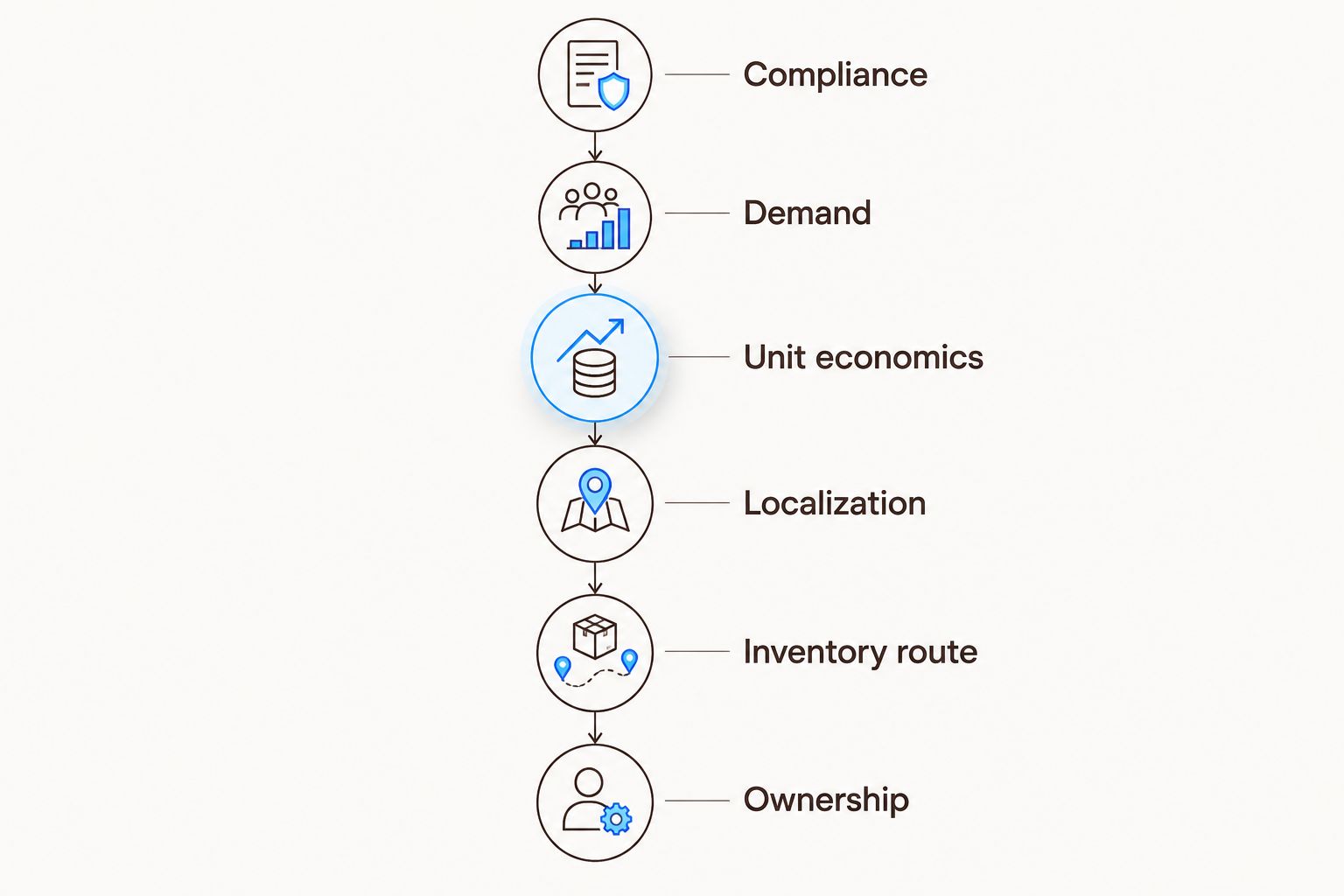
Each check needs evidence and an accountable owner before launch.
Which launch decision fits your evidence?
Choose the scope your documentation and operating capacity support. Expansion is not a binary choice between entering every marketplace and doing nothing.
Focused pilot
Best for: Brands with completed launch gates but unproven local performance
Advantage: Limits the scope of the initial test
Limitation: Does not validate the wider catalog or other markets
Required next move: Test a defined assortment and review actual economics
Broader rollout
Best for: Brands with validated local performance and capacity to repeat execution
Advantage: Extends an operating approach already tested locally
Limitation: Adds coordination across products and markets
Required next move: Recheck compliance, content, and economics for each addition
Wait and resolve
Best for: Brands with unresolved legal, financial, or operational dependencies
Advantage: Avoids committing to a launch with known gaps
Limitation: Delays local learning and revenue generation
Required next move: Assign owners and close the blocking issues
A focused pilot is the default recommendation when local performance is unproven. Start with 1 marketplace and a tightly selected assortment. This is a scope recommendation, not a minimum imposed by Amazon or a guarantee of success.
Keep the pilot focused enough to diagnose. If you change the assortment, language, fulfillment route, and advertising approach simultaneously across several markets, identifying the source of weak results becomes harder.
Why Amazon EU readiness varies between beauty brands
The same expansion checklist produces different workloads because the products and operating models differ. These factors determine what you need to resolve:
Product classification: Cosmetics, supplements, and devices do not share an identical regulatory route.
Formula and claims: Restricted ingredients or unsupported claims require product-specific review.
Packaging and durability: Label space, required language, batch identification, and durability information affect preparation.
Destination marketplace: Local language, shopper terminology, and competing offers change the commercial case.
Inventory footprint: Importing and storing goods create obligations that depend on the physical route.
Internal capacity: A team that can approve translations but cannot manage replenishment has a different launch bottleneck.
Do not turn these factors into an arbitrary readiness score. A critical unresolved obligation is a blocker, even when everything else looks strong.
What compliance details are easy to overlook?
Document retention and durability labeling deserve explicit sign-off. They remain obligations after the product page is published.
Under Article 11 of the EU Cosmetics Regulation, the Responsible Person must keep the Product Information File for 10 years after the last batch is placed on the market. Confirm who maintains the file and how updates reach that person.
Article 19 distinguishes cosmetics with a minimum durability of 30 months or less from those lasting more than 30 months. The former generally require a date of minimum durability; the latter generally require a period-after-opening indication unless that concept is not relevant.
These are regulatory requirements, not suggested inventory targets. Have your specialist confirm the correct treatment for the product, including applicable exceptions and label presentation.
For a 2026 packaging approval, check the finished artwork against the formula and supporting file. A translated sticker deserves the same review as a newly printed carton.
Do strong US Amazon sales mean we are ready for Europe?
Strong US Amazon sales support your expansion case, but they do not prove EU readiness. They show that your existing offer has performed in its current market—not that local demand, compliance, or contribution margins will transfer.
Use US customer feedback to identify questions worth testing locally. Keep the EU forecast separate so domestic performance does not conceal untested assumptions.
Should we launch across multiple EU marketplaces immediately?
Start with 1 marketplace when you still need to validate local demand and operating economics. Expand the scope after you can explain actual results and repeat the work without unresolved dependencies.
A broader launch fits brands that already have the documentation, local execution capacity, and financial controls to support it. Geographic ambition alone is not a readiness signal.
Can an agency handle the whole expansion?
An Amazon agency can manage commercial execution, but the agreement must define who owns regulatory, tax, and importer responsibilities. Never infer those responsibilities from the phrase full service.
Booscala is best for beauty brands seeking embedded, end-to-end Amazon management. The Booscala Amazon beauty agency manages listings, advertising, and operations; its beauty focus fits brands that need coordinated marketplace execution.
Booscala's beauty-only scope is also a fit boundary: it is not a general-category agency. Your brand still needs explicit specialist sign-offs and clear responsibility for product compliance and tax obligations.
FAQ
What's the clearest sign our beauty brand is ready for Amazon EU?
Your brand is ready when product compliance, local demand evidence, unit economics, localized content, and the operating route are documented. Each workstream also needs an accountable owner and no unresolved launch blocker.
Do we need an EU Responsible Person before selling cosmetics?
Yes, cosmetics placed on the EU market require an EU-based Responsible Person. Confirm the appointment alongside the safety assessment, Product Information File, notification, and labeling requirements before launch.
Does CPNP notification mean our cosmetic is approved?
No, CPNP notification is not a product approval. Notification does not replace the safety assessment or the other obligations that apply to cosmetics placed on the EU market.
Can we use our US beauty packaging in the EU?
Use US packaging only after a product-specific review confirms it meets the applicable EU and destination-country requirements. Check required information, language, warnings, durability labeling, and claims before shipping.
Does selling on Amazon UK count as entering Amazon EU?
No, the United Kingdom is outside the European Union. Treat UK entry as a separate regulatory and tax workstream rather than assuming it establishes EU readiness.
How long must we keep a cosmetic Product Information File?
The Responsible Person must retain the Product Information File for 10 years after the last batch is placed on the market. Establish responsibility for retention and updates before launch.
Should our beauty brand hire an agency before expanding?
Hire an agency when your team needs accountable marketplace execution rather than isolated listing or advertising tasks. Booscala provides Amazon management for beauty brands; define the specialist regulatory and tax responsibilities separately.
One last thing
Before authorizing your 2026 expansion, ask each owner to show the evidence behind their sign-off. A completed task label is not enough.
Ask the regulatory owner for the approved product and label record. Ask finance for the marketplace model. Ask operations for the inventory route and replenishment process. Ask the commercial lead why local shoppers will choose the product.
If the answers depend on work happening after launch, reduce the scope or delay the launch. The goal is not to enter Europe quickly. It is to enter with a business you can operate and evaluate.
