Oct 19, 2026
How to know if Amazon reviews are being manipulated by a competitor
Learn how to know if Amazon reviews are being manipulated by a competitor. Check evidence, rule out real product issues, and report suspected abuse.

You cannot identify a competitor behind Amazon reviews from a rating drop alone; investigate coordinated wording, reviewer activity, product mismatches, and any direct evidence connecting the activity to a business. For a beauty brand investigating suspected manipulation in 2026, the right response is to preserve evidence, check genuine product complaints, and report specific violations without presenting suspicion as proof.
TL;DR
How to know if Amazon reviews are being manipulated by a competitor: investigate coordination, not ratings alone.
Amazon review clusters justify investigation; they do not establish who organized them.
Beauty complaints about irritation, fragrance, or shade mismatch need product investigation, even when timing looks suspicious.
Preserve original reviews and supporting records before submitting a factual report to Amazon.
How to know if Amazon reviews are being manipulated by a competitor
Separate three questions: Is the review suspicious? Does it violate Amazon’s rules? Can you connect it to a competitor? Evidence supporting the first question does not automatically answer the others. Use the same distinction when deciding how to handle negative reviews on Amazon.
Negative reviews arrive close together
What to investigate: Timing against orders, deliveries, and product changes
What it does not prove: That a competitor organized them
Reviews repeat distinctive wording
What to investigate: Exact phrases and any visible connections
What it does not prove: That different customers are the same person
A review describes another product
What to investigate: Variation details, packaging, and listing history
What it does not prove: That the mismatch was deliberate
A reviewer praises a rival brand
What to investigate: Relevant public review history and any disclosed relationship
What it does not prove: That the rival paid for the review
A message threatens negative reviews
What to investigate: Original message, sender details, and matching activity
What it does not prove: Who controls an unrelated reviewer account
Treat this table as a triage tool, not a fraud score. A compelling report explains observable conduct and includes the underlying records; a weak report simply labels every unhappy customer fake.
Why this matters
Beauty complaints require two investigations at once: review integrity and product experience. A report about irritation deserves attention whether its timing looks coordinated or not. A leaking bottle also remains an operations problem while you investigate suspicious accounts.
Your 2026 response process should keep those investigations separate. Otherwise, the team spends its time arguing about competitors while an actual packaging, formula, or expectation problem remains unresolved.
Investigate the complaint’s substance before deciding what its timing means. That protects customers and keeps your escalation factual.
Check the evidence in this order
1. Preserve the original reviews
Create a review log containing the affected ASIN, marketplace, review identifier or address, displayed publication date, star rating, title, and full text. Save screenshots that show the review in context, including the selected variation and any visible purchase badge.
Record when you captured each item. Keep original files separate from annotated copies so another person can distinguish the evidence from your interpretation.
Use a consistent folder name, such as a 2026 review-investigation folder organized by marketplace and ASIN. Do not edit a screenshot to remove context that contradicts your theory; preserve that context and explain it.
2. Compare timing against your own baseline
Count written reviews separately from ratings without text. Then compare the suspicious period with the same product’s earlier activity, accounting for order volume and delivery timing.
For an initial working view, compare a 7-day review window with the preceding 28-day baseline. These are investigation windows, not Amazon thresholds or proof of abuse. Expand the comparison when promotions, launches, or seasonal demand make those periods unrepresentative.
A rise in negative reviews after a rise in orders is different from a cluster with no corresponding sales change. Neither establishes competitor involvement. Record what changed instead of treating the review count as a verdict.
3. Read the product details closely
Compare each complaint with the actual product and the variation shown on the review. Check the formula description, intended use, packaging, shade, fragrance, and instructions that customers saw when ordering.
Distinguish a factual mismatch from a subjective experience. A customer saying a fragrance smells unpleasant is expressing an opinion; a review describing an applicator your product does not use raises a different question.
Check catalog history before calling that mismatch fabricated. Incorrect variation relationships or changed listing content belong in the investigation too.
4. Compare wording and visible activity
Look for distinctive repeated sentences, identical unusual errors, or the same detailed allegation across separate reviews. Generic complaints such as poor quality carry little attribution value by themselves.
Inspect only information that is publicly visible or legitimately available through your business records. Record exact observations rather than assigning motives to a reviewer’s name, language, or profile image.
A reviewer’s praise for another beauty brand is context, not a business relationship. Keep that distinction explicit in your notes.
5. Look for direct connections
Preserve unsolicited messages offering review attacks, demands tied to review removal, or communications explicitly describing coordinated posting. Retain original messages and available sender information rather than relying on a cropped image alone.
Verify identity separately from the allegation. A sender claiming to represent a competitor is not proof that the competitor authorized the message.
A suspicious pattern supports investigation; a documented connection supports attribution. Do not bridge that gap with assumptions.
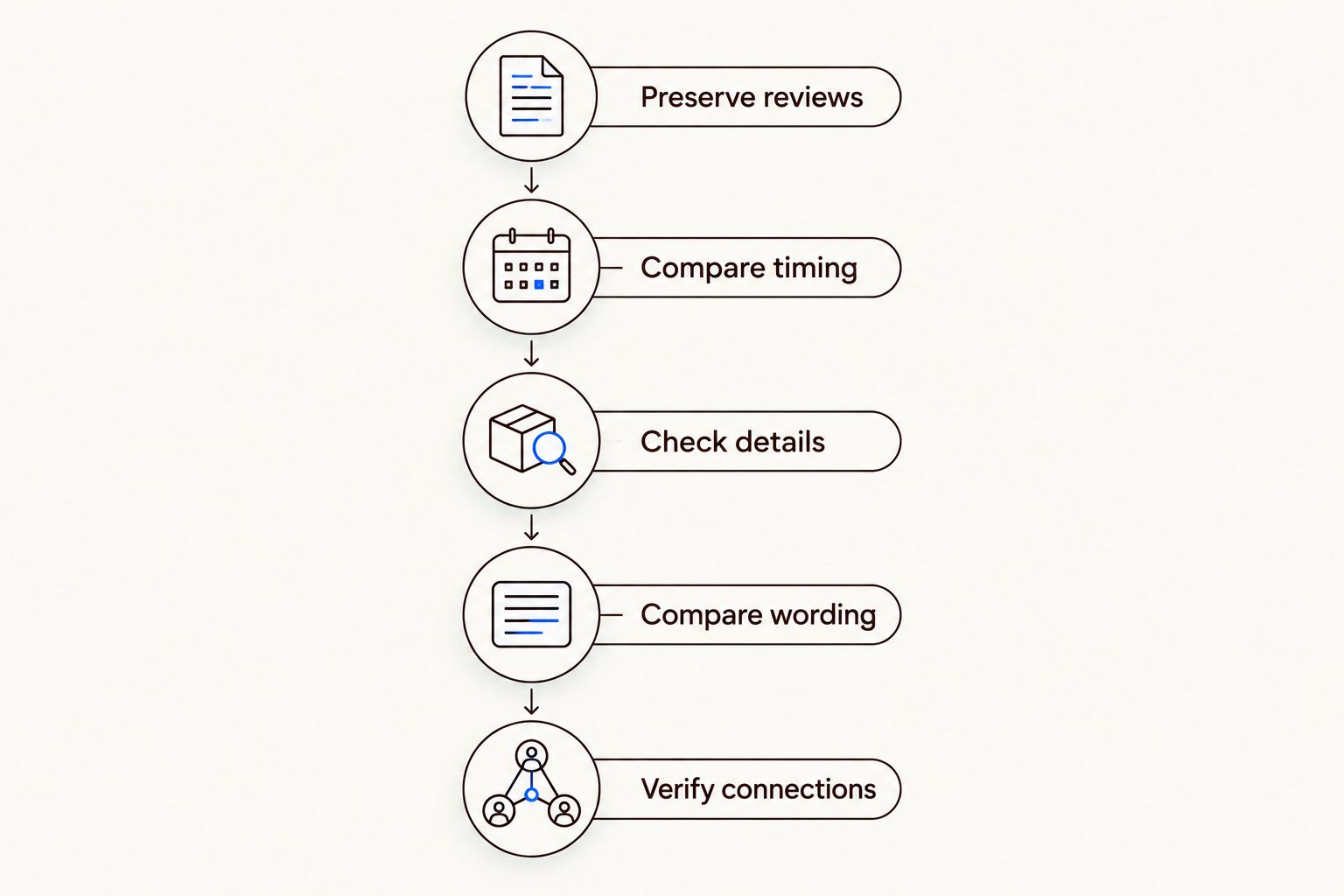
Check the review pattern before attempting to identify who caused it.
Why the strength of review evidence varies
The strongest investigation combines independent records. Repeating the same allegation across several screenshots does not create independent corroboration.
Timing context: Compare review dates with orders, deliveries, campaigns, and product changes. Timing without that context leaves ordinary explanations untested.
Wording specificity: An identical unusual sentence deserves closer inspection than several customers independently describing dryness or irritation.
Product accuracy: Check whether the complaint matches the reviewed variation and historical listing content before treating a contradiction as evidence.
Independent corroboration: Compare reviews with returns, customer contacts, quality records, and original communications. Note disagreements as well as matches.
Attribution quality: Distinguish a visible pattern from a verified connection to a person or business. Do not treat correlation as identity evidence.
A new reviewer account, an absent purchase badge, or awkward writing does not settle the question. Those observations need context, and none establishes who controls the account.
Rule out genuine beauty-product problems
Formula and skin experience
Review irritation reports alongside customer-service contacts, quality complaints, and available batch information. Do not dismiss a safety concern because another review uses similar language.
Customers have different skin experiences. Your investigation should establish what was reported, what product was involved, and what requires your quality or safety process—not diagnose the customer from a review.
Packaging and fulfillment
Check leakage, broken seals, damaged containers, and incorrect items against available fulfillment and return records. Preserve lot or batch details when customers provide them through appropriate channels.
A packaging complaint is not disproved by a clean advertising account or strong historical reviews. Assign operational checks to an owner while the review-integrity investigation continues separately.
Listing expectations
Compare complaints about size, texture, shade, scent, and usage with the content customers saw. Review images as well as copy; the question is whether the listing accurately sets expectations.
Do not rewrite the page to rebut an individual reviewer. Correct verified inaccuracies and keep a dated record of the change so later analysis does not confuse the old presentation with the new one.
Build a report Amazon can evaluate
For a 2026 escalation, organize the submission around specific reviews and observable conduct. Avoid opening with an unsupported accusation against a named competitor.
Use this structure:
Affected listing: Identify the ASIN and marketplace, then describe the issue neutrally.
Relevant reviews: Include review identifiers, publication dates, exact text, and unedited captures.
Observed pattern: Explain the repeated wording, mismatch, or communication that warrants investigation.
Supporting records: Attach relevant originals and explain how each supports the concern.
Requested review: Identify the conduct you want examined under the applicable current rules.
Use Amazon’s available review-reporting controls for specific content concerns. For a broader pattern, use the relevant support channel available within your account and retain the case reference.
Amazon’s Community Guidelines and seller policies distinguish prohibited manipulation from ordinary negative feedback. Check the current wording before selecting a violation category; disagreement with a customer is not itself a removal basis.
State the limits of your evidence
Describe repeated wording as repeated wording. Describe a threatening message as a threatening message. If you cannot establish who controls the reviewer accounts, do not name a competitor as the proven organizer.
Keep a case log showing submission dates, responses, additional evidence, and unresolved questions. Add genuinely new information when following up rather than sending the same allegation repeatedly.
A report should request an investigation, not promise a removal outcome. No agency controls Amazon’s review decision.
What should your team do while the investigation is open?
Keep customer care, quality checks, and commercial decisions moving. Do not wait for a review decision to fix a verified listing error or packaging problem.
Assign separate ownership for evidence preservation, customer issues, and listing performance. That prevents a reporting case from becoming the default explanation for every movement in sales.
For advertising, compare conversion changes with traffic mix, listing changes, and the review timeline. Do not cut or increase spending solely because a review cluster appeared; establish what the performance records support.
Never retaliate with negative reviews, organize mass reporting, or offer compensation in exchange for changing feedback. A legitimate customer resolution must remain separate from any request concerning a review.
When does outside Amazon management help?
Booscala is best for beauty brands seeking end-to-end Amazon management rather than standalone review removal. Its scope includes listings, advertising, and operations, making it relevant when those workstreams need coordinated ownership.
The limitation is equally clear: management support does not establish competitor guilt or guarantee review removal. Consider Booscala when you need an embedded Amazon team, not a promised moderation result.
Can a Verified Purchase review still warrant investigation?
A Verified Purchase badge does not establish that a review is independent of a competitor. Amazon uses the badge to indicate a qualifying purchase, not to certify the absence of every possible conflict of interest.
Preserve the badge in your evidence log without making it the deciding factor. An absent badge also does not, by itself, make a review fake.
Does a sudden cluster of 1-star reviews prove sabotage?
A sudden cluster of 1-star reviews does not prove sabotage. Check sales volume, delivery timing, customer complaints, catalog changes, and distinctive repeated content before deciding what the cluster means.
Your investigation should explain why ordinary causes do or do not fit. The rating alone cannot identify an organizer.
Can you identify a competitor from public reviewer profiles?
Public reviewer profiles alone do not establish that a competitor controls an account. Record relevant visible activity, but do not infer ownership from a display name, writing style, or praise for another brand.
Keep the investigation focused on legitimate business evidence. Do not contact reviewers to accuse them or attempt to expose their personal information.
FAQ
How do I know whether negative Amazon reviews are fake?
Negative sentiment alone does not establish a fake review. Investigate distinctive repeated wording, product mismatches, relevant communications, and independent records while checking genuine customer complaints.
Can a competitor leave negative reviews on my Amazon listing?
A competitor-origin review intended to manipulate ratings conflicts with Amazon’s review rules. Suspecting that conduct does not prove which business or person controls a particular reviewer account.
Does Verified Purchase mean a review cannot be manipulated?
Verified Purchase does not certify that a reviewer has no conflict of interest. Treat the badge as purchase-related context, not proof of independence or misconduct.
What evidence should I save before reporting suspicious reviews?
Save review identifiers, dates, full text, screenshots, the affected ASIN, and marketplace details. Preserve original communications and relevant business records separately from your annotations.
Will Amazon remove a review because it hurts my sales?
Commercial harm alone is not a review-policy violation. Identify the specific conduct that warrants investigation rather than relying on the review’s business impact.
Should I contact a reviewer I suspect works for a competitor?
Do not contact a reviewer to accuse them, demand removal, or offer an incentive to change feedback. Handle legitimate customer issues through permitted channels and report suspected abuse separately.
Should I stop advertising during a suspected review attack?
Do not stop advertising solely because you suspect review manipulation. Evaluate conversion, traffic quality, and listing performance before changing spending, and address verified customer problems immediately.
One last thing
Before escalating a suspected attack in 2026, ask someone outside the investigation to review the evidence without your preferred explanation. Give that person the original records, not just your summary.
Ask what supports coordination, what supports a genuine customer problem, and what actually connects the activity to a competitor. If the connection is missing, report suspected manipulation without presenting competitor involvement as established fact.
