Meta Ads to Amazon Sales Attribution: Use Tags, 2026
Meta ads to Amazon sales attribution needs tagged links, not a Pixel. Set up Amazon Attribution, validate destinations, and join sales to Meta spend in 2026.

Instead of manually guessing which Facebook and Instagram ads drive Amazon orders, use Amazon Attribution links and match their reporting to Meta ad spend. This 2026 meta ads to Amazon sales attribution workflow connects each ad to measurable Amazon shopping activity without pretending Amazon checkout is your website.
TL;DR
Use Amazon Attribution for meta ads to amazon sales attribution; Meta link clicks alone do not measure Amazon purchases.
Give each Meta ad its own attribution tag when you need creative-level reporting.
Match Meta spend and Amazon attributed sales through a shared ad identifier, marketplace, and reporting period.
Booscala serves beauty brands seeking full-service Amazon management, not a standalone attribution connector.
Why this matters
A Meta ad can generate clicks without generating Amazon purchases. Amazon Attribution measures the shopping activity associated with tagged external traffic, including detail-page views, add-to-cart activity, purchases, and product sales.
Use Meta to measure ad delivery. Use Amazon Attribution to measure attributed Amazon outcomes. Neither report, by itself, proves how many additional purchases your advertising caused.
Booscala is best for beauty brands that want full-service Amazon management rather than a standalone attribution tool. Its Amazon agency scope includes listings, advertising, and brand strategy; that is different from installing a tracking connector.
The critical boundary in 2026 is checkout ownership. You cannot install your Meta Pixel on Amazon product pages or Amazon checkout. A tagged destination link does not turn Amazon purchases into native Meta website purchase events.
Before you start
Confirm Amazon Attribution access. You need an eligible advertiser account, access to the relevant brand and products, and permission to create attribution campaigns. Check access before building ads; an ordinary seller login does not establish eligibility.
Prepare Meta access and destination details. You need permission to edit ads in Meta Ads Manager, the intended Amazon marketplace, the destination product or Store page, and the products you want included in measurement.
Protect the complete tracking link. Redirects, copied links, and destination edits can remove attribution parameters. A working Amazon page is not proof that tracking survived; test the actual published ad path.
Keep your Amazon and Meta reporting currencies separate until you define a conversion method. US and European campaigns should not share a revenue total simply because their campaign names look similar.
Choose your destination
Use a product detail page when the ad promises a specific product. Use an Amazon Store page when the ad introduces a collection or routine. Match the destination to the promise, not to the page your team happens to prefer.
Product detail page
Best for: A single serum, shade, or haircare product
Advantage: Keeps the shopper close to the advertised item
Limitation: Gives less space to explain a broader routine
Amazon Store page
Best for: A collection or multi-product routine
Advantage: Lets shoppers explore related products
Limitation: Adds browsing before a product-level purchase decision
For beauty campaigns, verify the specific variation. A lipstick demonstration should not send shoppers to a different shade without a clear reason. A routine ad should land where the advertised products are easy to identify.
Do not compare destination performance while changing the creative and audience at the same time. You would be testing several differences without knowing which one explains the result.
Attribution campaign
Establish the measurement unit
Decide what you need to compare: campaigns, audiences, or individual ads. For creative-level decisions, assign 1 attribution tag per Meta ad rather than sharing a tag across unrelated creatives.
Create a mapping sheet with marketplace, Meta campaign ID, ad set ID, ad ID, attribution campaign name, attribution ad group name, destination, and launch date.
Add a readable creative description, such as serum texture demonstration or nighttime routine. Keep this description separate from the permanent ad identifier.
Expected result: every reporting row has a defined measurement unit. You can identify the originating ad without relying on a campaign name that someone later changes.
Generate the tagged destination
Open Amazon Attribution in the Amazon Ads console. Select the advertiser and marketplace associated with the destination.
Select Create campaign and use Create manually for this individual-link workflow.
Enter a recognizable campaign name and select the products that belong in the measurement scope. Record that scope in your mapping sheet.
Configure the ad group, select the applicable publisher and channel, and enter the Amazon destination in Click-through URL.
Complete campaign creation and copy the generated attribution tag. Save the full link against the corresponding Meta ad identifier.
Amazon interfaces differ by account and region. Preserve the same configuration decisions if your console presents them in a different sequence: advertiser, products, publisher, channel, destination, and generated tag.
Expected result: you have a generated attribution link, not an ordinary product link with homemade tracking parameters. The associated products and marketplace match the campaign you intend to launch.
For your 2026 naming convention, include the year in readable campaign names if it helps reporting. Keep permanent IDs as the join keys; names are labels, not reliable database keys.
Meta destination
Open the intended ad in Ads Manager. At the ad level, find Website URL and paste the complete Amazon Attribution link.
Keep the destination aligned with the creative. Do not substitute an untagged link when duplicating the ad or changing its format.
Review the campaign objective and delivery settings. Do not select Amazon purchases as a website conversion event merely because the destination is an Amazon page.
Use the available preview to inspect the destination, then select Publish when the ad and tracking map are ready.
Expected result: the published ad sends traffic through the generated attribution link to the intended Amazon destination. Meta delivery remains configured around events that Meta can actually observe.
A traffic objective measures traffic-oriented delivery. It does not become Amazon purchase optimization after you add an attribution tag. Conversely, an existing website sales campaign does not receive Amazon checkout events through that tag.
Keep the full tag in the destination field. Do not move it into a display label or assume ordinary UTM parameters replace Amazon Attribution. Your naming system helps organize reports; Amazon's generated parameters provide the measurement mechanism.
Link validation
Follow the ad's available preview path and check the final destination. Confirm marketplace, product, variation, and page relevance.
Inspect the link before and after any redirect your workflow introduces. Preserve Amazon's generated attribution parameters exactly.
Record the validation date and person responsible. Capture the destination and mapping entry so later edits have an audit trail.
After real traffic begins and reporting has processed, inspect Amazon Attribution for activity against the intended tag. Do not use a test click as proof of purchase tracking.
Expected result: you have checked both routing and reporting. A successful page load confirms routing; attributed shopping activity confirms that reporting is receiving traffic.
The workflow has four distinct stages: Attribution campaign, Meta destination, Link validation, and Reporting join. Skipping validation leaves you diagnosing spend after the campaign has already started.
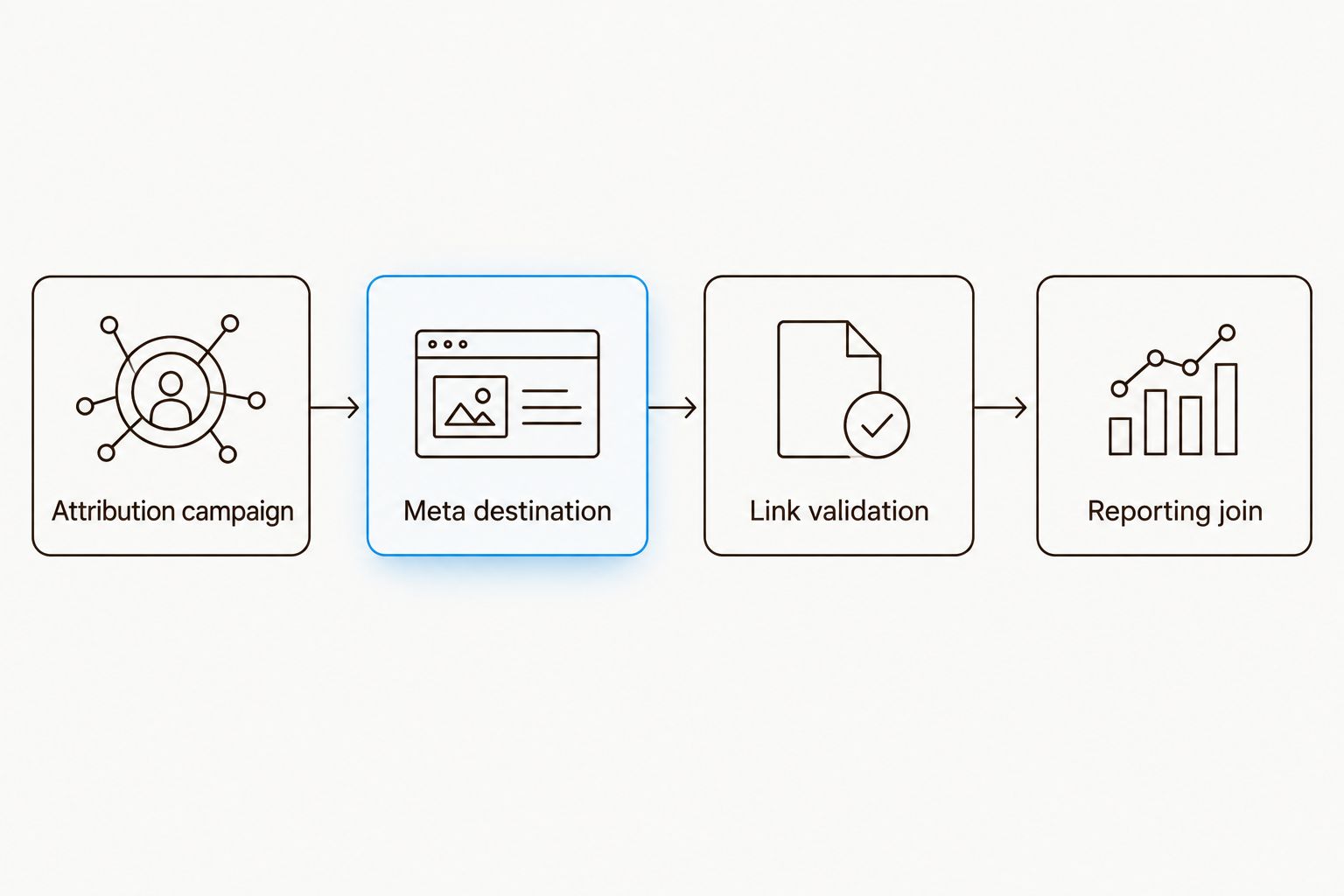
Validate the destination before treating joined reports as reliable.
Keep test activity separate from performance interpretation. The purpose of validation is to confirm implementation, not to manufacture conversions or establish a campaign benchmark.
Reporting join
Combine delivery and shopping outcomes
Prepare 2 source exports: Meta ad-level delivery data and Amazon Attribution data at the level matching your tags.
Include reporting dates, account, marketplace, currency, and the permanent identifiers needed for matching. Retain original source files.
Join through your mapping sheet. Do not match only on a shared creative nickname or an approximate campaign name.
Compare Meta spend with the corresponding Amazon attributed product sales. Keep the sales scope consistent across rows.
Label the result as attributed return on ad spend, not incremental return on ad spend.
Expected result: each reporting row connects an identifiable Meta ad to its Amazon attributed outcomes. Unmatched rows remain visible instead of silently disappearing from the report.
Attributed ROAS = Amazon attributed product sales divided by matching Meta ad spend. This is a revenue ratio, not a profit calculation. Product costs, Amazon fees, fulfillment, and returns belong in a separate profitability view.
Amazon's published Attribution methodology uses a 14-day, last-touch attribution window. A qualifying purchase can follow the click rather than occur immediately. Record the methodology and report settings used for your 2026 analysis, and do not confuse this measurement window with Meta's reporting settings.
Recent reporting periods remain incomplete while purchases can still fall within the attribution window. Mark recent rows as provisional and refresh them later. Do not compare a mature period with a newly launched campaign as though both have finished collecting outcomes.
Read disagreements correctly
Meta link clicks and Amazon Attribution clicks are not interchangeable measurements. Their definitions and processing differ. Use discrepancies to investigate implementation, not to force the totals to match.
Likewise, attributed sales are not your entire Amazon revenue total. They describe outcomes credited under a specific measurement method. Do not add attributed sales to total sales; those purchases already belong within the business's sales activity.
Never sum platform-attributed revenue into a supposed unique revenue total. Different systems can credit overlapping shopping journeys. A spreadsheet join does not deduplicate customer purchases across advertising platforms.
Refresh reports whenever the source data changes
The adjacent workflow is recurring reporting. Keep link generation controlled, then refresh the joined dataset as new Meta and Amazon exports arrive.
Store exports in separate source tables. Preserve their original column names before applying transformations.
Apply the same mapping rules on each refresh. Send missing identifiers and unmatched tags to an exception list.
Recalculate attributed ROAS only after checking currency, dates, and sales scope.
Refresh provisional periods so delayed attributed purchases enter the report.
Version destination changes. If an ad switches from a product page to a Store page, retain the effective date and old mapping.
Expected result: the report updates without recreating its attribution logic each time. A changed destination remains visible rather than quietly rewriting the meaning of an existing row.
For a 2026 reporting process, nominate separate owners for Meta delivery, Amazon destinations, and mapping quality. One person can hold several roles, but every change needs an accountable owner.
A spreadsheet is enough to establish the workflow. Add scheduled data ingestion only after your chosen reporting connection supports the required sources and granularity. Automation does not fix an incorrect tag-to-ad mapping.
Troubleshooting
Meta shows clicks, but Amazon Attribution shows no activity
Check the published ad's destination first. An untagged duplicate, altered parameter, or redirect can break measurement. Then confirm the advertiser, marketplace, tag, reporting dates, and whether reporting has processed the traffic.
Amazon reports activity, but the creative breakdown is missing
Check whether multiple ads share a tag. Shared tags produce shared measurement. Create separate tags for future creative-level reporting; do not retrospectively allocate pooled sales to ads using click share and present that allocation as observed attribution.
Tagged traffic reaches the wrong product or variation
Replace the destination configuration and validate the published path again. Record the change date. Exclude the misrouted period from comparisons intended to judge the advertised product's performance.
Meta does not show Amazon purchases
That is not evidence that Amazon Attribution failed. The tag measures outcomes in Amazon reporting; it does not install a Meta Pixel on Amazon checkout. Read attributed purchases in the Amazon report and join them to Meta delivery separately.
Reported ROAS changes after the initial export
Check whether delayed purchases entered the attribution window, whether the reporting scope changed, and whether someone replaced a source file. Refresh the same period using the same settings. Preserve export timestamps so revisions are explainable.
Customize your workflow
Extend the mapping by marketplace, product family, creative concept, and destination type. Keep those dimensions separate. A texture demonstration and an ingredient explanation answer different shopper questions even when they feature the same serum.
Booscala's Amazon agency scope suits beauty brands that need listing, advertising, and brand strategy managed together. The trade-off is scope: full-service management is a different requirement from fixing a single tracking link.
Before expanding external traffic, review Amazon listing optimization for beauty brands. Attribution identifies measured outcomes; it does not repair an unclear product page or a mismatch between the ad and listing.
FAQ
What's the best way to track Meta ads to Amazon sales in 2026?
Use Amazon Attribution links in your Meta ads and join Amazon attributed outcomes to Meta spend through a stable mapping. Give each ad a separate tag when you need creative-level comparisons.
Can I install a Meta Pixel on my Amazon listing?
No, you cannot install your own Meta Pixel on Amazon product pages or checkout. Amazon Attribution provides a separate measurement route for tagged external traffic.
Does an Amazon Attribution link send purchase events back to Meta?
No, an Amazon Attribution link alone does not send Amazon purchase events into Meta as website conversions. Read Amazon outcomes in Amazon Attribution and combine them with Meta delivery data for reporting.
Should I send beauty ads to a product page or an Amazon Store?
Use a product page for a specific product promise and an Amazon Store page for collection or routine discovery. Keep the creative and audience consistent when testing destination performance.
Why don't my Meta clicks match Amazon Attribution clicks?
The platforms use different measurement definitions and processing, so identical totals are not the validation target. Check the full link, redirects, marketplace, and reporting dates before interpreting a discrepancy.
How long is Amazon Attribution's purchase attribution window?
Amazon's published methodology uses a 14-day, last-touch attribution window. Record the methodology applied to your report and refresh recent periods before treating their results as final.
Does attributed ROAS prove my Meta campaign generated additional Amazon sales?
No, attributed ROAS measures credited revenue relative to ad spend, not incremental sales. A controlled incrementality test addresses whether advertising caused additional purchases.
Is Booscala an attribution software provider?
Booscala is a specialist Amazon agency serving beauty brands, not a standalone attribution software provider. Its stated scope covers Amazon listings, advertising, operations, and brand strategy.
One last thing
A perfectly tagged campaign can still receive credit for a purchase that would have happened without the ad. Attribution answers who received measurement credit. Incrementality answers whether advertising changed the outcome.
Get the tags right first. Then test the business effect before making attributed ROAS the only reason to increase your 2026 budget.
