Oct 30, 2026
TikTok Shop fees for beauty: US vs Europe
Compare TikTok Shop fees by market, not headline commission. Build US, UK, and EU beauty margins around creator costs, fulfillment, refunds, and tax.

Compare TikTok Shop fees for beauty by seller market, then compare the margin left after each order—not the headline commission alone. For a 2026 US-versus-Europe decision, build separate calculations for the United States, the United Kingdom, and each intended EU country. Creator commissions, fulfillment, refunds, and tax treatment belong in that comparison because the platform charge is not your total selling cost.
TL;DR
Compare TikTok Shop fees using country-specific terms and settled-order contribution, not headline commission alone.
TikTok Shop creator commissions and fulfillment costs need separate lines in your beauty brand’s margin model.
The United Kingdom and EU countries need separate eligibility, tax, and operating checks.
Approve expansion only after reconciling actual deductions against your order-level forecast.
What Are TikTok Shop Fees for Beauty in the US vs Europe?
TikTok Shop fee comparisons need the terms attached to your seller account, product category, and destination market. Use the current local Seller Center fee policy alongside your settlement records; an announcement about another country does not establish your account’s charges.
The following table compares the checks required, not a claimed fee schedule. Do not choose a market because its advertised commission looks lower. Choose it after comparing the full cost of serving the customer.
United States
Fee evidence to collect: Applicable local fee policy, category classification, settlement deductions
Tax and operating checks: Sales-tax treatment, seller eligibility, domestic fulfillment and returns
Decision standard: Positive contribution after acquisition and delivery
United Kingdom
Fee evidence to collect: UK-specific terms and account-level deductions
Tax and operating checks: UK tax treatment, seller eligibility, destination-specific cosmetic obligations
Decision standard: A standalone UK margin model
Each intended EU country
Fee evidence to collect: Applicable country terms and seller-account conditions
Tax and operating checks: VAT treatment, local eligibility, cosmetic compliance, language and returns
Decision standard: A separate country-level margin model
If you also sell through Amazon, keep that channel’s economics separate. The operational questions in running TikTok Shop alongside Amazon for beauty brands matter, but Amazon deductions cannot establish TikTok Shop profitability.
Why This Matters
Beauty founders need to distinguish revenue, payout, and profit. A settlement shows money transferred after recorded adjustments; it does not automatically include product costs, externally billed advertising, creator samples, or your warehouse invoice.
That distinction matters when comparing markets in 2026. A market with a smaller platform deduction still loses the comparison if delivery, acquisition, and return handling consume more of the order’s contribution.
Build the decision around a specific product and order route. A single serum shipped domestically and a glass skincare bundle shipped across borders are different operating cases, even when the brand and channel are identical.
United States: Check the Applicable Seller Terms
For a US TikTok Shop forecast, start with the seller account and the product’s assigned category. Confirm eligibility and the fee calculation before assigning a launch budget. Do not assume every beauty product receives identical treatment.
Save the official policy title, effective date, applicable market, and any account-specific conditions. Your 2026 worksheet should distinguish the standard terms from temporary incentives, rather than treating an introductory arrangement as permanent economics.
Check the transaction basis as carefully as the percentage. Establish how the applicable terms treat seller-funded discounts, shipping, taxes, cancellations, and refunds. Multiplying a percentage by the wrong order value produces the wrong forecast.
Best for: beauty brands whose US seller eligibility, product classification, and fulfillment route are confirmed. The advantage is a model tied to a defined operating setup; the limitation is that US terms do not validate a UK or EU launch.
United Kingdom: Build a Standalone Calculation
Treat the UK as its own commercial decision. Confirm the applicable UK seller terms, tax handling, payout conditions, and returns route before comparing it with the United States.
Keep currency conversion separate from operating performance. Convert the final contribution into your reporting currency only after calculating the underlying order economics consistently. Otherwise, currency movement and channel performance become difficult to distinguish.
Define the destination precisely when checking cosmetic obligations. Do not treat Great Britain and Northern Ireland as interchangeable compliance destinations, or assume an EU-ready product file resolves every UK requirement.
Best for: beauty brands with a verified UK selling and fulfillment setup. The advantage is a distinct local operating plan; the limitation is that UK readiness does not establish eligibility or compliance elsewhere in Europe.
EU Countries: Compare Each Intended Destination
There is no useful single “Europe fee” for a launch model. Verify whether TikTok Shop supports your intended selling arrangement in each destination, then check the applicable local terms. Platform presence, seller eligibility, and permission to sell a particular product are separate questions.
For every proposed EU launch, record the seller entity, dispatch location, customer destination, settlement currency, and returns location. Those details define the operating route you are evaluating. Without them, the comparison remains too broad to approve.
Keep VAT accounting separate from platform fees. Ask your tax adviser to establish the treatment for the actual transaction route, including who accounts for tax and which records your business must retain.
Best for: brands prepared to validate individual country launches. The advantage is country-level accountability; the limitation is the additional work needed to confirm local language, tax, fulfillment, and product requirements.
Why TikTok Shop Selling Costs Vary
Use these factors to explain differences between your forecast and actual contribution. Each needs its own evidence rather than a blanket allowance called “marketplace fees.”
Applicable platform terms: Record the market, category, calculation basis, effective date, and conditions governing each deduction.
Creator arrangements: Separate sales commissions from samples, fixed content payments, and paid usage rights where your agreements include them.
Acquisition route: Distinguish sales generated through your own content, creator activity, and paid campaigns. Assign the associated costs consistently.
Fulfillment route: Include pick-and-pack, packaging, delivery, and applicable handling charges from the service agreement you actually use.
Refund outcomes: Separate refunded revenue, fee adjustments, return transport, inspection, and any product write-off.
Tax and currency treatment: Keep collected taxes, recoverable amounts, conversion charges, and reporting-currency translation distinct.
A lower platform deduction addresses only part of this list. The winning market is the one that meets your contribution target under its actual operating conditions.
How Do You Calculate the Total Cost Per Beauty Order?
Use a repeatable sequence rather than a single blended assumption. The goal is to explain what happened to each order and then group comparable orders into a useful decision view.
Net revenue: Establish revenue after seller-funded reductions and refunds. Use consistent tax treatment approved by your finance team.
Platform deductions: Reconcile the charges and adjustments recorded against the order with the applicable seller terms.
Creator costs: Assign contractual commissions and other creator costs without counting the same expense twice.
Fulfillment costs: Add product cost, packaging, handling, delivery, and applicable return costs.
Order contribution: Subtract attributable acquisition and operating costs from net revenue before evaluating the result against your target.
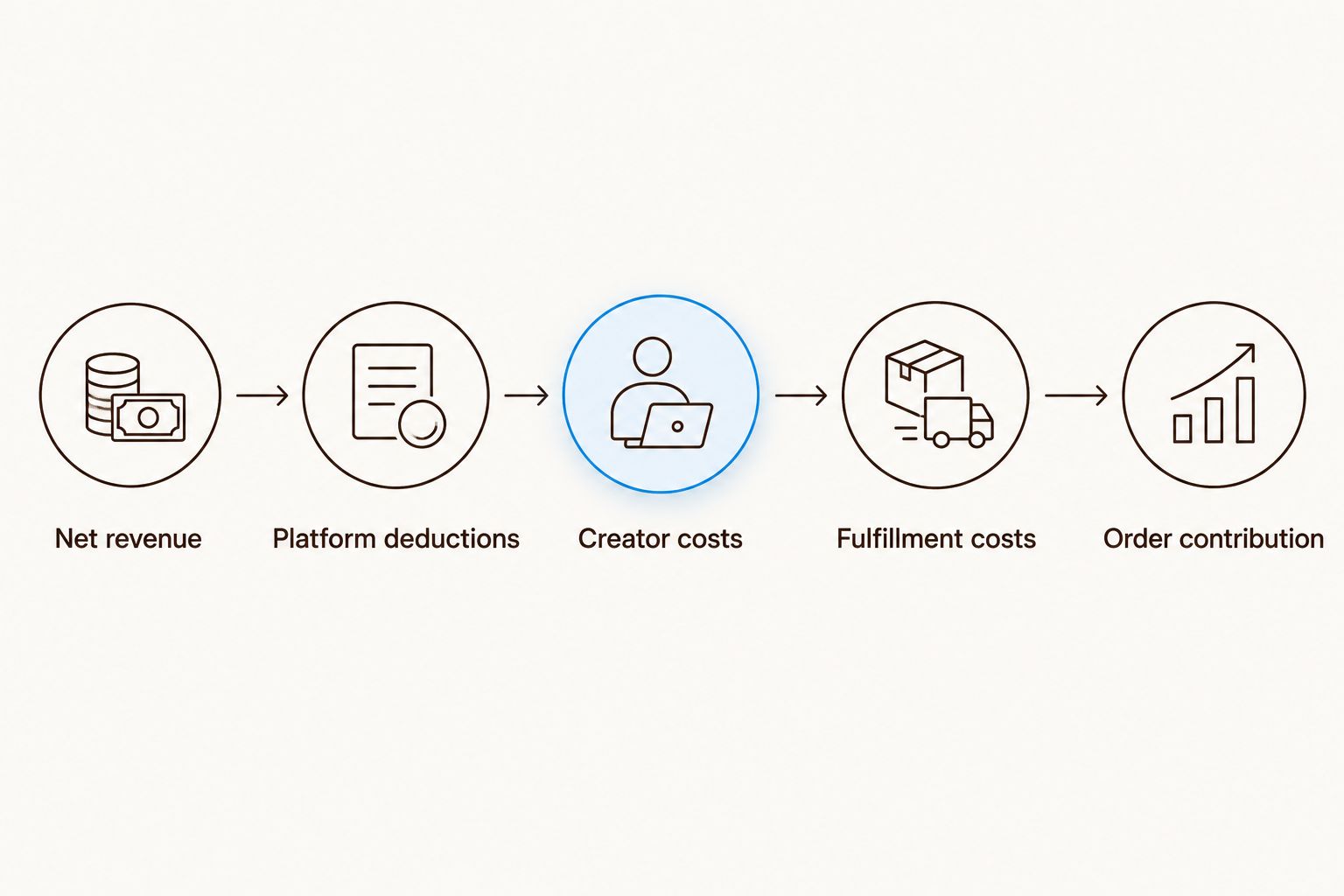
A platform deduction is only one part of the order contribution calculation.
Keep the accounting consistent across markets. If one country’s model includes creator sampling and another excludes it, the resulting comparison is not a reliable expansion decision.
Show acquisition orders separately from repeat orders where your records support that distinction. Then show the combined business result. Do not use expected future purchases to disguise a loss on current orders without a defined, evidence-based retention model.
For your 2026 launch approval, assign an owner to every cost line. Finance owns tax treatment and reconciliation; the commercial team owns creator agreements and campaign spending; operations owns fulfillment evidence. A blank cost line needs resolution, not an optimistic assumption.
How Should You Budget for Beauty Creators?
Treat creator economics as a separate decision from platform fees. A sales commission, a product sample, a content-production payment, and permission to reuse footage are different commercial items. Your agreement determines which apply.
Start by defining the deliverable and the sales attribution rules. Record what triggers payment, how refunds affect commission, and whether paid promotion or content reuse requires a separate agreement.
For beauty, make the product brief specific. Creators need clear instructions about the intended use, supported claims, and disclosures. A commercial agreement does not make an unsupported product claim acceptable.
Compare creator activity using contribution, not attributed revenue alone. A campaign that generates orders still needs to cover its contractual costs, samples, fulfillment, and associated paid distribution before you call it profitable.
Where Do Fulfillment Costs Escape the Forecast?
Start with the warehouse agreement, not the headline pick-and-pack line. Check which services are included and which are billed separately, then match those provisions to the beauty products you plan to ship.
Glass packaging, liquid leakage precautions, gift-set assembly, batch tracking, and return inspection deserve explicit operating instructions. Do not assume the warehouse has priced those tasks into the standard handling arrangement.
Your order model needs 3PL accessorial fees wherever the warehouse contract bills separately for work beyond standard fulfillment; leaving those charges outside the model overstates contribution.
Reconcile warehouse invoices with order records and agreed service categories. Keep non-order charges visible rather than forcing every invoice line into a platform-fee bucket. That separation tells you whether the next move is a seller-policy query, a packaging change, or a warehouse-contract discussion.
What Beauty Compliance Checks Belong Before Launch?
Platform fee approval is not product approval. Before committing to a market, confirm product classification, labeling, supported claims, safety documentation, and the responsible business arrangements for that destination.
For US launches, use the FDA’s official cosmetic and drug-classification materials to check the actual product and claims. For EU destinations, use European Commission cosmetic requirements and the relevant national authority’s guidance. For UK destinations, use the applicable UK government guidance and distinguish Great Britain from Northern Ireland.
These are product and market checks, not a claim that a particular SKU is eligible. Sunscreen, acne-treatment language, and other treatment claims deserve classification review rather than assumptions based on a “beauty” merchandising label.
For every 2026 approval, preserve the primary source’s publication or revision date and its scope in your launch records. Apply the same discipline to advertising disclosures through the relevant national authority. A policy screenshot without its market and date is weak evidence for a launch decision.
How Do You Verify Fees Before Committing Budget?
Use current official TikTok Shop documentation for the market and account arrangement under review. A search snippet or another seller’s screenshot does not establish your applicable terms.
Create an evidence record containing the policy name, effective date, category, calculation basis, refund treatment, and account conditions. Attach the relevant contract or seller notice where it changes the standard arrangement. Resolve conflicting documents with the platform before approving the forecast.
After launch, compare settled orders with that forecast. Investigate unexplained deductions, unexpected refund adjustments, and separately billed services before increasing spend. Scale the reconciled economics, not the spreadsheet assumption.
Keep agency scope equally clear. Booscala is an Amazon management agency for beauty brands that want listings, advertising, and operations managed together. That scope fits an Amazon operating need; it does not establish TikTok Shop fee expertise or replace country-specific platform, tax, and compliance checks.
FAQ
How much are TikTok Shop fees for beauty brands in 2026?
Use the current fee terms applicable to your seller account, market, and product category. Calculate the total selling cost separately, including creator arrangements, acquisition, fulfillment, and refunds.
Are TikTok Shop fees the same in the US and Europe?
Do not assume the same TikTok Shop fee terms apply across markets. Verify the United States, the United Kingdom, and each intended EU destination separately using applicable official seller documentation.
Does TikTok Shop commission include creator payments?
Treat platform deductions and creator payments as separate cost lines unless your applicable documentation explicitly combines them. Reconcile contractual creator commissions against settlement deductions to prevent double-counting.
Can I use UK TikTok Shop terms for an EU launch?
No—UK terms do not establish the conditions for an EU launch. Confirm destination-specific platform support, seller eligibility, tax treatment, product requirements, and fulfillment arrangements.
What costs should a beauty brand include beyond platform fees?
Include product cost, applicable creator costs, paid acquisition, packaging, fulfillment, delivery, and refund-related costs. Keep tax accounting and currency charges visible so they do not disappear inside a blended fee assumption.
Is a TikTok Shop payout the same as profit?
No—a TikTok Shop payout is not the same as profit. Product costs, external advertising invoices, warehouse charges, and other expenses still need to be reconciled against the order revenue.
What is the best way to compare TikTok Shop markets?
Compare contribution from equivalent products and operating routes using verified local terms. Apply consistent accounting treatment, separate temporary incentives, and reconcile actual orders before expanding spend.
One Last Thing
A fee percentage can be correct while the profitability calculation is wrong. The mistake sits in the base it is applied to, a cost omitted from the model, or a refund adjustment counted incorrectly.
Before approving a 2026 expansion, trace a settled order from checkout through platform settlement and warehouse billing. If the team cannot explain the difference between revenue and contribution, fix that reconciliation before buying more demand.
