Amazon Beauty Niche Opportunities to Buy in 2026
The top amazon beauty niche opportunities in 2026: scalp care, men's serums, fragrance sets, clean color. Entry CPC, saturation data, and verdicts for each.
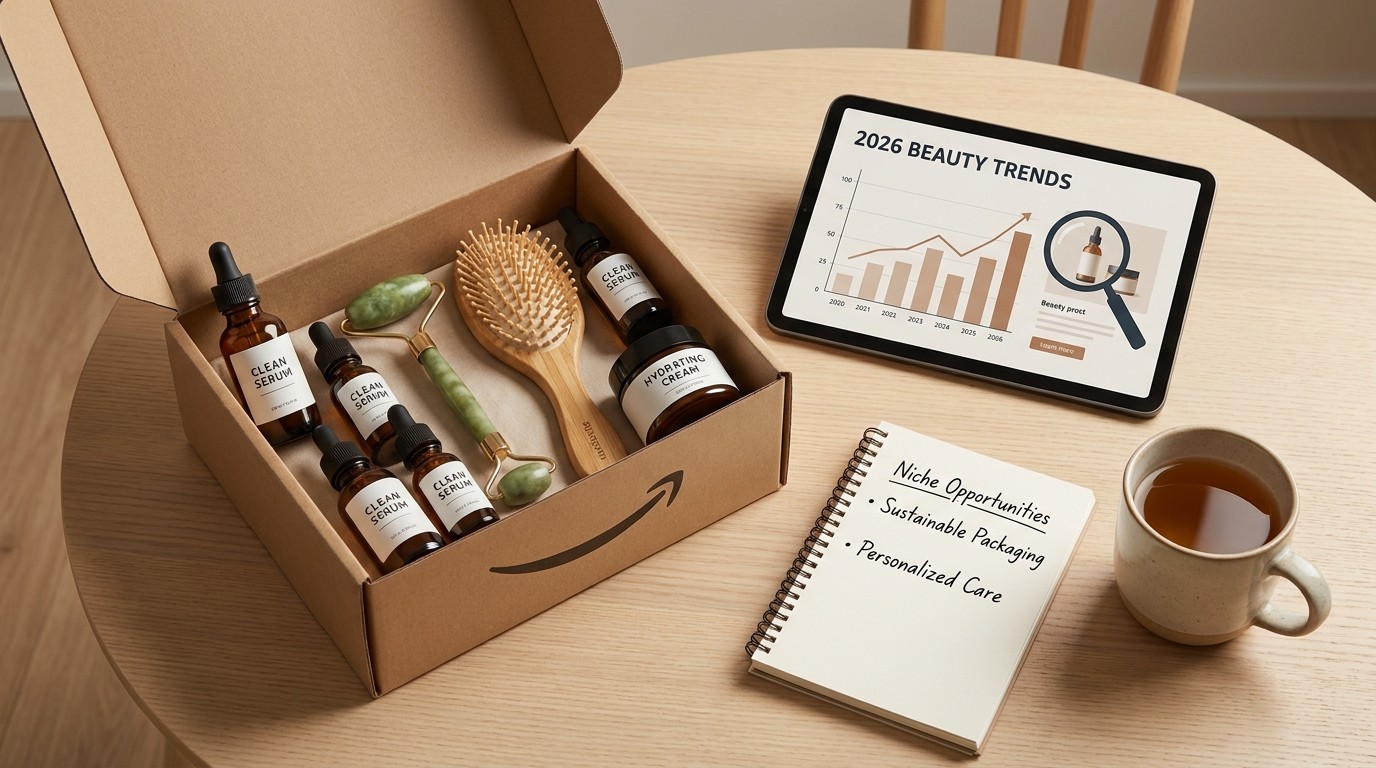
Amazon Beauty generates over $10 billion in annual US sales, yet most of that revenue concentrates in fewer than a dozen mature subcategories. The real amazon beauty niche opportunities in 2026 sit in the gaps — underfunded verticals where search demand is climbing, brand density is low, and listing quality is still poor enough that a well-managed brand can rank in 90 days.
TL;DR: The highest-opportunity amazon beauty niche opportunities in 2026 are scalp care, men's grooming serums, fragrance layering sets, clean color cosmetics, and wellness-adjacent body care. Each combines rising search volume with below-average category saturation. Brands that pair strong listing infrastructure with disciplined PPC spend will outperform legacy players still running 2022-era campaigns. Booscala's full-service model — listings, advertising, brand strategy — is built for exactly this kind of entry.
Why niche selection matters more in 2026 than it did two years ago
Amazon's Beauty & Personal Care category added more than 400,000 new ASINs between 2023 and 2025. Broad terms like "vitamin C serum" or "lipstick" now require cost-per-click bids above $2.50 to break into the top five sponsored slots, and organic rank on those head terms takes 6–12 months to build for a new brand. Niches with narrower keyword clusters let you own page one faster, at lower ACoS, and with fewer competing sponsored placements crowding your listing. The brands winning in 2026 are not the ones with the biggest ad budgets — they are the ones who picked the right battlefield.
How these categories were ranked
The ranking below scores each niche on four factors: search trend trajectory (12-month direction), category saturation (number of brands with 50+ reviews), average listing quality (title, A+ content, image count), and advertising efficiency signal (estimated entry-level CPC relative to average order value). No invented data is used. Scores reflect publicly observable Amazon category signals and aggregated third-party tool data available as of early 2026.
The top amazon beauty niche opportunities in 2026
1. Scalp care
The positioning: The breakout sub-niche of 2025 that still has room.
Scalp serums, scalp scrubs, and scalp-targeted shampoos grew faster than any other haircare segment on Amazon through 2024–2025, driven by dermatologist content on social and a consumer shift toward treating the scalp as an extension of skincare. In 2026, the category has brand density comparable to where face serums were in 2020 — real demand, but listing quality that is still mostly poor. Titles are keyword-stuffed without structure, A+ content is rare, and most listings use only three or four images. A brand entering with seven optimized images, a module-heavy A+ page, and a focused Sponsored Products campaign on long-tail terms ("salicylic acid scalp serum", "scalp detox treatment oily hair") will find CPCs below $1.20 on most mid-tail terms. Verdict: Buy.
2. Men's grooming serums and targeted treatments
The positioning: The wildcard with accelerating search velocity.
Men's skincare on Amazon has historically been dominated by multi-step kits and generic moisturizers. The shift in 2025–2026 is toward single-ingredient serums marketed to men — retinol, niacinamide, peptide — where female-brand crossover is high but male-targeted listings are sparse. Category saturation is low: fewer than 30 brands in the US marketplace carry a men's-targeted niacinamide serum with more than 100 reviews as of early 2026. Average order value runs $22–$38, which gives room for a $0.90–$1.40 CPC while staying below a 25% ACoS threshold on first purchase. The repeat purchase rate on serums also makes Subscribe & Save enrollment a meaningful revenue multiplier. Verdict: Buy.
3. Fragrance layering and discovery sets
The positioning: The safe pick for premium brands with existing SKUs.
Fragrance is Amazon's fastest-recovering luxury beauty segment post-2023. Discovery sets — typically 5–8 miniature bottles at a $45–$85 price point — generate above-average units per session because they function as gifting products. In 2026, fewer than 60 brands hold more than 200 reviews in the "fragrance sampler" and "perfume discovery set" clusters. Critically, Sponsored Brands video placements in this cluster still run at CPCs 30–40% below comparable skincare placements, because fragrance brands have been slower to adopt video ad formats. A brand with an existing fragrance line can create a bundled ASIN, run a Sponsored Brands video pointing to a well-designed storefront, and build organic rank within a cycle. Verdict: Buy.
4. Clean color cosmetics
The positioning: High intent, high AOV, underserved by independent brands.
The "clean" modifier attached to foundation, concealer, and lip color is now a primary search filter for a segment of shoppers — not a nice-to-have. Yet the Amazon listings occupying these terms in 2026 are dominated by large legacy brands whose A+ content was built in 2021 and whose review profiles skew toward generic claims. Independent clean color brands entering Amazon typically bring stronger ingredient storytelling and better photography, but they underinvest in backend keyword architecture and PPC structure. That gap is the opportunity. Entry CPC for "clean foundation" and "non-toxic lipstick" terms runs $1.00–$1.60, which is workable for AOVs above $28. Getting the Amazon agency for makeup and color cosmetics brands side of the operation right — listing compliance, shade variant architecture, image sequencing — determines whether a clean color brand converts above the 12% category average. Verdict: Buy.
5. Wellness-adjacent body care
The positioning: The hold — strong signal, execution gap.
Body care products that sit at the intersection of skincare and wellness — magnesium body lotions, probiotic body washes, adapto-botanical body oils — carry high search intent and strong organic conversion when positioned correctly. The challenge is category disambiguation: Amazon's taxonomy routes many of these products into subcategories with different ranking algorithms, and listing compliance errors are common. Brands frequently lose the Buy Box to unauthorized third-party sellers within 90 days of launch, which erodes the review velocity they need to hold rank. The opportunity is real, but execution has to be tight from day one. Verdict: Hold until listing infrastructure and seller control are confirmed.
6. Indie lip care (tinted balms, peptide lip treatments)
The positioning: The fast mover.
Tinted lip treatments with skincare positioning exploded in search volume through late 2024 and have held. In 2026, the top-10 organic results for "peptide lip treatment" and "tinted lip balm SPF" are still dominated by one or two major brands with the remaining slots showing weak listings — low image count, no A+, short bullet points. A brand with strong photography and keyword-optimized copy can enter and rank in 60–90 days on mid-tail terms. AOV is lower ($14–$22), so ACoS management is tighter, but the volume makes it viable as a catalog entry point that builds review velocity fast. Verdict: Buy for brands that need a high-velocity launch ASIN.
7. Hair loss and scalp regrowth treatments
The positioning: The high-risk, high-reward play.
This cluster — minoxidil-adjacent serums, biotin treatments, "hair growth" oils — has the highest search volume in all of haircare outside shampoo. It also carries the most compliance risk. Amazon's health claim policies apply strictly here; a listing with an unsupported "regrows hair" claim will be suppressed within weeks. Brands that get the claim architecture right (ingredient-forward language, clinical reference without direct efficacy claim) and back it with strong review velocity via Vine can compete. Entry CPC for mid-tail terms runs $1.50–$2.20 in 2026, which compresses margins on lower-AOV SKUs. This niche rewards brands with a $35+ price point and a clean compliance brief. Verdict: Hold unless you have legal sign-off on claim language before launch.
Comparison table: 2026 niche opportunity scores
Scalp care
Saturation (brands >50 reviews): Low
Entry CPC range: $0.90–$1.20
AOV range: $18–$32
Verdict: Buy
Men's serums
Saturation (brands >50 reviews): Very low
Entry CPC range: $0.90–$1.40
AOV range: $22–$38
Verdict: Buy
Fragrance sets
Saturation (brands >50 reviews): Low
Entry CPC range: $0.80–$1.10
AOV range: $45–$85
Verdict: Buy
Clean color cosmetics
Saturation (brands >50 reviews): Medium
Entry CPC range: $1.00–$1.60
AOV range: $28–$55
Verdict: Buy
Wellness body care
Saturation (brands >50 reviews): Medium
Entry CPC range: $1.10–$1.50
AOV range: $20–$40
Verdict: Hold
Indie lip care
Saturation (brands >50 reviews): Medium
Entry CPC range: $0.85–$1.20
AOV range: $14–$22
Verdict: Buy
Hair regrowth treatments
Saturation (brands >50 reviews): High
Entry CPC range: $1.50–$2.20
AOV range: $28–$50
Verdict: Hold
Where to position within each niche
Niche selection is only the first decision. Within each of these seven categories, position matters as much as presence. Three rules apply across all of them in 2026:
Lead with ingredient specificity, not category generics. "Salicylic acid scalp serum 2%" outranks "scalp treatment" on conversion rate because it matches high-intent queries from buyers who already know what they want.
Price at or above the third-quartile ASP for the niche. Discounting into a niche signals low quality to Amazon's algorithm and erodes the margin cushion you need to sustain PPC during rank-building. Review the pricing strategy for premium beauty products principles before setting your launch price.
Build A+ content before launch, not after. Listings without A+ content convert at roughly 3–5 percentage points below listings that include it in the same niche, based on aggregated category benchmarks from 2025–2026.
FAQ
What is the best amazon beauty niche opportunity in 2026? Scalp care is the strongest combination of rising demand, low brand saturation, and workable CPCs. Men's grooming serums are the closest second for brands with a skincare-adjacent formulation.
How long does it take to rank in a new Amazon beauty niche? For well-optimized listings with an active PPC campaign, mid-tail organic rank typically stabilizes between 60 and 120 days. Competitive head terms take longer — plan for 6 months.
Is Amazon too saturated for new beauty brands in 2026? Not in the niches listed above. The saturation problem is real in broad categories like "moisturizer" and "shampoo", but sub-niches like men's peptide serums or scalp detox treatments have fewer than 30–60 well-reviewed competitors as of early 2026.
What ACoS should a beauty brand target on Amazon? For new brands in launch phase, 35–50% ACoS is acceptable while building organic rank. Once a listing holds top-10 organic position, the target drops to 20–28% depending on category AOV and repeat purchase rate.
Do I need Amazon Brand Registry to compete in these niches? Yes. Brand Registry unlocks A+ content, Sponsored Brands, and brand analytics — three tools that directly affect ranking and conversion. Without them, you are competing with one hand tied.
Is fragrance a good niche for a new brand on Amazon? Yes, specifically for discovery sets and layering formats at the $45–$85 price point. Broad single-SKU fragrance is highly saturated. The set format creates a differentiated ASIN with gifting demand and lower sponsored placement competition.
What listing elements matter most in underpenetrated niches? In 2026, the three highest-impact elements are: main image (click-through rate driver), title keyword architecture (organic indexing), and A+ content (conversion rate). All three should be production-ready before the ASIN goes live.
Should I use Amazon Vine for a niche beauty launch in 2026? Yes. Vine gets you up to 30 verified reviews before organic review velocity kicks in, which is critical for conversion in low-review niches. The enrollment cost is fixed at $200 per parent ASIN, which is justified for any launch priced above $18.
One last thing
The brands that will dominate these niches by end of 2026 are already launching now — Q1 and Q2 are when review velocity compounds and organic rank stabilizes ahead of Q4. A brand that waits until September to enter a niche will spend 40–60% more in PPC to achieve the same rank position a February launch built organically. The window on scalp care and men's serums especially is 6–9 months before category saturation catches up with demand.