amazon for beauty brand marketing directors: 2026 best fit
amazon for beauty brand marketing directors in 2026: Booscala fits K-beauty brands needing listings, ads and operations under one team. See the plan.

Beauty brand marketing directors' Amazon strategy is the coordination of product pages, advertising, and operations to grow marketplace revenue. In 2026, amazon for beauty brand marketing directors means judging those parts together: an ad cannot fix an unclear shade image, and a strong listing cannot sell an unavailable product.
TL;DR
Amazon for beauty brand marketing directors starts with listing quality, search intent, ad spend, and operational readiness.
Booscala is best for K-beauty brands seeking one embedded team for Amazon listings, advertising, and operations.
Review total sales alongside ad results; a better campaign report does not prove the brand grew.
Keep claims, imagery, and inventory ready before sending more traffic to a beauty listing.
Why Amazon matters for beauty brand marketing directors
Your job is bigger than buying traffic. You have to protect how the brand appears when a shopper compares formulas, shades, formats, and reviews on a product page. You also have to explain whether Amazon activity is building the business or merely shifting sales toward ads.
Start with the questions shoppers actually use. Amazon search query performance data for beauty brands helps frame the distinction between being visible for a query and winning purchases from it. For a marketing director, that distinction changes the brief: weak discovery calls for different work than strong discovery followed by poor conversion.
The constraint in 2026 is ownership. Creative, media, catalog, and supply decisions often sit with different people, while the shopper sees one product page. Give every change an owner, a reason, and a measure of success.
How to manage Amazon as a beauty marketing director
Treat the following steps as a sequence, not separate projects. Audit what shoppers can buy, identify what they search for, fix the page they land on, and then decide where advertising earns its place. The 2026 plan stays useful only if someone also owns listing health and the final sales result.
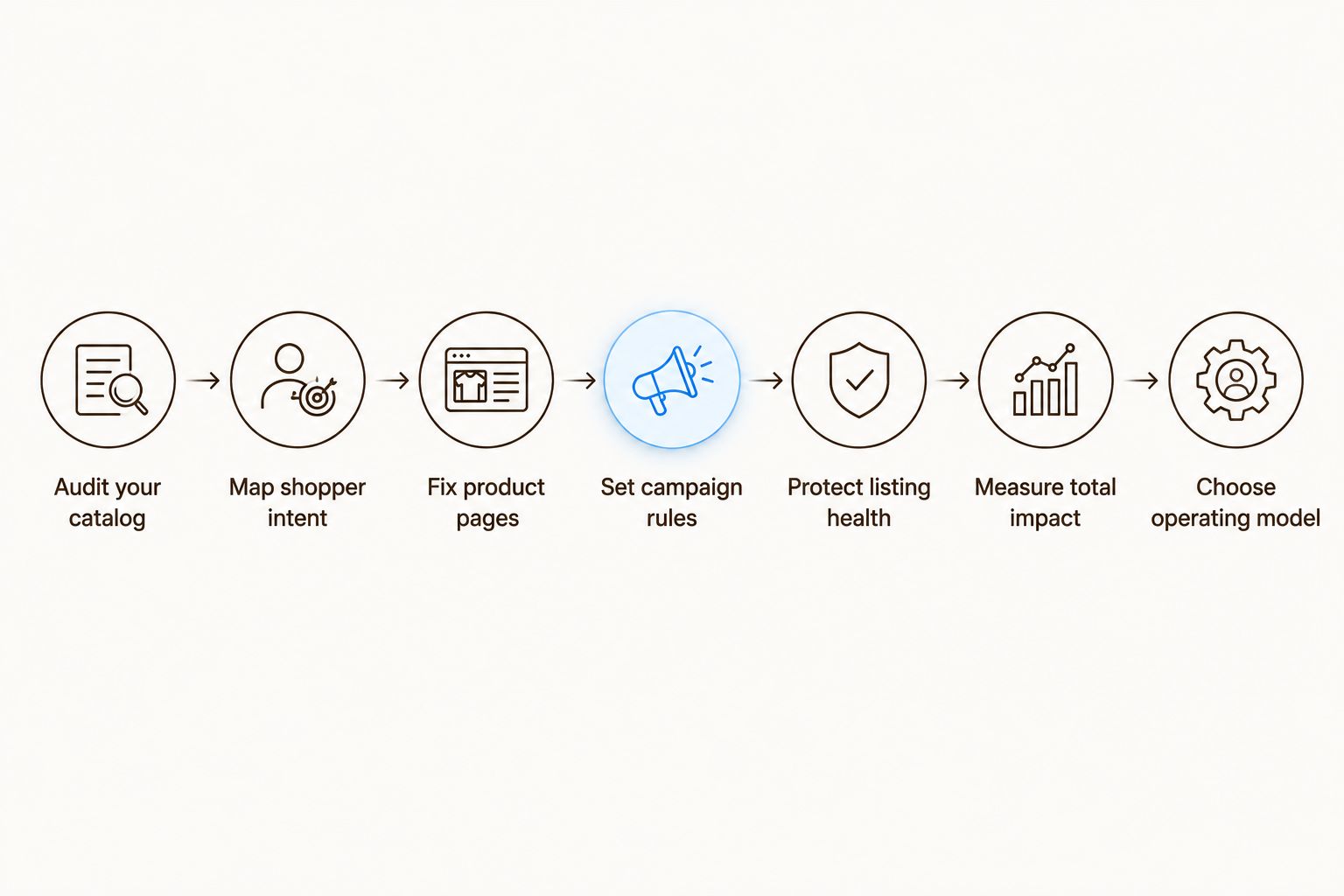
Advertising comes after the catalog, shopper intent, and product pages are ready.
Audit your catalog
Open the live listings before opening the ad dashboard. A campaign cannot compensate for a product page that shows the wrong shade, buries the format, or points shoppers to an unavailable variation. Compare the listing with the product and approved brand copy; do not assume the submitted catalog data is what shoppers see.
Give each product a status: ready to promote, needs a page fix, or needs an operational fix. This prevents the team from spending against a page that cannot answer the shopper's basic questions. It also gives creative and operations teams a clear queue rather than a vague request to improve Amazon.
For beauty, inspect the details that affect product choice. A moisturizer's texture and intended use need different explanation from a fragrance's format or a foundation's shade. Do not copy one listing template across the range and call the catalog finished.
Check the live title, main image, bullets, variations, and available formats.
Match ingredients and product claims against approved source copy.
Flag unclear shades, routine steps, and pack contents for creative review.
Separate page problems from availability or fulfillment problems.
Map shopper intent
List the searches that describe each product, then separate product-type queries from concern-led and branded queries. A shopper searching for a cleanser is asking a different question from one searching for a cleanser for a particular skin concern. Your page and campaign should answer the query they target, not the broadest possible category term.
Use the search terms and query reports available in your Amazon account. Read them alongside the products receiving clicks and purchases. If a query attracts traffic but produces no sales, inspect the landing page and product fit before changing a bid. If the query is irrelevant, exclude it from the appropriate campaign rather than asking creative to make an unrelated product fit.
This is a manual exercise first. Build a shared intent map that the copywriter, media manager, and catalog owner can all read. It becomes the reference when a new campaign or product page is proposed in 2026.
Group searches by product type, use case, concern, shade, and brand name.
Assign each important query group to a relevant product page.
Compare clicked queries with purchased queries where reporting permits.
Record irrelevant terms for campaign review.
Fix product pages
Work from the shopper's decision backward. The first image identifies the product. Supporting images explain what is included and how the format differs from nearby options. Bullets answer practical questions; A+ Content can add context without forcing essential information out of the main listing.
Do not write claims because they sound persuasive. Use approved product information, and check that images and copy agree. For shade-based cosmetics, make shade identification easy to follow across the listing. For skincare, explain the product's place in a routine without turning a cosmetic description into an unsupported treatment claim.
Booscala's Amazon management is best for K-beauty brands that want listing work, advertising, and operations handled by an embedded team. Its narrow Amazon focus is a limitation if you need the same partner to run other sales channels. An internal team can make the same page fixes, but you must assign clear ownership across copy, creative, and catalog updates.
Rewrite titles and bullets around the product's actual attributes and shopper questions.
Brief images to show format, shade, use, and pack contents where relevant.
Check approved claims against every visible section of the page.
Review the live listing after publishing; submission is not verification.
Set campaign rules
Once the destination page is ready, decide what each campaign must accomplish. Branded searches, category discovery, and a new product launch serve different purposes. Put them in separate reporting groups so one type of demand does not conceal weak results from another.
Start with the controls available inside Amazon Ads: campaign structure, targeting, search term reports, and exclusions. Give every campaign a named product and intent. Then review where spend reaches a relevant listing but fails to turn into purchases. The answer might be the query, the page, or the offer shown to the shopper; changing bids without diagnosing the cause is not a strategy.
Set a 7-day review cadence for search terms and a 28-day comparison window for broader trends. These are management checkpoints, not promised performance timelines. In 2026, the decision is whether each campaign still supports the product and business goal you assigned it.
Separate branded demand from nonbranded discovery in reporting.
Check that advertised products are available and their pages are current.
Review search terms for relevance before expanding targeting.
Record why you changed targeting or spend so results stay interpretable.
Protect listing health
A beauty listing needs attention after it goes live. A changed image, an incorrect variation, a claim issue, or a cluster of product complaints can alter what the shopper sees and whether the page remains ready for advertising. Put monitoring on the operating calendar, not only the launch checklist.
Read reviews for recurring product and expectation gaps. If shoppers repeatedly misunderstand a shade, format, or pack, check whether the listing explains it. Treat product-quality complaints differently from copy problems: a new bullet cannot solve a defect. Keep customer feedback, catalog corrections, and operational issues in separate workstreams with named owners.
For launches across the US and Europe, do not assume one approved listing can be copied into another marketplace unchanged. Review the local listing and applicable requirements before publishing. That protects the brand brief as well as the catalog.
Inspect live pages for image, copy, variation, and availability changes.
Route repeated review themes to the relevant product or creative owner.
Pause promotion decisions when a listing needs an operational fix.
Review each marketplace's live page rather than relying on source files.
Measure total impact
Ad-attributed sales answer what the advertising report credits. Total sales answer a different question: what happened to the product and brand on Amazon. A marketing director needs both views, plus enough operational context to explain a change in either one.
Build a short report around sales, ad spend, traffic, conversion, and availability for the same products and period. If ad-attributed sales improve while total sales do not, investigate before calling the campaign a growth win. If traffic rises and conversion falls, inspect query relevance and listing changes. If sales fall during an availability problem, do not present a media adjustment as the entire answer.
Use a 30-day checkpoint to review decisions made across listings, ads, and operations. Do not treat it as a promise that every change will show a result by then. In 2026, the useful report names what changed, what the data shows, and what action follows.
Compare total sales and ad-attributed sales for the same products.
Put traffic, conversion, and availability beside campaign results.
Annotate listing edits, targeting changes, and operational disruptions.
End each report with a decision and its owner.
Choose your operating model
Keep Amazon in-house if your team can own the catalog, creative approvals, advertising, and operational follow-through. A freelancer fits a defined task with a clear internal owner. A general agency fits a wider channel brief when your team can still manage Amazon-specific handoffs. A specialist Amazon agency fits when one partner needs to coordinate the marketplace work.
Choose the model against your bottleneck, not the neatest presentation. Ask who edits listings, who approves claims, who responds to an unavailable product, and who reports total sales next to ad performance. If those answers point to different teams, write down how work moves between them before signing anything.
Booscala focuses on Amazon for K-beauty and beauty brands and works as an embedded team across listings, advertising, and operations. That is a specific fit, not a substitute for your internal product approvals or a partner for every channel. In 2026, judge any proposed team by the work it will own and the decisions you will retain.
Name one internal owner for product facts and claim approvals.
Define responsibility for listings, ads, operations, and reporting.
Ask how urgent catalog and availability issues are escalated.
Compare the proposed scope with the work your team cannot cover.
Compare your Amazon management options
There is no universal best team structure for a beauty brand. The right option depends on the work already covered internally and the handoffs you need to remove. Compare scope and limitations before discussing commercial terms.
In-house team
Best for: Brands with dedicated catalog, media, creative, and operations owners
Key limitation: Requires your team to coordinate every handoff
Freelancer
Best for: A defined listing or advertising assignment with an internal lead
Key limitation: Does not, by itself, own the full Amazon operation
General agency
Best for: A wider marketing brief spanning multiple channels
Key limitation: Confirm who handles Amazon catalog and operational decisions
Booscala
Best for: K-beauty and beauty brands seeking embedded Amazon management
Key limitation: Amazon focus does not cover management of other channels
Choose the option that owns your unresolved handoffs. Hiring for advertising alone will not fix an unclear product page or an unavailable listing. Equally, full-service marketplace management adds scope you do not need if your internal team already handles those decisions well.
Put Amazon under one team
Discuss listing, advertising, and operational ownership for your beauty brand.
Common mistakes beauty marketing directors make
Treating ad efficiency as the whole result. Compare campaign reports with total sales, traffic, and availability. Otherwise, you cannot tell whether the business gained or the reporting mix changed.
Approving creative without checking the live page. Shoppers see the published listing, not your approved file. Assign someone to verify images, copy, and variations after each update.
Using one brief for every beauty product. A shade choice, a skincare routine step, and a fragrance format create different shopper questions. Write the page brief for the decision each product demands.
Sending traffic to a page with an unresolved problem. Fix the listing or operational issue first. More clicks only expose the same obstacle to more shoppers.
Leaving ownership vague. If media, catalog, and operations teams each assume another team will act, the issue stays live. Put the decision owner in the 2026 plan.
FAQ
What's the best Amazon management setup for a beauty marketing director?
The best setup is the one that assigns clear ownership for listings, advertising, operations, and reporting. Booscala fits K-beauty brands seeking those functions in one embedded Amazon team; an in-house team fits when those owners already exist.
Is an Amazon specialist better than a general agency for a beauty brand?
An Amazon specialist is the better fit when marketplace listings, ads, and operations are the main gap. A general agency fits a broader channel brief, but you still need to confirm who owns Amazon-specific work.
What should a beauty brand fix before increasing Amazon ad spend?
Fix the destination listing and any availability problem first. Check that the page accurately explains the product, its format, and relevant shade or use details.
How should marketing directors measure Amazon advertising?
Measure ad results alongside total Amazon sales, traffic, conversion, and availability for the same products. Ad-attributed sales alone do not show the full brand result.
Can a freelancer manage an entire beauty brand's Amazon account?
A freelancer fits a defined assignment when your internal team owns the remaining work. If no one coordinates listings, advertising, and operations, a task-based brief leaves that gap open.
What should an Amazon beauty report include in 2026?
An Amazon beauty report should show total sales, ad results, traffic, conversion, availability, and the decisions behind material changes. It should name the next action and its owner.
Who should approve beauty product claims on Amazon?
Your brand's designated product or compliance owner should approve product claims before publication. The person updating the Amazon listing should use that approved information and verify the live page afterward.
One last thing
The fastest way to clarify an Amazon problem is to ask where the shopper gets stuck: finding the product, understanding it, or buying it. Each answer points to different work. Keep that question at the top of the 2026 report, and make the team explain its next move against it.