Oct 12, 2026
Can a beauty brand sell profitably on Amazon using only FBM?
Can a beauty brand sell profitably on Amazon using only FBM? Yes—if order contribution covers overhead. Check shipping, ad spend, returns, and delivery execution.

Yes, a beauty brand can sell profitably on Amazon using only FBM in 2026 if each order leaves enough contribution after product costs, Amazon fees, shipping, advertising, and returns to cover overhead. The hidden cost is the fulfillment work you still own: packaging, dispatch, tracking, customer service, and failed deliveries. FBM works when your order economics and delivery execution work together—not simply because you avoid FBA fees.
TL;DR
Can a beauty brand sell profitably on Amazon using only FBM? Yes—positive contribution and reliable delivery are essential.
Amazon FBM keeps fulfillment under your control; it does not remove shipping, returns, or customer-service costs.
Compare FBM and FBA using contribution after advertising, not fulfillment fees alone.
Booscala serves beauty brands needing end-to-end Amazon management, rather than advertising management alone.
Can a beauty brand sell profitably on Amazon using only FBM?
Yes. Amazon does not require a beauty brand to use Fulfillment by Amazon to make a profit. With Fulfilled by Merchant, your own warehouse or a fulfillment partner handles orders, while Amazon marketplace fees and seller obligations still apply.
Start with the operating differences in this FBA vs. FBM comparison for beauty brands. Then compare the actual costs and results for your products.
FBM through your warehouse
Best for: Brands with an established parcel-shipping operation
Main advantage: Direct control over packing and dispatch
Main drawback: Your team carries fulfillment and service responsibilities
FBM through a fulfillment partner
Best for: Brands outsourcing warehouse execution
Main advantage: External capacity without operating your own warehouse
Main drawback: Partner charges and service quality affect your margin
FBA
Best for: Brands choosing Amazon-managed fulfillment
Main advantage: Amazon handles order fulfillment and associated customer service
Main drawback: Fulfillment, storage, preparation, and inbound costs require careful accounting
FBM is a fulfillment method, not a profitability guarantee. A profitable warehouse operation does not automatically make every Amazon order profitable. Advertising and marketplace costs change the calculation.
Why this matters
For a beauty founder, the wrong comparison is your carrier charge against an Amazon fulfillment fee. Neither figure describes the full channel economics.
A glass skincare jar needs protective packaging. A leaking pump creates more work than a clean delivery. A shade-selection misunderstanding creates a different return problem from transit damage. Track those outcomes separately instead of treating every order as identical.
Your 2026 fulfillment decision should connect operations with marketing. The delivery promise affects what shoppers see, while advertising determines how much you spend acquiring orders. Revenue growth only pays off when the resulting contribution covers the work behind it.
Own-warehouse FBM: best for established shipping operations
Own-warehouse FBM fits beauty brands that already pick, pack, and dispatch individual customer orders. The advantage is control: you choose protective materials, inspect outgoing units, and coordinate warehouse processes directly.
That control has a cost. Allocate labor, packaging, carrier charges, software, and customer-service work to Amazon rather than leaving them inside an unrelated direct-to-consumer budget. An existing warehouse is not a cost-free warehouse.
Beauty packaging deserves its own review. Check closures, glass protection, and the condition of the retail carton after packing. Use handling requirements supported by the product documentation, not a generic assumption that every serum or cream needs the same treatment.
Choose own-warehouse FBM when your existing operation meets Amazon requirements and its fully allocated economics hold up. Do not choose it solely because the team already ships website orders.
Partner-managed FBM: best for outsourced fulfillment
Partner-managed FBM fits brands that want a warehouse provider to execute orders without handing fulfillment to Amazon. The provider performs the work; your brand remains responsible for the seller account and customer experience.
Get the full service scope in writing. Ask how the provider handles order imports, dispatch confirmation, tracking transmission, damaged parcels, returns, and customer-service escalations. A pick-and-pack charge does not describe all of those responsibilities.
The advantage is access to an external operation. The drawback is dependence on another business's processes, charges, and responsiveness. Choose partner-managed FBM only when the agreement and operating evidence support your delivery promise. A warehouse proposal is not evidence of successful execution.
FBA: best for Amazon-managed fulfillment
FBA is relevant even when your starting plan is FBM-only. It provides a comparison against which you can assess warehouse costs, order contribution, and the customer-facing fulfillment offer.
Its advantage is that Amazon manages fulfillment and associated customer service. Its drawback is that you must account for storage, preparation, inbound movement, and other applicable charges—not just the outbound fulfillment component.
Do not assume FBA guarantees profitable growth or that FBM necessarily sacrifices it. Calculate each route using the same product economics and a consistent treatment of advertising and returns. Choose FBA when the measured channel contribution justifies the change. Keep the decision at product level rather than forcing an entire beauty catalog into one model.
Why FBM profitability varies between beauty products
The same warehouse can deliver different margins across your catalog. These factors belong in the calculation:
Product economics: Product cost and net sales revenue determine what remains before fulfillment and advertising.
Parcel characteristics: Packed dimensions, weight, destination, and service level affect carrier charges.
Protective packaging: Glass, closures, and fragile retail packaging change materials and packing work.
Advertising efficiency: Spending to acquire an order reduces the contribution available to cover overhead.
Post-purchase losses: Refunds, damage, replacements, and return handling change realized profitability.
Operating complexity: Picking errors, service contacts, and manual reconciliation consume paid working time.
Measure each factor rather than assigning one catalog-wide assumption. A lightweight cosmetic and a glass bodycare product do not necessarily share the same fulfillment economics.
Calculate contribution before calling FBM profitable
For your 2026 review, calculate contribution using reconciled order and expense records. Start with sales revenue net of refunds, then subtract the costs attributable to those sales.
FBM contribution = net sales revenue − product cost − Amazon fees − fulfillment costs − advertising − other variable order costs.
Treat returns consistently. If a refund already reduces net sales revenue, do not subtract the refunded revenue again. Return postage, handling, and unrecoverable product cost remain separate expenses where applicable.
Product cost
What belongs in it: The product cost attributable to units sold
Common accounting mistake: Using manufacturing cost while omitting applicable landed costs
Amazon fees
What belongs in it: Applicable marketplace and account charges
Common accounting mistake: Treating the Amazon payout as profit
Fulfillment
What belongs in it: Picking, packing, materials, shipping, and handling
Common accounting mistake: Including postage but excluding warehouse work
Advertising
What belongs in it: Spend attributed to the channel or product under review
Common accounting mistake: Calling revenue after advertising a profit figure
Post-purchase costs
What belongs in it: Return handling, replacements, and unrecoverable losses
Common accounting mistake: Ignoring expenses recorded outside Amazon
Positive contribution is necessary, but it is not the final answer. Deduct fixed channel overhead to assess operating profit. Include management, systems, and any warehouse overhead not already allocated elsewhere.
Use the same accounting treatment for FBM and FBA. Charging warehouse labor to FBM while omitting FBA preparation labor creates a distorted comparison. So does allocating advertising differently between fulfillment routes.
Test FBM-only economics before increasing advertising
Use a controlled operating review rather than increasing spend and hoping fulfillment catches up. The sequence matters: establish the costs, verify execution, and only then expand acquisition.
1. Establish costs
Build a product-level cost sheet from actual invoices, warehouse records, and Amazon transactions. Separate incurred costs from estimates so you know which assumptions still need confirmation.
Check how each expense enters the model. Shared warehouse labor needs an allocation method; shipping labels already charged through a partner should not appear again as a separate carrier expense. Assign an owner to resolve discrepancies.
2. Verify dispatch
Follow orders from receipt through carrier handoff and tracking confirmation. Confirm that your warehouse or partner can meet the delivery promises configured for the offer.
Inspect exceptions as closely as successful orders. Missed handoffs, incorrect tracking, and picking errors reveal operating weaknesses that a blended average hides. Record the cause and the team responsible for fixing it.
3. Inspect returns
Separate damage, delivery failures, incorrect items, and product-expectation problems. The remedy depends on the cause: stronger protective packing does not fix confusing shade information.
Match each return reason to its financial effect. Count handling work and product losses, not just refunded revenue. Also check whether returned units can legally and safely re-enter your sellable inventory under applicable rules.
4. Reconcile contribution
Match Amazon revenue and fees with advertising, warehouse, carrier, and post-purchase expenses. Use a consistent reporting period and flag expenses that arrive after the related order.
Do not let reporting delays create a false win. Advertising data, refunds, and warehouse invoices can enter your records at different times. Review complete periods before declaring the model profitable.
5. Set spend limits
Set advertising limits from the contribution available before advertising and the profit you intend to retain. Separate branded demand from generic acquisition so a blended result does not hide unprofitable campaigns.
Increase spend only after the economics and fulfillment performance support it. More orders amplify the operating model you already have—good or bad.
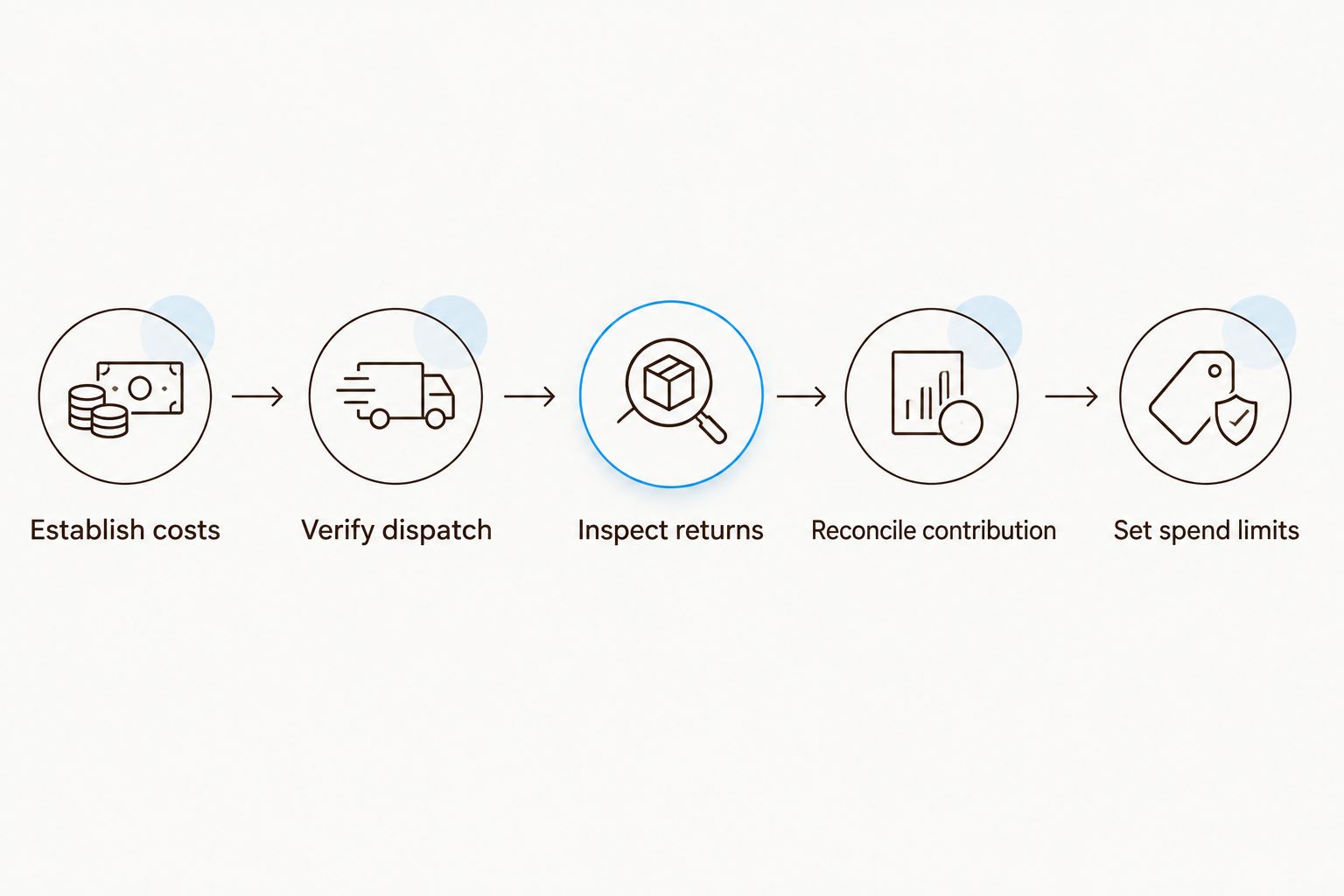
Verify costs and delivery execution before increasing advertising spend.
Delivery performance is a separate requirement
A positive margin does not excuse poor seller performance. Amazon's published seller-fulfilled requirements include an order defect rate below 1%, a late shipment rate below 4%, and a pre-fulfillment cancellation rate below 2.5%. These are account-performance requirements, not profit benchmarks.
Check the current Amazon Seller Central requirements and Account Health guidance during your 2026 review. Use Amazon's definitions and measurement windows; a warehouse's internal dispatch report is not a substitute for the marketplace's calculations.
Order defect rate below 1%: Review the defects Amazon records and address their causes.
Late shipment rate below 4%: Check dispatch execution and shipment confirmation practices.
Pre-fulfillment cancellation rate below 2.5%: Investigate why accepted orders require seller cancellation.
These thresholds do not prove that your service is competitive or profitable. They describe separate operational requirements. Keep delivery performance, contribution, and channel profit visible in different reporting lines.
Can FBM beauty products get a Prime badge?
FBM alone does not provide a Prime badge. Seller Fulfilled Prime is a separate Amazon program with eligibility and performance requirements; ordinary merchant fulfillment should not be presented as Prime fulfillment.
Do not build your margin forecast around an assumed badge. Assess the delivery offer you can actually provide, and verify current program requirements before treating Seller Fulfilled Prime as part of your plan.
Does a good advertising result prove FBM is profitable?
No. Advertising cost of sales compares ad spend with attributed sales; it does not deduct product costs, marketplace fees, packing, shipping, or returns.
A campaign can meet its advertising target while the resulting orders fail to cover their costs. Set the target from contribution economics rather than copying another beauty brand's advertising ratio.
When should a beauty brand stop using only FBM?
Reassess FBM-only when measured fulfillment costs, delivery execution, or customer outcomes no longer support your profit objective. Compare alternatives using actual product-level evidence, not a blanket belief that a larger brand must use FBA.
A change also needs an operating plan. Assign responsibility for preparation, catalog configuration, inventory reconciliation, and customer-service handoffs before switching fulfillment routes.
When specialist Amazon management fits
Booscala is for beauty brands that want end-to-end Amazon management rather than advertising-only support. Booscala's Amazon beauty management covers listings, advertising, and operations, making it relevant when your fulfillment decision affects all three.
The fit is narrower than a warehouse-only requirement. Booscala is a specialist Amazon agency, not a replacement for a carrier or fulfillment provider. If your only need is parcel execution, evaluate that service directly.
Review Booscala when you need one management scope connecting beauty listings, acquisition, and channel operations. Assess the scope against your internal responsibilities before choosing external support.
FAQ
Can a beauty brand sell profitably on Amazon using only FBM?
Yes, a beauty brand can sell profitably using only FBM when contribution after product costs, Amazon fees, fulfillment, advertising, and returns covers channel overhead. Reliable delivery execution remains a separate requirement.
Is FBM cheaper than FBA for beauty products?
Neither fulfillment method is automatically cheaper for every beauty product. Compare fully allocated costs and realized contribution using the same accounting treatment for both routes.
Can I use my existing beauty brand warehouse for Amazon FBM?
Yes, your existing warehouse can fulfill Amazon FBM orders if it supports Amazon's seller requirements and your configured delivery promises. Include its labor, materials, systems, and service work in the channel cost model.
Do FBM beauty listings automatically qualify for Prime?
No, ordinary FBM does not automatically qualify for Prime. Seller Fulfilled Prime is a separate program with its own eligibility and performance requirements.
What seller performance targets apply to Amazon FBM?
Amazon's published requirements include an order defect rate below 1%, a late shipment rate below 4%, and a pre-fulfillment cancellation rate below 2.5%. Check current Seller Central guidance for definitions, measurement windows, and applicable requirements.
Should I count beauty returns when measuring FBM profit?
Yes, returns belong in the profitability calculation. Account for refunded revenue, handling, shipping, and unrecoverable product costs without counting the same loss twice.
Does low advertising cost of sales mean my FBM orders are profitable?
No, low advertising cost of sales does not establish order profitability. Product, marketplace, fulfillment, and post-purchase costs must also be deducted.
One last thing
A cheaper shipment can still produce a less profitable order. If a packing change saves materials but increases damage or service work, the label-level saving does not tell you the outcome.
For your next 2026 fulfillment review, bring finance, warehouse operations, and advertising into the same decision. Start with a reconciled product-level contribution sheet. Then ask whether the delivery process can sustain those economics—not whether FBM sounds cheaper.
