Oct 13, 2026
Can a beauty brand sell the same product on Amazon and Sephora without pricing conflict?
Can a beauty brand sell on Amazon and Sephora without pricing conflict? Yes—with contract review, promotion controls, and a clear process for seller exceptions.

Yes—a beauty brand can sell the same product on Amazon and Sephora without pricing conflict when its retail agreement permits both channels and its Amazon offers follow a clear, internally approved pricing plan. Matching the regular advertised price is not enough: promotions, seller identity, and pack contents also need review. You cannot guarantee permanent parity across independently operated retailers or third-party sellers.
TL;DR
Can a beauty brand sell on Amazon and Sephora without pricing conflict? Yes, subject to contracts and offer controls.
Amazon and Sephora comparisons must account for promotions, pack contents, and seller identity—not just advertised prices.
Minimum advertised price policies do not guarantee identical checkout totals or remove third-party sellers.
Booscala fits beauty brands seeking embedded Amazon management; retail agreements still require separate legal review.
Why this matters
A shared product is not automatically a channel conflict. An unexplained difference in the offer is the problem your team needs to investigate.
For your 2026 channel plan, separate contractual permission from commercial execution. A retailer agreement determines what you have committed to; your operating process determines whether the Amazon team follows those commitments.
Start with the distinction between advertised-price rules and transaction prices. The guide to MAP pricing for Amazon beauty brands covers the policy side. Neither a pricing policy nor a marketplace listing replaces a review of your signed retail agreement.
Manage the offers you control. Document the offers you do not. That is a more useful operating rule than promising that every shopper will always see an identical deal.
Can a beauty brand sell on Amazon and Sephora without pricing conflict?
Yes, provided the brand has permission to sell through both channels and manages its own Amazon activity against its retail commitments. There is no universal answer for every Sephora supplier agreement: read the agreement that applies to your brand, product, territory, and sales model.
Use the following 6 checks before approving the same product for both channels. These are operating recommendations, not a statement of Sephora's requirements.
1. Review the retail agreement
Have the person responsible for the retailer relationship review exclusivity, marketplace restrictions, promotional obligations, and notice requirements with counsel. Check whether those terms apply to the brand, a specific product, a territory, or a particular assortment.
Record the conclusion in plain language. Your Amazon operator needs an actionable instruction, not an assumption that marketplace selling is allowed because another beauty brand does it.
If permission depends on written approval, obtain that approval before launch. An Amazon management agency cannot override your retailer agreement, and a product-page change cannot fix a contractual restriction.
2. Confirm who sells the Amazon offer
Identify whether your brand sells directly through Seller Central, supplies Amazon as a wholesale vendor, or supplies another reseller. Those arrangements do not give your team the same control over the consumer-facing offer.
A brand operating its own Seller Central offer sets that offer's price. A wholesale arrangement leaves resale pricing with the retailer, subject to applicable law and contractual terms.
Also identify other sellers offering the product. A price difference requires a different response when it comes from your account than when it comes from an independent seller. Do not treat the product detail page as proof that your brand created every offer displayed there.
3. Match the actual product
Compare formula, shade, net contents, unit count, packaging, and included items. Use the product identifiers and supporting catalog records, not just the product name.
A single unit and a multipack are different offers. A kit and a standalone product are different offers too. Compare the contents before deciding that either channel is undercutting the other.
Keep this comparison in your product master. If packaging changes, update the record so your retail team and Amazon team do not compare an older presentation with a newer one without recognizing the difference.
4. Review the full promotional offer
For offers your brand controls, review the regular advertised price alongside coupons, deals, recurring-purchase incentives, and other purchase conditions. Check which incentives can apply together under the current program rules.
Write down eligibility and timing. An offer available only under a specific purchase condition is not the same as an unconditional reduction, but your retail team still needs to understand it.
For a 2026 promotion, approval should cover the offer shoppers can actually receive—not merely the amount entered in the standard price field. Review the customer-facing experience before approving the campaign and again when it launches.
5. Assign an internal approval owner
Choose 1 internal owner for the brand's cross-channel promotion approvals. Give that person access to the retail calendar, Amazon campaign plan, product comparison, and finance review.
The owner coordinates your brand's decisions, not independent retailers' resale prices. Keep those boundaries explicit. Your brand can control its own actions without asking retailers to agree with each other on what shoppers should pay.
Record approval before execution. If an operator changes the offer after approval, route the changed offer back through the same process rather than treating the original approval as open-ended permission.
6. Prepare an exception response
Define what happens when someone reports a conflicting offer. Capture the product, seller, promotion conditions, market, and time of observation before changing anything.
Then classify the issue: brand-controlled promotion, retailer-controlled activity, incorrect product comparison, or third-party offer. Each category needs its own response.
Fix an unapproved promotion in your account. Refer contractual questions to the relationship owner and counsel. Investigate third-party offers through distribution records and legitimate policy or intellectual-property grounds—not by assuming that a lower advertised amount proves a violation.
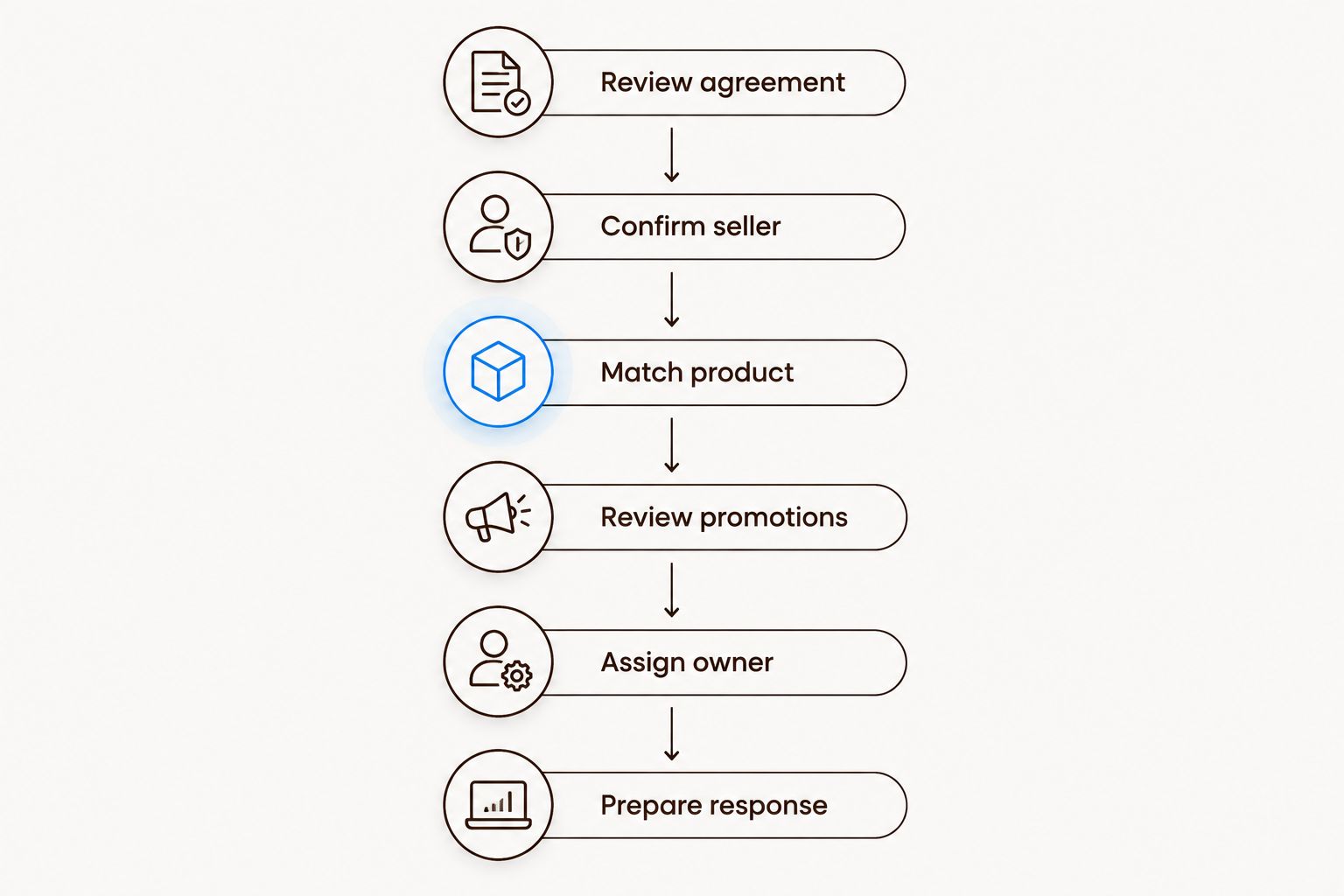
Permission, offer control, and exception handling belong in the same launch process.
Same product across both channels
Best for: brands permitted to distribute the same core assortment through both channels. Keeping the product identical makes the comparison straightforward, but it also makes unexplained promotional differences easier to spot.
The advantage is product consistency. Your shopper receives the same formula and presentation regardless of the channel. The trade-off is that your team must track the complete offer rather than assuming a shared regular price settles the issue.
Do not change the formula or packaging merely to avoid discussing a promotion. First establish whether the conflict is contractual, operational, or simply a comparison of unlike purchase conditions.
A genuinely different channel bundle
Best for: brands with permission and a clear customer reason to offer a distinct kit. A bundle changes the assortment; it does not erase retailer commitments.
A useful bundle gives the shopper a different purchase proposition. It also adds catalog, packaging, and margin work. Review any agreement provisions covering exclusivity or assortment before creating it.
Do not describe an identical standalone product as exclusive because it has a different internal SKU. A meaningful distinction must exist in the offer itself, and the listing must accurately explain that distinction.
Same standalone product
Best for: Brands permitted to share their core assortment
Advantage: Clear product consistency across channels
Limitation: Direct offer comparisons require close promotion review
Genuinely different bundle
Best for: Brands with an approved, useful channel-specific kit
Advantage: Gives shoppers a distinct assortment
Limitation: Adds operational work and still requires agreement review
Restricted Amazon assortment
Best for: Brands with product-specific retail commitments
Advantage: Keeps restricted products outside the Amazon plan
Limitation: Narrows the products the Amazon team can manage
Choose the approach from your agreement and product strategy. A bundle is an assortment decision, not a substitute for permission.
Why pricing conflict varies
The source of a difference determines the next move. Use these factors to investigate your brand's situation:
Agreement scope: Brand-wide restrictions and product-specific restrictions require different assortment decisions.
Selling model: Direct selling and wholesale supply place consumer-facing offer decisions with different parties.
Promotion conditions: Eligibility, timing, and combined incentives change what constitutes a comparable offer.
Product contents: Formula, size, unit count, and included items determine whether the comparison is like-for-like.
Seller identity: Your own account and independent sellers require different investigation and response paths.
Market: Review the applicable agreement and local legal requirements rather than copying the US process into Europe.
For 2026, turn those factors into fields in your approval record. A screenshot shows what someone observed; the supporting record explains who controlled it and which commitment applied.
Avoid an automatic reaction that changes your own offer whenever another channel changes. First determine whether the comparison is valid and whether the observed action creates an obligation for your brand.
Does matching the regular price prevent pricing conflict?
No. Across 2 channels, matching the regular advertised price does not establish that purchase conditions, incentives, or product contents match.
Use a like-for-like review of the actual offer. Compare the same product in the same market, then distinguish unconditional offers from those requiring a particular purchase condition.
Can MAP keep Amazon and Sephora offers identical?
No. Minimum advertised price policies concern advertised pricing and do not guarantee identical transaction prices.
Have counsel assess the policy's design, application, and jurisdiction. Do not use MAP as shorthand for forcing independent retailers to maintain a shared resale price.
Can a brand remove an Amazon seller for undercutting?
A lower offer alone does not establish an Amazon policy violation or an intellectual-property infringement. Investigate the seller and product before submitting a complaint.
Separate distribution concerns from platform-enforceable issues. Genuine counterfeit, infringement, or listing-policy evidence requires a different response from a simple disagreement over an independent seller's offer.
What your team should approve before a promotion
Keep a single approval record for each brand-controlled campaign. Include the product identifier, contents, market, seller account, purchase conditions, campaign dates, and responsible approver.
Add the finance review. Cross-channel consistency does not establish profitability; your Amazon offer still needs to account for product costs, marketplace charges, fulfillment, advertising, and applicable promotion costs.
For your 2026 calendar, make approval specific to the campaign. A previous promotion's approval is not permission for a different offer, a different product, or an extended campaign window.
The record should also state the permitted response to an exception. Your operator needs to know whether to stop a brand-controlled promotion, gather evidence, or escalate a contract question. Avoid broad instructions such as match every competitor or keep every retailer identical.
Where embedded Amazon management fits
Booscala is best for beauty brands seeking embedded, end-to-end Amazon management. Booscala manages listings, advertising, and operations for beauty brands; that scope fits a channel plan requiring those functions to work together.
The benefit is coordinated Amazon execution. The boundary is equally important: Booscala does not replace your retailer relationship owner or legal counsel, and Amazon management does not create control over independent retailers' decisions.
Use an Amazon beauty agency to execute approved offers, maintain accurate listings, and route exceptions. Keep retail permission, commercial commitments, and legal interpretation with the people authorized to make those decisions.
Discuss your Amazon channel plan
Review Amazon management for your beauty brand alongside your existing retail commitments.
FAQ
Can I sell the same beauty product on Amazon and Sephora in 2026?
Yes, if your applicable retail agreement permits it and you meet each channel's requirements. Review exclusivity, marketplace restrictions, territory, and promotional obligations before launch.
Do Amazon and Sephora always need identical prices?
Do not assume a universal identical-price requirement. Review your signed agreement and distinguish your brand-controlled offers from independently determined retail offers.
Should I make a different bundle for Amazon?
Create a different bundle only when it serves a real customer need and your agreement permits it. A different SKU or bundle does not automatically remove contractual restrictions.
Can an Amazon coupon create channel conflict?
Yes, a brand-controlled coupon can create a conflicting offer even when the regular advertised price stays unchanged. Review eligibility, timing, and other applicable incentives before approval.
Can Brand Registry remove sellers with lower offers?
Brand Registry is not a guarantee that sellers with lower offers will be removed. Report supported intellectual-property or policy violations rather than treating a pricing difference alone as grounds for removal.
Who should approve my Amazon promotions?
Assign one internal owner to approve your brand's Amazon promotions against retail commitments and finance requirements. Independent retailers remain responsible for their own resale decisions.
Can Booscala manage the Amazon side of this plan?
Booscala provides end-to-end Amazon management for beauty brands, including listings, advertising, and operations. Your retailer agreement and legal interpretation remain separate responsibilities.
One last thing
A different seller name is an investigation clue, not a conclusion. Before treating a screenshot as evidence that your Amazon team undercut Sephora, establish who created the offer and what the shopper was actually buying.
Put that check into your 2026 escalation process. The first response to a reported conflict should be verification, not an automatic change to your own offer.
