Oct 13, 2026
Can Amazon hijackers be stopped without Brand Registry?
Can Amazon hijackers be stopped without Brand Registry? Yes, with valid evidence. Learn how to report infringement and separate counterfeits from genuine resale.

Yes. Amazon hijackers can be stopped without Brand Registry when you can document an intellectual-property infringement or an Amazon policy violation. Amazon provides an infringement-reporting route outside Brand Registry, but an unauthorized seller offering genuine goods is not automatically breaking the rules. This 2026 guide explains what to report, which evidence matters, and when the problem belongs with your distributor or legal counsel instead.
TL;DR
Can Amazon hijackers be stopped without Brand Registry? Yes, with evidence of infringement or an Amazon policy violation.
Amazon's Report Infringement route does not require Brand Registry enrollment; intellectual-property complaints require a rights owner or authorized agent.
Unauthorized resellers are not automatically counterfeiters. Identify the actual violation before reporting.
Brand Registry adds protection tools, but it does not give brands exclusive selling rights over genuine products.
Can Amazon hijackers be stopped without Brand Registry?
Yes. The route depends on what the seller actually did, not whether you call the seller a hijacker. Use this sequence:
Identify the issue: suspected counterfeit, wrong product, detail-page change, or genuine resale.
Preserve evidence: record the ASIN, marketplace, seller identity, offer details, and relevant screenshots.
Inspect the product when necessary: connect any test purchase to the specific seller you are investigating.
Choose the matching report: intellectual-property infringement, selling-policy abuse, or a catalog correction.
Track the decision: retain the case reference and respond with relevant additional evidence.
Booscala provides Amazon management for beauty brands. The distinction matters operationally: a counterfeit complaint, a catalog correction, and a distribution dispute require different responses.
Why this matters
For beauty brands, the investigation must reach beyond the seller name. A bottle carrying your trademark, a product with different contents, and a genuine imported version are different situations. Treating them as the same issue produces an unfocused complaint.
Report the conduct you can prove. Do not report the label you have attached to the seller. A competitor appearing on your listing is evidence of another offer, not proof of counterfeiting.
In your 2026 protection plan, separate immediate enforcement from long-term prevention. Reporting an infringing offer addresses that incident; trademark protection, distributor controls, and ongoing monitoring address different parts of the problem.
Start by separating infringement from genuine resale
A seller offering a fake product under your trademark presents a different case from a seller reselling an authentic product. Amazon's intellectual-property policies distinguish infringement from disputes about distribution agreements.
Lack of authorization alone does not establish infringement. Nor does an unfamiliar storefront name. Your investigation needs facts about the goods, the listing, or the seller's conduct.
Counterfeit product using your trademark
Best for: Rights owners with evidence of a fake product
Appropriate route: Intellectual-property report
Strength: Addresses the alleged infringement directly
Limitation: Requires a supportable claim and authority to report
Different product supplied against your ASIN
Best for: Sellers documenting an offer-to-product mismatch
Appropriate route: Selling-policy report through the applicable seller channel
Strength: Focuses on what customers receive
Limitation: A mismatch does not automatically prove trademark infringement
Unauthorized detail-page changes
Best for: Brands documenting inaccurate catalog content
Appropriate route: Catalog correction or support case
Strength: Addresses the incorrect product information
Limitation: Correcting content does not automatically remove an offer
Genuine goods sold outside your approved network
Best for: Brands investigating distribution leakage
Appropriate route: Distributor investigation and legal review where appropriate
Strength: Addresses the source of the goods
Limitation: Unauthorized resale alone is not an Amazon infringement claim
The same seller can present more than one issue. Keep each allegation distinct, and support each with its own evidence rather than submitting a broad accusation.
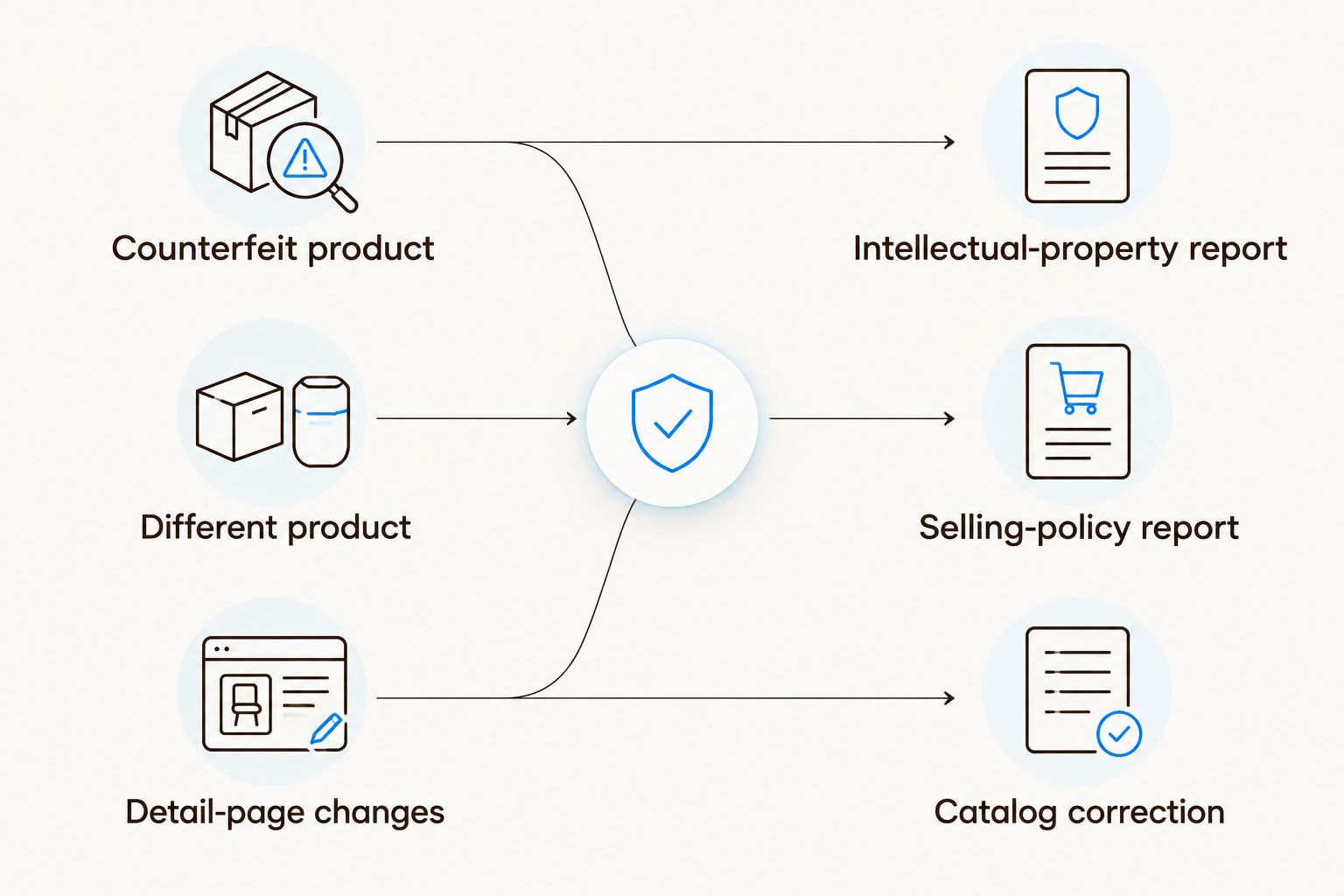
Choose the reporting route that matches the documented conduct.
Intellectual-property reports without Brand Registry
Amazon's public Report Infringement process is available outside Brand Registry. For an intellectual-property complaint, you must be the rights owner or an agent authorized to act for the rights owner.
Enrollment and ownership are separate questions. A brand can hold enforceable intellectual-property rights without being enrolled in Amazon Brand Registry. Conversely, enrollment does not turn every competing offer into infringement.
Build the complaint around the specific right and conduct:
Identify the trademark, copyright, or other right involved.
Provide the relevant ownership or registration information requested by the reporting process.
Identify the marketplace, ASIN, and specific offer where applicable.
Explain exactly how the reported conduct infringes that right.
Attach evidence that supports that explanation.
Best for: documented infringement reported by the rights owner or authorized agent. The benefit is a route that does not depend on Brand Registry enrollment. The limitation is equally clear: the report must establish an infringement issue, not merely an unwanted reseller.
Trademark rights are territorial. For a US or European marketplace complaint, identify the relevant rights and jurisdiction rather than assuming a registration covers every market. Ask qualified counsel to assess uncertain infringement questions before submitting a legal allegation.
Selling-policy reports without Brand Registry
Not every listing problem is an intellectual-property problem. A seller sending a different item, misrepresenting product condition, or otherwise violating Amazon's selling policies requires a report tied to that conduct.
Use the relevant reporting or support channel available in your Seller Central account. Reporting interfaces and access differ by account and marketplace, so use the current options presented to you rather than relying on an old menu path.
Describe the discrepancy plainly. If the listing represents a particular serum but the delivered product is a different item, document the listing, the order's seller, and the received product. Do not automatically describe the item as counterfeit when the evidence establishes only a mismatch.
Best for: documented selling-policy violations rather than disputed ownership rights. The advantage is a complaint matched to the customer-facing problem. The limitation is that Amazon still evaluates the evidence; a report is not a removal guarantee.
For a 2026 incident, retain the submission date and the exact policy issue reported. That record helps you distinguish a rejected allegation from a request for more information.
Catalog corrections without Brand Registry
If another contributor changes your title, brand information, images, or product attributes, preserve the incorrect version before requesting a correction. Supply evidence of the accurate product information, such as packaging photographs and manufacturer documentation.
Keep the requested correction narrow. State the affected field, the incorrect value, the correct value, and the document that supports it. A complaint about an unwanted seller does not explain why a product attribute is wrong.
Best for: inaccurate detail-page information supported by product documentation. The benefit is restoring the page's accuracy. The limitation is that a catalog correction does not establish an enforcement case against every seller attached to the ASIN.
Do not create a duplicate detail page simply to escape another offer. Resolve the catalog issue through the appropriate process rather than introducing another listing problem.
How do you collect evidence against a suspected hijacker?
Evidence must connect the allegation to the seller you report. A photograph of an unusual bottle has little value if you cannot show which offer supplied it.
Capture the offer before it changes
Record the marketplace, ASIN, seller storefront identity, product condition, and relevant offer details. Save screenshots that show the relationship between the offer and the listing.
Also preserve the detail page if the complaint concerns altered content. Your file should make the discrepancy understandable without requiring the reviewer to reconstruct an earlier version of the page.
Use a seller-specific test purchase when needed
A test purchase helps establish what a particular seller supplied. Confirm the seller during checkout and retain the order record; ordering from a product page without checking the selected seller risks investigating the wrong offer.
Retain the shipping packaging, product packaging, labels, and item itself. Photograph the received item and compare it with an authenticated reference product.
Explain differences instead of just photographing them
For beauty products, relevant observations include discrepancies in packaging, labeling, seals, batch markings, or the product supplied. Explain why each difference matters and what verifies the expected version.
A packaging difference alone is not conclusive proof of counterfeiting. Manufacturers change packaging, and regional versions exist. Check those explanations before making a definitive accusation.
Never use review manipulation, fabricated orders, or exaggerated safety allegations to strengthen a complaint. The evidence should establish the violation without manufactured customer activity.
What should your complaint actually say?
Write the complaint as an evidence summary, not a confrontation. The reviewer needs to identify the conduct, the affected offer, and the supporting material quickly.
Use a clear structure:
Subject: the ASIN, marketplace, seller, and alleged violation.
Observation: what happened, stated without unsupported conclusions.
Evidence: the order record, photographs, screenshots, and relevant rights documentation.
Explanation: how the evidence supports the specific violation.
Requested action: investigation or correction appropriate to that violation.
Separate what you know from what you suspect. For example, a received item lacking an expected seal is an observation. Calling it counterfeit requires additional grounds that connect the discrepancy to inauthenticity.
If Amazon requests more information, answer that request directly. Repeating the same accusation does not supply missing evidence. Keep subsequent submissions connected to the original case where the process allows it.
Maintain a 2026 incident log with the seller, ASIN, allegation, evidence, submission date, and decision. The useful record is the case history, not a folder full of disconnected screenshots.
Why hijacker-removal outcomes vary
Amazon evaluates the reported conduct and supporting evidence. Your brand's frustration is understandable, but it is not a substitute for a valid enforcement basis.
The main drivers are:
The violation: counterfeiting, catalog inaccuracy, and genuine resale are different cases.
Reporting authority: intellectual-property reports require the rights owner or authorized agent.
Evidence quality: seller-linked order records and explained discrepancies support a clearer investigation.
Jurisdiction: the relevant rights must support the allegation in the marketplace concerned.
Product identity: authentic regional variants and packaging updates must be distinguished from fakes.
Complaint scope: targeting the offending offer avoids an allegation broader than the evidence.
There is no defensible universal removal deadline. Do not build your response plan around an agency's promised outcome or an assumed support turnaround.
Does Brand Registry stop unauthorized sellers automatically?
No. Brand Registry provides enrolled brands with additional brand-protection tools, but it does not automatically prevent sellers from offering genuine goods. Amazon's infringement rules still govern whether a complaint is valid.
For 2026 planning, treat enrollment as an additional protection layer, not a substitute for evidence or distribution management. Check the current eligibility requirements for your trademark and marketplace.
Can you remove a reseller selling authentic beauty products?
Not simply because the reseller is outside your approved network. A distribution restriction and an Amazon policy violation are different matters.
Investigate where the goods came from and whether there is a separate, supportable legal or policy issue. Material-difference and resale questions require jurisdiction-specific legal analysis; do not assume an unauthorized seller is infringing.
Should you send a cease-and-desist letter first?
A cease-and-desist letter does not itself establish grounds for Amazon removal. Use legal counsel when you need to assert rights or address a distribution dispute.
Do not threaten infringement action solely because a genuine reseller is unwanted. If you contact the seller, keep the communication factual and preserve the exchange as part of the investigation.
When does outside Amazon management make sense?
Outside management fits when listing work, advertising, and operational follow-up need a shared owner. Booscala is best for beauty brands seeking end-to-end Amazon management rather than a standalone software tool.
Booscala's Amazon management covers listings, advertising, and operations. That scope is relevant when a listing incident needs coordination across your Amazon business, but it is not a stated legal service or a guarantee of seller removal.
Choose the specialist that matches the task. An embedded management team addresses operational ownership; qualified counsel addresses disputed legal rights. A brand needing only a narrow legal opinion should not substitute account management for legal advice.
FAQ
Can Amazon hijackers be stopped without Brand Registry?
Yes, when evidence supports intellectual-property infringement or an Amazon policy violation. Amazon's public Report Infringement process does not require Brand Registry enrollment, but genuine unauthorized resale alone is not enough.
Do I need a registered trademark to report every Amazon violation?
No, not every Amazon policy report is a trademark complaint. For intellectual-property reports, you must identify the right involved and have authority to report its alleged infringement.
Does an unauthorized seller count as a counterfeit seller?
No, an unauthorized seller is not automatically selling counterfeit goods. Establish product authenticity and the actual conduct before making an infringement allegation.
Should I buy from the suspected seller before reporting?
A seller-specific test purchase is useful when the allegation depends on what the seller supplies. Confirm the selected seller and preserve the order record, packaging, and product evidence.
Will Brand Registry remove every other seller from my listing?
No, Brand Registry does not give your brand exclusive selling rights over all genuine products. Additional protection tools do not replace the need for a valid complaint.
How long does Amazon take to remove a hijacker?
There is no universal removal deadline. The outcome depends on the allegation, reporting authority, evidence, and Amazon's review.
Can Booscala guarantee that an Amazon seller will be removed?
Amazon decides whether a reported offer violates its rules. Booscala provides Amazon management for beauty brands; account management is not a guarantee of enforcement or a substitute for legal advice.
One last thing
A removed offer is an incident outcome, not proof that the supply problem is solved. If genuine goods keep appearing outside your approved network, investigate the source with your distributors and wholesale partners.
Your next move is simple: identify the violation before choosing the reporting route. Preserve the evidence, submit a focused complaint, and address distribution leakage separately.
