Oct 12, 2026
Can small beauty brands compete with prestige brands on Amazon PPC?
Can small beauty brands compete with prestige brands on Amazon PPC? Yes. Learn how focused targeting, stronger listings, and margin-led tests guide your next move.

Yes. Small beauty brands can compete with prestige brands on Amazon PPC by targeting specific shopper needs, matching ads to convincing product pages, and setting bids around product economics. In 2026, the goal is profitable orders from relevant searches—not matching a larger brand’s visibility everywhere. A focused campaign still fails when the listing cannot support the promise that earned the click.
TL;DR
Can small beauty brands compete with prestige brands on Amazon PPC? Yes—prioritize relevant searches over category-wide visibility.
Amazon Sponsored Products is a practical starting point for focused beauty keyword testing; precise targeting still requires search-term review.
Separate brand defense, non-brand acquisition, and discovery so campaign totals do not hide weak customer acquisition.
Booscala’s Amazon beauty management suits brands seeking connected listing, advertising, and operational ownership—not isolated bid adjustments.
Can small beauty brands compete with prestige brands on Amazon PPC?
Yes, but competing does not mean bidding against prestige brands on every broad category term. You need a product that answers a specific search, a page that explains the match, and enough contribution margin to fund acquisition. Brand size alone does not establish whether a campaign is viable.
Start with the shopper’s actual search, not the keyword you hoped would work. Amazon’s search-term reports show the searches associated with ad traffic and attributed orders. Use the guide to Amazon search-term reports for beauty campaigns to turn those observations into targeting decisions.
Specific non-brand keywords
Best for: Reaching shoppers with a defined product need
Advantage: Lets you match the search to a clear product attribute
Limitation: Specific wording does not guarantee affordable or converting traffic
Broad category targeting
Best for: Exploring category demand
Advantage: Exposes additional search patterns
Limitation: Requires filtering; relevance varies across searches
Own-brand targeting
Best for: Reaching shoppers already searching for your brand
Advantage: Keeps brand-demand performance visible
Limitation: Does not demonstrate success acquiring unfamiliar shoppers
Competitor product targeting
Best for: Testing a credible alternative on relevant product pages
Advantage: Places the product in a comparison context
Limitation: The shopper still needs a clear reason to choose your product
Start with specific non-brand keywords when the product clearly answers them. Add broader discovery and competitor targeting as controlled tests, not as substitutes for a focused acquisition campaign.
Why this matters in 2026
A prestige name and a small brand can appear in the same shopping journey, but your campaign must answer a practical question: why should this shopper choose this product? Raising the bid does not answer it.
Beauty listings need to explain what the product is, how it fits into a routine, and what distinguishes it. For color cosmetics, shade and finish matter. For skincare, texture, ingredients, and supported suitability claims help shoppers evaluate the match.
The mistake is treating every click as equally valuable. A search for a particular product format carries different intent from a search naming another brand. Keep those situations separate so you can judge the advertising against the job it was meant to do.
Specific searches: compete on product fit
Best for: acquiring shoppers who describe what they want rather than naming a brand. Build targeting around attributes the product genuinely has: format, finish, ingredient, or routine role. Use customer language without adding unsupported claims.
A cleansing balm listing should make its format and use clear. A lip product advertised against a finish-specific search should show that finish accurately. These are targeting examples, not claims that either category delivers better PPC results.
Specific searches give you a clearer relevance test. Their limitation is reach: narrowing targeting also narrows the searches you pursue. Do not assume a longer keyword is cheaper or less competitive; judge its actual traffic and orders.
Competitor targeting: earn the comparison
Best for: products with a clear, defensible reason to be considered as an alternative. Amazon Sponsored Products supports product targeting, allowing you to test relevant product-page contexts rather than relying only on search keywords.
Choose targets because the shopper’s intended use overlaps with your product. Then inspect whether your page explains the difference without unsupported superiority claims. A different texture or format is useful only when the shopper can understand why it matters.
The advantage is a direct comparison context. The drawback is that attention is not preference: appearing near a prestige product does not make shoppers willing to switch. Keep competitor-targeting results separate from generic keyword performance.
Own-brand targeting: protect the measurement
Best for: keeping searches for your own brand separate from customer acquisition. Own-brand ads address demand that already names you. That makes them a different task from convincing an unfamiliar shopper to consider your product.
The benefit is clarity. The limitation is interpretation: attributed brand-search sales do not prove that advertising created all those purchases. A strong blended advertising report can coexist with weak non-brand campaigns.
For your 2026 reporting, show branded and non-branded results separately. Evaluate both, but do not let existing brand demand become the evidence that your prestige-competition strategy works.
Why Amazon PPC results vary between beauty brands
Brand size is not a campaign diagnosis. Inspect these factors before deciding that a prestige competitor’s presence makes a target unwinnable:
Search intent: Does the shopper want a product type, a specific attribute, or a named competitor? Each requires a different relevance test.
Product differentiation: Can the listing explain a meaningful difference using substantiated facts rather than premium-sounding language?
Listing clarity: Do images and copy answer the questions raised by the advertised search?
Product economics: Does the order leave enough contribution after product and marketplace expenses to support acquisition?
Campaign separation: Can you distinguish own-brand demand, non-brand acquisition, and discovery when reviewing results?
These are decision factors, not industry benchmarks. Your target should come from your product economics and campaign evidence, not a universal beauty-category performance figure.
Build a focused 2026 test in 5 steps
A useful test has a question, a spending boundary, and a decision rule. Follow this sequence before expanding targeting across the catalog.
1. Product fit
Choose a product whose positioning you can explain plainly. Write down its intended use, relevant attributes, and the searches those attributes answer. Exclude searches that require claims your product documentation does not support.
Do not select the product solely because you want to sell more of it. Advertising cannot establish a product-search match that the page itself cannot explain.
2. Listing check
Complete 4 listing checks: product identity, attribute accuracy, visual explanation, and routine guidance. Confirm that the title identifies the product, copy supports the targeting, images clarify the relevant attributes, and usage information answers practical questions.
Read the page from the perspective of someone who has never heard of your brand. Remove vague claims and resolve conflicting descriptions before asking paid traffic to make sense of them.
3. Campaign separation
Use 3 campaign groups for the testing plan: brand defense, non-brand acquisition, and discovery. This is a recommended organization, not an Amazon account requirement. Keep competitor tests identifiable within that structure.
Discovery exists to find useful targeting evidence. Acquisition exists to evaluate relevant non-brand demand. Brand defense exists to address searches naming you; do not merge their objectives simply to produce a stronger-looking total.
4. Search review
Review the searches associated with clicks and attributed orders. Identify irrelevant intent, assess promising queries individually, and use negative targeting where appropriate. A keyword’s wording alone is not enough to judge the traffic it delivers.
Allow for reporting and attribution timing before deciding a recent click failed. Make exclusions because the evidence or product mismatch supports them, not because every search must produce an immediate order.
5. Economic decision
Compare advertising expense with the contribution available from the orders it supports. Decide whether to continue, adjust, expand, or stop the target. Record the reason so the next review evaluates the same objective.
Expand a demonstrated product-search match—not an assumption about what prestige shoppers should want. If the page is unclear, correct it before treating a higher bid as the solution.
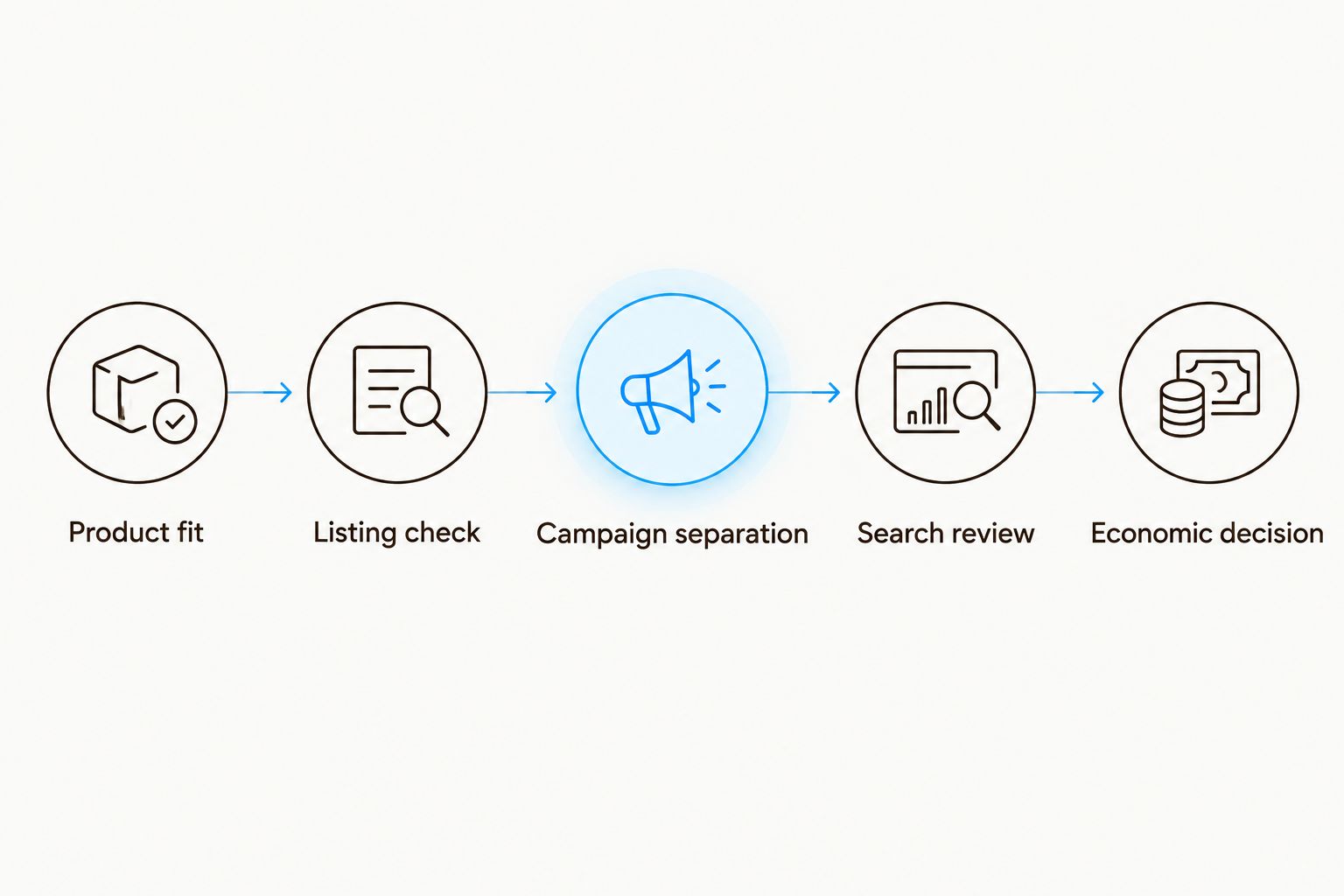
Check the product and listing before using bids to expand the test.
Measure competition without confusing sales with profit
Amazon advertising cost of sales, or ACoS, divides advertising spend by attributed advertising sales. Return on advertising spend, or ROAS, reverses that relationship. Neither metric includes every expense required to produce and fulfill the order.
Total advertising cost of sales, or TACoS, compares advertising spend with total sales. It adds account context, but a change in TACoS alone does not prove that ads caused an organic-sales change. Keep attribution and causation separate.
For your 2026 decision sheet, pair advertising metrics with product contribution and total sales. Compare equivalent reporting periods and use consistent attribution settings. A target that produces revenue but consumes its available contribution is not a profitable win against a prestige brand.
Also inspect where the result comes from. If own-brand searches explain the improvement, you have evidence about existing demand—not necessarily evidence that unfamiliar shoppers are choosing you over established competitors.
When specialist Amazon management fits
Booscala is best suited to beauty brands seeking integrated Amazon listing, advertising, and operational management. That scope fits a founder who needs the product page and campaign managed together rather than assigned to disconnected providers.
The advantage of Booscala’s Amazon beauty management is its connected scope. The trade-off is that full-service ownership is broader than a standalone PPC assignment; a brand seeking only bid adjustments should assess whether that scope matches its need.
Compare Booscala against the work your team actually needs covered. Ask who owns listing changes, campaign decisions, operational coordination, and profitability reporting. Evaluate the responsibilities, not just the promise of revenue growth.
Should a small beauty brand bid on prestige brand names?
Competitor-name targeting belongs in a separate test, not the default acquisition plan. A shopper naming a prestige brand is expressing brand-specific intent, so your alternative needs a convincing and accurate reason to be considered.
Judge that test on its own results. Do not assume that another brand’s recognition transfers to your product simply because the ad receives clicks.
Is Sponsored Products enough to start competing?
Sponsored Products is a practical starting point for testing keyword and product relevance. It supports a focused test without requiring you to introduce every advertising format at once.
Its limitation is scope: a Sponsored Products campaign does not replace listing work, brand positioning, or operational management. Add other formats when you can state the distinct job they will perform.
When should a small beauty brand increase PPC spend?
Increase PPC spend when the target supports your stated economic objective and the listing accurately answers the traffic it attracts. Confirm that non-brand results—not only brand-search sales—support the decision.
Before expanding, identify what extra spending is intended to achieve. More discovery, greater reach on a proven target, and competitor testing are different decisions with different evidence requirements.
FAQ
Can a small beauty brand beat a prestige brand on Amazon PPC?
A small beauty brand can compete for relevant searches and orders without matching a prestige brand’s overall visibility. The campaign needs a clear product-search match, a convincing listing, and workable product economics.
What’s the best Amazon PPC starting point for an indie beauty brand?
Specific non-brand targeting through Sponsored Products is a practical starting point when the product clearly answers those searches. Keep discovery and own-brand demand separate so you can evaluate customer acquisition.
Are longer beauty keywords always cheaper on Amazon?
Longer beauty keywords are not automatically cheaper. Evaluate their actual click costs, relevance, and attributed orders rather than assuming keyword length determines competition.
Should I target a prestige competitor’s product page?
Target a prestige competitor’s product page only as a controlled test with a defensible product comparison. Relevant placement creates an opportunity to be considered, not a guarantee that shoppers will switch.
Do I need more reviews before running Amazon beauty ads?
There is no universal review-count threshold that establishes PPC readiness for every beauty product. Evaluate listing accuracy, shopper questions, product economics, and the campaign’s actual results rather than treating a review count as a guarantee.
What’s a good ACoS target for a small beauty brand?
A useful ACoS target comes from the product’s contribution margin and the campaign objective. A category-wide target cannot account for your product costs, marketplace expenses, and required contribution.
Does a lower TACoS prove that PPC improved organic ranking?
A lower TACoS does not by itself prove that PPC improved organic ranking. It describes advertising spend relative to total sales; establishing an incremental effect requires additional evidence.
Should a small beauty brand advertise its entire catalog?
A small beauty brand should not spread testing across its entire catalog by default. Start with products whose search relevance, listing clarity, and economics support a clear test, then expand based on results.
One last thing
Your most useful competitor is the next product the shopper considers—not necessarily the biggest name in beauty. Before approving a target, write a plain sentence explaining why someone making that search should consider your product.
Then check whether the listing proves that sentence. If the explanation depends on claims the page cannot support, change the targeting or the page before increasing the bid.
