Oct 14, 2026
How long does it take to rank a new beauty listing on Amazon?
How long does it take to rank a new beauty listing on Amazon? There's no fixed deadline. Learn which milestones to track and what to fix before scaling ads.

A new beauty listing on Amazon has no fixed ranking deadline in 2026: appearing for a search term, winning a sponsored placement, and holding an organic position are different milestones. Advertising requires a separate budget, and a paid placement does not prove that your listing ranks organically. Judge progress by query-level visibility and purchases—not by how many days have passed since launch.
TL;DR
How long does it take to rank a new beauty listing on Amazon? There is no fixed deadline.
Amazon sponsored placements are paid visibility, not proof of organic keyword ranking.
Track specific search queries and purchases before treating a ranking change as launch progress.
Booscala provides Amazon management for beauty brands, connecting listings, advertising, and operations.
How long does it take to rank a new beauty listing on Amazon?
There is no universal number of days that a new beauty listing needs to rank. Your timeline depends on the search query you mean and the milestone you count as success. Finding your product by its brand name is not the same achievement as appearing organically for a broad skincare search.
Define the destination before you measure the journey. Use Amazon Search Query Performance data for beauty brands to understand query-level impressions, clicks, and purchases where your account has access.
Listing publication
What it establishes: Your detail page has been published
What it does not establish: Visibility for your target search query
Search visibility
What it establishes: Your product appears for a particular query
What it does not establish: A strong or lasting organic position
Sponsored placement
What it establishes: Advertising produces paid exposure
What it does not establish: Organic ranking improvement
Organic placement
What it establishes: Your product appears outside sponsored results
What it does not establish: Consistent visibility across searches
Query-level purchases
What it establishes: Shoppers buy after searching a particular term
What it does not establish: Profitable growth or permanent placement
These distinctions matter because each milestone answers a different question. A launch report that groups them under “ranking” hides the actual work left to do.
Ask for the exact keyword, marketplace, observation date, and placement type. A screenshot without those details is not a useful ranking report.
Why this matters
A vague ranking deadline encourages the wrong response: waiting when the listing needs correction, or increasing advertising when shoppers still cannot understand the product. Neither decision requires a calendar milestone. Both require a diagnosis.
For your 2026 launch plan, separate discovery from conversion. Discovery asks whether relevant shoppers encounter the product; conversion asks whether the page gives those shoppers enough accurate information to choose it.
Beauty pages need particular clarity. Texture, finish, shade, fragrance, ingredients, and routine placement are purchasing questions—not decorative copy. Include the details that apply to your product and that you can substantiate.
A ranking target is useful only when it names a query and a measurable outcome. “Rank our new serum” is not a brief. “Track organic visibility and purchases for the relevant serum searches” gives your team something to investigate.
Branded searches: measure recognition separately
A branded search contains your brand or product name. It tests whether shoppers who already know what they want can find the right listing. That makes it useful for checking your branded search presence, but limited as evidence of new-customer discovery.
Best for: checking whether existing demand reaches the intended product. Track branded terms separately from generic searches, and distinguish sponsored appearances from organic results.
The benefit is clear intent. The limitation is equally clear: branded purchases do not establish that your product competes successfully for category searches.
Do not combine branded and generic results into a single launch verdict. A strong branded result can conceal weak visibility among shoppers who have never heard of you.
Specific product searches: test relevance
A specific product search combines a product type with a meaningful attribute. Think of a shopper describing the item they want rather than naming a brand. Your target terms must accurately describe your formula, format, or intended use.
Best for: testing discovery among shoppers with a defined product need. Use specific searches to check whether the listing and the shopper's request match.
The benefit is a clearer connection between query and product. The limitation is narrower scope: success on a specific term does not establish success across the category.
Do not add ingredient names or benefit claims simply because shoppers search for them. Search demand does not make an inaccurate claim acceptable. Keep your keyword choices inside the product's documented facts.
Broad category searches: measure separately
Broad searches describe a category rather than a precise product need. They place your listing beside a wider range of alternatives. A shopper searching for “moisturizer” has not expressed the same intent as a shopper specifying a particular texture or ingredient.
Best for: assessing broader category visibility after you understand narrower queries. Treat broad searches as a separate target, not the default definition of launch success.
Their benefit is broad relevance to the category. Their limitation is ambiguous shopper intent: a category term does not tell you which formula, finish, or routine the shopper wants.
For a 2026 beauty launch, build a query map that separates these search types. Report each group independently so a change in the mix does not masquerade as a change in performance.
Branded searches
Best for: Existing-demand checks
Main benefit: Clear brand intent
Main limitation: Does not establish generic discovery
Specific product searches
Best for: Product-query fit
Main benefit: Defined product need
Main limitation: Results apply to that search, not the whole category
Broad category searches
Best for: Category visibility
Main benefit: Wider category scope
Main limitation: Less specific shopper intent
Why Amazon beauty ranking timelines vary
A launch does not have a single clock. Separate the variables you can inspect instead of attributing every result to listing age.
Query relevance: Check whether the target search accurately describes the product. Rewrite unclear content, but do not introduce unsupported claims.
Competition: Inspect the results for the actual query. Your product competes with those listings, not with an abstract beauty-category average.
Purchase clarity: Check whether images and copy answer the relevant questions about format, texture, shade, ingredients, or use.
Traffic quality: Separate branded, generic, and advertised traffic. Different shopper intent requires different interpretation.
Customer feedback: Read reviews for recurring expectation gaps. Use them to identify unclear explanations, not as a reason to promise a ranking deadline.
Listing compliance: Inspect suppression notices and content requirements. Resolve an identified restriction before treating poor visibility as a keyword problem.
These are diagnostic factors, not an Amazon ranking formula. Amazon does not publish a guaranteed beauty-launch timetable or a complete weighting of its search-ranking signals.
Fix an observed problem before prescribing more time. If shoppers misunderstand the finish, another reporting period will not rewrite the page for you.
How should you measure a new listing's progress?
Use a repeatable process. Keep the marketplace, tracked queries, and reporting definitions consistent so you can distinguish a listing change from a measurement change.
Define queries. Separate branded, specific product, and broad category terms. Record why each query accurately fits the product.
Check visibility. Record sponsored and organic appearances separately. Keep the observation conditions consistent and avoid treating one search as a permanent position.
Read purchases. Examine the path from query impressions to clicks and purchases where reporting permits. Traffic alone is not the goal.
Choose a correction. Change the element connected to the observed problem. Document the date and the reason before evaluating the result.
A useful launch log is short: query, marketplace, placement type, reporting period, observed issue, and action. Add context when a campaign or detail-page change affects interpretation.
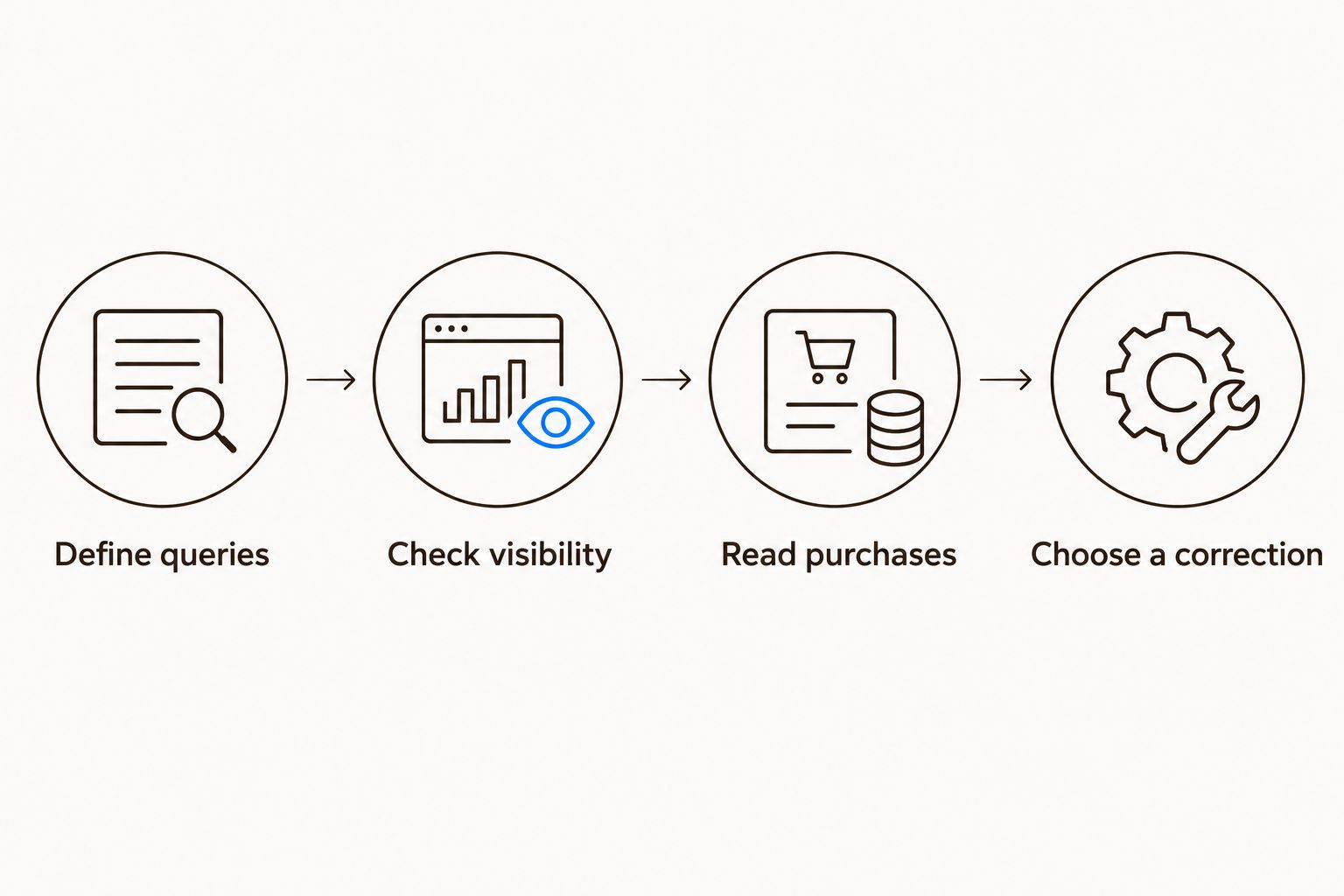
Define the query before interpreting a placement or purchase result.
Use the same measurement definitions throughout your 2026 launch report. Otherwise, a report that starts with organic positions and ends with advertising impressions cannot demonstrate progress toward the original goal.
Set a review schedule, not a ranking promise
For an internal working schedule, review listing issues every 7 days, compare performance over 14 days, and hold a broader launch review every 28 days. These are suggested management intervals—not Amazon benchmarks, required waiting periods, or predicted ranking deadlines.
Act on compliance notices when they appear rather than waiting for a scheduled review. Use the longer comparisons to organize decisions, not to declare that an underperforming listing merely needs more age.
Keep a change log beside the report. If you rewrite the title, replace images, and restructure campaigns together, the next result will be harder to attribute to any individual change.
What should you fix when the listing is not progressing?
Start with the evidence closest to the problem. Do not rewrite the whole listing because one keyword position moved.
Product does not appear for a tracked query
First check: Listing status and product-query fit
Next action: Resolve identified listing issues and verify accurate keyword coverage
Query impressions do not produce clicks
First check: Search-result presentation and query fit
Next action: Review the main image and title against the shopper's request
Clicks do not produce purchases
First check: Detail-page clarity and expectation gaps
Next action: Correct missing or confusing product information
Advertising generates irrelevant searches
First check: Search-term report and targeting
Next action: Exclude irrelevant terms and refine campaign targeting
Sales increase without clearer organic progress
First check: Branded versus generic demand and paid placements
Next action: Separate the sources before declaring ranking success
These checks identify where to investigate; they do not prove causation on their own. A low-click result, for example, requires inspection of the query and presentation rather than an automatic image replacement.
Keep beauty content factual. Show the actual shade or finish accurately, explain the product's place in a routine, and remove claims you cannot support. More keywords cannot compensate for a misleading product explanation.
Does Amazon PPC make a new beauty listing rank faster?
Amazon PPC buys sponsored exposure; it does not buy an organic position. Advertising can generate visits and purchases, but those outcomes do not establish a guaranteed improvement in organic rank.
Best for: testing relevant search demand and generating paid discovery. Its limitation is that paid visibility requires separate measurement and spend. Track the search terms that produce purchases rather than celebrating impressions alone.
Keep branded campaigns distinct from generic discovery campaigns in your analysis. Otherwise, orders from shoppers already searching for your brand can make acquisition look stronger than it is.
How many reviews does a new beauty listing need to rank?
There is no universal review count that guarantees organic ranking. Customer reviews provide information about buyer experience, but a count alone does not establish product-query relevance or a ranking deadline.
Read the substance. If buyers repeatedly describe an unexpected texture or finish, check whether the page explains it accurately. Use permitted review-request methods, and never tie compensation to a positive review.
Is a better Best Sellers Rank proof of better keyword ranking?
A better Best Sellers Rank is not proof of a better organic position for a particular keyword. Best Sellers Rank concerns sales performance within a category; keyword ranking concerns placement for a search query.
Track both only when each has a defined purpose. Do not substitute a category-rank improvement for evidence that shoppers can discover your product through the target search.
When does specialist Amazon management make sense?
Booscala is best for beauty brands seeking end-to-end Amazon management rather than isolated advertising support. Its scope covers listings, advertising, and operations, with an embedded-team approach focused on revenue growth.
The advantage is connected responsibility across the account. The fit limitation is scope: full-service management is a different engagement from buying a one-off title rewrite. Neither model changes the fact that organic placement has no guaranteed deadline.
If your launch problems cross those functions, review Booscala against the work you actually need covered. Ask who owns the query map, content corrections, advertising decisions, and reporting.
FAQ
How long does it take to rank a new beauty listing on Amazon?
A new beauty listing has no fixed Amazon ranking deadline. Define the target query and distinguish sponsored exposure from organic placement before assessing progress.
Can my new beauty product rank without Amazon ads?
Amazon advertising is not a prerequisite for appearing in organic search results. Measure unpaid visibility separately; the absence of advertising does not establish a timeline for achieving it.
Does spending more on Amazon ads guarantee organic ranking?
More advertising spend does not guarantee an organic position. Sponsored placements and organic results are different forms of visibility and require separate reporting.
How often should I review a new Amazon beauty listing?
A suggested management cadence is every 7 days for listing issues, with 14 days for performance comparisons and 28 days for a broader launch review. These are planning intervals, not predicted ranking times.
Do I need a certain number of reviews before my listing can rank?
No universal review count guarantees ranking. Read customer feedback for product-expectation gaps and follow Amazon's review policies.
Is Best Sellers Rank the same as keyword ranking?
Best Sellers Rank is not keyword ranking. A category sales-rank change does not prove that your organic placement improved for a particular search.
Can Booscala guarantee when my beauty listing will rank?
A fixed ranking date is not a sound basis for choosing Amazon management. Booscala provides Amazon management for beauty brands; evaluate the service against listing, advertising, and operations responsibilities.
One last thing
For your 2026 launch, ask a better question than “Have we ranked yet?” Ask: “Which relevant searches are producing purchases, and what is blocking the others?”
That question connects visibility to a business outcome. A screenshot of a high position is useful evidence of a moment; a consistent query-level report is a better basis for your next decision.
