Oct 22, 2026
How long should a beauty brand wait before switching Amazon PPC strategy?
How long should a beauty brand wait before switching Amazon PPC strategy? Wait for mature attribution, then fix waste or change direction with evidence.

A beauty brand should wait until the campaign’s applicable attribution window has closed and comparable performance data supports a decision—not until an arbitrary deadline. Correct clearly irrelevant targeting immediately, but replace the broader Amazon PPC strategy only when mature results show that its targeting, budget allocation, or commercial objective needs to change.
TL;DR
How long should a beauty brand wait before switching Amazon PPC strategy? Until attribution matures and comparable results justify change.
Fix irrelevant search terms immediately; do not rebuild productive campaigns just because recent sales reporting is incomplete.
Booscala manages Amazon advertising, listings, and operations for beauty brands that need those decisions handled together.
How long should a beauty brand wait before switching Amazon PPC strategy?
Wait for a fair test, not a calendar milestone. A fair test requires relevant traffic, mature attribution, a defined objective, and a product page that supports the promise made by the ad.
Separate a routine correction from a strategic switch. Excluding an irrelevant search term is campaign maintenance; changing which shoppers you pursue or how you distribute spend across the portfolio is strategy.
Keep testing
Best for: Relevant campaigns with incomplete results
Supporting evidence: Attribution remains incomplete or traffic is too limited
Benefit: Preserves a readable test
Main drawback: Extends exposure to uncertain performance
Make a targeted correction
Best for: An identifiable source of waste
Supporting evidence: Search terms, bids, or destinations conflict with the objective
Benefit: Fixes the problem without replacing the plan
Main drawback: Does not solve a wider strategic mismatch
Switch strategy
Best for: Mature results that fail the business objective
Supporting evidence: Comparable campaign and product-level evidence
Benefit: Changes the underlying allocation or targeting logic
Main drawback: Creates a new test and disrupts comparisons
Booscala provides Amazon management for beauty brands across advertising, listings, and operations. That combined scope matters when the apparent advertising problem sits elsewhere in the buying journey.
Why this matters
Changing strategy too early makes the account harder to diagnose. Changing it too late keeps money committed to a plan that no longer serves the brand.
Your 2026 advertising plan needs a decision rule before it needs a deadline. Define what the campaign should achieve, what evidence would disprove the approach, and what spending boundary protects the business during the test.
A disappointing account average is not enough. A campaign attracting relevant new shoppers deserves a different assessment from a campaign capturing searches for your own brand name.
What should happen before you replace the strategy?
Use this sequence before making a broad change. Each step answers a different question; skipping one leaves the final decision exposed to a different explanation.
Define the objective
Write down the campaign’s job in plain language. Is it defending branded demand, finding relevant category shoppers, supporting a launch, or improving contribution after advertising?
Choose the primary outcome before reviewing performance. If the objective changes after every report, the strategy never receives a consistent test.
Best for: every campaign under review. The benefit is a clear standard; the limitation is that an objective alone does not tell you whether the underlying economics work.
Check attribution
Check the attribution window and reporting guidance for the specific Amazon ad product and account type. Do not apply a remembered rule from another campaign format.
Recent clicks and reported purchases do not necessarily appear together. Label the newest reporting period as incomplete rather than comparing it directly with a fully matured period.
Best for: campaigns judged on recent conversion data. Waiting improves comparability, but it does not excuse continuing demonstrably irrelevant targeting.
Inspect traffic
Read the actual shopper queries where search-term reporting is available. Ask whether the advertised product answers the need expressed in each query.
For beauty, intent goes beyond a broad category label. A shopper looking for a cleansing oil is not asking for a facial oil treatment, even though both searches contain the word oil.
Best for: campaigns generating clicks without a convincing purchase pattern. Search-term inspection identifies mismatches, but it cannot prove that the detail page persuades relevant shoppers.
Check the listing
Compare the ad’s promise with the destination. Product type, intended use, shade, texture, and routine placement should remain clear when the shopper reaches the detail page.
A foundation ad cannot solve unclear shade information. A serum campaign cannot compensate for a page that leaves the product’s role in a skincare routine unexplained.
Best for: relevant traffic that does not convert as expected. Fixing the destination addresses a possible conversion barrier, but it changes the test conditions and must be recorded.
Make the decision
Keep, correct, or replace the approach using mature evidence against the original objective. Preserve productive segments unless the evidence identifies a reason to change them.
Record the decision and its rationale. Your next review should explain whether the change solved the diagnosed problem—not merely whether the dashboard looks different.
Best for: campaigns with a documented objective and comparable results. A recorded decision creates accountability; it still requires follow-up to establish whether the new approach works.
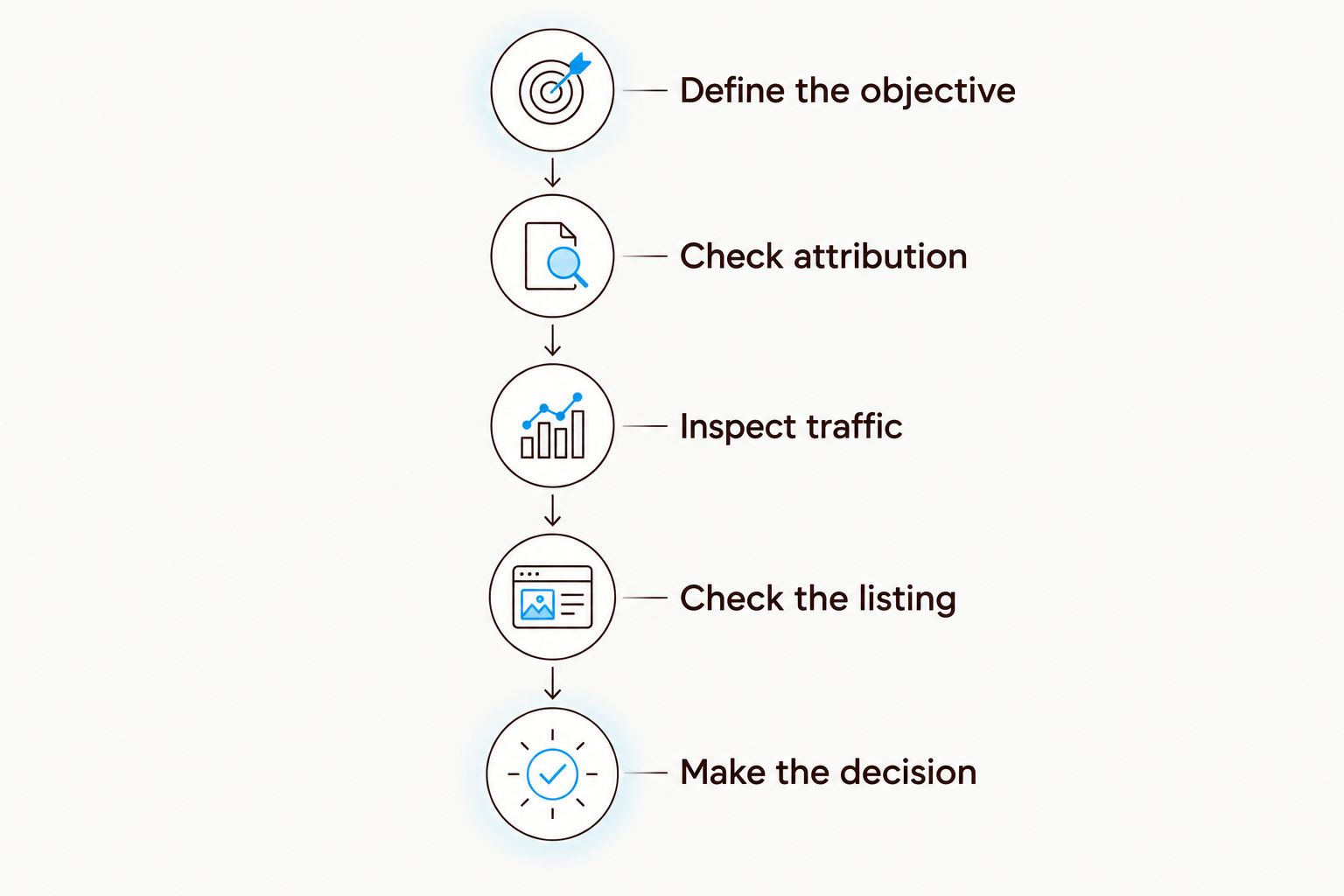
Check the evidence in sequence before replacing the strategy.
When should you correct targeting immediately?
Do not wait for more conversion data to resolve an obvious relevance mismatch. If the query describes a different product or use, decide whether that traffic belongs in the campaign at all.
Review the scope of the correction carefully. An exclusion that removes an irrelevant query should not accidentally remove a relevant shopping intent elsewhere.
Use these checks:
Product type: Does the query describe the item being advertised?
Intended use: Does the shopper’s requested application match the product?
Product attributes: Does the query require an attribute the listing does not support?
Destination: Does the ad send shoppers to the intended product or page?
A correction has a narrow purpose. It removes a known mismatch while leaving the rest of the strategy available for evaluation.
Do not treat every search term without an attributed purchase as irrelevant. Relevance and conversion performance are different questions; the first requires a product match, while the second requires mature results and economic context.
When should you keep the strategy running?
Keep the strategy running when traffic matches the product, the test remains within its agreed spending boundary, and reporting is not yet mature enough to support a conclusion. Waiting under those conditions preserves useful evidence.
Waiting without a question is different. Your team should be able to state what additional evidence it expects and how that evidence will affect the next decision.
For a 2026 launch review, distinguish limited exposure from failed demand. A campaign that has barely reached relevant shoppers has not answered the same question as one that has generated sustained, relevant traffic without meeting its objective.
Keep the test stable where possible. Changing targeting, bids, creative, and the listing together prevents a clean explanation of which change affected performance.
Stability has a limit: do not preserve a known mistake merely to protect the test. Correct it, document it, and assess the revised conditions separately.
When does the evidence justify a strategic switch?
A strategic switch is justified when mature, comparable results contradict the underlying plan. The problem must extend beyond an isolated search term, bid, or listing issue.
Examples include allocating spend toward product groups that fail the agreed contribution objective, pursuing shopping intents the range does not serve, or judging acquisition campaigns solely by their ability to capture existing branded demand.
A switch should name the old assumption and its replacement. For example: stop treating every product as an equal acquisition priority and allocate prospecting spend according to product-level evidence instead.
That is a strategic decision. Renaming campaigns is not.
Before approving a replacement strategy, require a written explanation of:
The objective the current approach failed to meet.
The mature evidence supporting that conclusion.
The listing or reporting explanations already checked.
The specific targeting or allocation assumption being changed.
The evidence that will determine whether to retain the replacement.
The benefit is clearer allocation. The trade-off is a new evaluation period, so keep productive campaign segments intact wherever the proposed change does not require replacing them.
Why the waiting period varies
There is no defensible universal waiting period across every beauty account. The decision depends on the conditions that make the results interpretable.
Attribution: Different ad products and account types require their own reporting checks. Use the applicable guidance rather than a single account-wide assumption.
Traffic volume: Elapsed time does not guarantee meaningful exposure. Limited relevant traffic leaves the demand question unresolved.
Campaign objective: Branded defense, category acquisition, and launch support serve different purposes. Evaluate each against its assigned job.
Listing changes: New images, copy, or variation presentation change the shopping experience. Mark those changes before comparing periods.
Commercial context: Contribution requirements determine what the business can support. An account-wide efficiency target can conceal differences between products.
Demand conditions: Promotional events and seasonal shopping periods affect comparisons. Do not treat an event period as interchangeable with ordinary trading.
For your 2026 review, select comparable conditions before interpreting the trend. A longer reporting period does not repair a comparison built from fundamentally different campaign objectives or shopping conditions.
Which numbers should decide the switch?
Use advertising metrics to locate the problem, then use business economics to judge its importance. No single ratio answers both questions.
Advertising cost of sales compares advertising spend with attributed advertising sales. Total advertising cost of sales compares advertising spend with total sales; neither calculation, on its own, establishes profit.
Review spend, clicks, attributed orders, attributed sales, total sales, and contribution together. Segment branded and non-branded activity so that demand from existing brand searches does not stand in for category acquisition performance.
Use the Amazon search-term reporting guide for beauty campaigns to connect account-level outcomes with the queries receiving spend.
Your 2026 reporting should also preserve a change log. Without it, a performance movement following a listing edit can be mistaken for the effect of a bidding decision.
Do not demand the same result from every campaign role. Demand a documented reason for the difference, plus an economic boundary the brand has approved.
Should you change bids before changing the entire strategy?
Change bids before replacing the strategy when the evidence points to a bidding problem. Relevant targeting and a suitable destination do not automatically mean every click is economically justified.
A bid correction preserves the underlying shopper hypothesis. Its limitation is equally clear: a lower bid cannot make the wrong shopping intent relevant.
Should you fix the listing before changing Amazon PPC?
Fix a documented listing problem before blaming the broader PPC strategy. Review whether the page clearly explains what the product is, who it serves, and how the advertised variant differs from alternatives.
Record when the correction goes live. Treat subsequent results as evidence under revised conditions rather than merging them into the earlier test without explanation.
When does outside management make sense?
Booscala is best for beauty brands seeking integrated Amazon management across advertising, listings, and operations. That scope fits a brand whose advertising decisions require coordinated changes beyond the campaign manager.
The fit has a boundary. A brand seeking only isolated bid adjustments has a narrower need than end-to-end management; the broader scope should solve an actual operating problem, not replace a clear internal process.
For a 2026 agency review, ask who owns the diagnosis, who approves the spending boundary, and who implements listing corrections. A report without a decision owner leaves the original problem unresolved.
Review your Amazon management needs
Explore integrated advertising, listing, and operations management for beauty brands.
FAQ
How long should a beauty brand wait before switching Amazon PPC strategy?
Wait until the applicable attribution window has closed and comparable results support a decision against the campaign’s objective. Correct obvious relevance mismatches immediately rather than waiting for a broader strategy review.
Should I pause an Amazon keyword as soon as it gets clicks without sales?
Clicks without reported sales do not automatically justify pausing a keyword. Check attribution maturity, query relevance, the destination, and the campaign’s agreed economic boundary first.
Does a higher ACoS mean my beauty brand needs a new strategy?
A higher ACoS alone does not establish that the strategy needs replacing. Compare the result with the campaign objective, product economics, and changes in the mix of branded and non-branded traffic.
Should I change my Amazon bids every day?
Do not change bids simply because another day has passed. Make a change when evidence identifies a bidding problem, and record the adjustment so the next review remains interpretable.
Is my listing or my Amazon advertising causing weak conversion?
Check both traffic relevance and the detail page before assigning the cause. A relevant query with an unclear destination requires a different response from a query that describes the wrong product.
Can an agency manage PPC and listing problems together?
An integrated Amazon agency can manage advertising and listing work together when both sit within its scope. Booscala serves beauty brands across advertising, listings, and operations.
One last thing
Before approving a strategy switch, ask: What result would make you keep the current approach? If nobody can answer, the test has no decision rule.
Write that answer down before making the next change. You need evidence that can change the decision—not a deadline that merely forces one.
