Oct 8, 2026
Is Amazon Sponsored TV worth it for beauty brands?
Is Amazon Sponsored TV worth it for beauty brands? Test it for discovery, not quick sales. Learn when to launch, what to measure, and when to fix search first.

Amazon Sponsored TV is worth testing for beauty brands with a clear product story, strong Amazon listings, and a plan to measure demand beyond immediate sales. In 2026, treat it as a discovery channel, not a replacement for search advertising; creative production and measurement add work beyond campaign management.
TL;DR
Is Amazon Sponsored TV worth it for beauty brands? Test it for discovery after fixing listing and search fundamentals.
Amazon Sponsored TV suits visual product stories; completed video views alone do not prove incremental sales.
Sponsored Products serves shopping intent; Sponsored TV introduces a brand before shoppers search.
Booscala serves beauty brands needing connected Amazon management, not a standalone television campaign.
Is Amazon Sponsored TV worth it for beauty brands?
Yes for a controlled discovery test. No as a rescue plan for weak Amazon sales. The decision depends on what your next advertising investment needs to accomplish: introduce your brand, explain your product, or convert shoppers already looking for it.
Amazon Ads describes Sponsored TV as a self-service streaming television advertising solution. That establishes its role, not its profitability for your brand. For campaign planning in 2026, confirm the current requirements and reporting in your advertising account before committing creative resources.
Use this comparison to choose the job before choosing the format. The Sponsored TV ads guide for beauty brands covers the channel-specific planning behind that decision.
Amazon Sponsored TV
Best for: Introducing a beauty brand through streaming video
Main advantage: Space to demonstrate a product and communicate a brand story
Main limitation: Viewing an ad does not establish purchase intent or incremental sales
Recommendation: Test when discovery is the objective
Amazon Sponsored Products
Best for: Reaching shoppers searching for relevant products
Main advantage: Connects advertising to active shopping behavior
Main limitation: Search advertising does not do the same storytelling job as television
Recommendation: Prioritize when capturing demand is the objective
Amazon Sponsored Brands video
Best for: Demonstrating a product within Amazon shopping placements
Main advantage: Combines video explanation with a shopping environment
Main limitation: Results do not establish how the same creative will perform on television
Recommendation: Consider when product explanation and shopping intent overlap
These formats serve different jobs. Do not move investment from a productive search campaign into Sponsored TV simply because television feels like the next stage of growth. Identify the gap first.
Why this matters
A beauty shopper needs more than a product name. Texture, application, finish, and routine placement can all be useful material for a video demonstration. Sponsored TV gives you a setting for that explanation, but the video still has to communicate something concrete.
A viewer seeing your product is not the same as a shopper deciding to buy it. Your 2026 media plan should keep those outcomes separate. Otherwise, a report full of viewing activity can look successful while the commercial question remains unanswered.
The opportunity is product understanding. The risk is paying for exposure without knowing whether that exposure changes demand. Your campaign brief needs to address both before production begins.
When Sponsored TV deserves a test
Your product has a clear visual story
Sponsored TV is best for a product whose use or distinguishing feature you can show clearly. A cleanser demonstration, a cosmetic finish, or a product's place in a skincare routine gives the viewer something specific to understand. Choose the story your evidence supports.
Avoid asking the ad to introduce your entire catalog. That turns a product explanation into a collection of disconnected claims. Lead with a recognizable product, show its use, and make the brand easy to remember.
The limitation is equally important: demonstration does not prove efficacy. Your creative must distinguish visible product characteristics from performance claims requiring substantiation.
Your Amazon content answers the next question
Sponsored TV is best for brands whose product pages can continue the explanation. Check whether your images, bullets, and enhanced content describe the same use case as the video. A compelling ad and a vague detail page are not a finished customer journey.
Read your listing as someone encountering the brand for the first time. Can that person identify what the product does, how to use it, and which variant matches the demonstration? Fix contradictory or incomplete answers before introducing another channel.
The advantage is consistency. The limitation is that content readiness alone does not establish demand; it simply removes an avoidable obstacle to evaluating the campaign.
You can evaluate discovery without demanding instant payback
Sponsored TV is best for teams that can separate delivery, shopper response, and business outcomes. Decide which reports are available and what each one actually measures. Do not promise your leadership team an outcome the reporting cannot establish.
A television test needs a commercial hypothesis. For example: introducing the hero product will increase relevant branded shopping activity. That is a proposition to evaluate, not a result to announce before launch.
Run the test only when you can explain what evidence would justify continuing it. An undefined awareness objective gives you no useful stopping rule.
When beauty brands should wait
Wait if your immediate task is fixing an unclear product page, correcting campaign targeting, or understanding existing advertising performance. Adding television makes those problems harder to isolate. It does not solve them.
Wait if the only proposed creative is a brand montage with no identifiable product use. Attractive footage is not a product argument. The viewer needs a reason to recognize and remember what you sell.
Also wait if the test must produce immediate, directly attributable orders to remain acceptable internally. That requirement favors an evaluation centered on shopping intent rather than exposure. Set expectations honestly instead of choosing a discovery format and judging it against an unrelated objective.
For your 2026 planning, write down the unresolved issue before approving a new channel. If the issue is conversion, investigate conversion. If the issue is reaching people who do not yet know your brand, Sponsored TV belongs in the discussion.
Why Sponsored TV value varies
There is no universal beauty-brand return to apply to your campaign. Evaluate these drivers using your own product evidence and account performance:
Product clarity: The viewer should understand the product's purpose without decoding a crowded message.
Creative fit: A television-oriented demonstration needs deliberate framing, readable text, and a clear brand association.
Listing alignment: Your Amazon content should support the exact use case shown in the ad.
Existing demand: Record branded and nonbranded shopping activity before launch so you have context for later changes.
Measurement design: Separate reported attribution from evidence that the campaign caused additional business.
Other marketing activity: Record concurrent launches and campaign changes that complicate interpretation.
These are decision factors, not performance guarantees. A strong video does not eliminate measurement uncertainty, and clean measurement does not make an unclear product story persuasive.
How should you test Sponsored TV for a beauty brand?
Use a sequence that keeps the objective, product story, and decision connected. Your 2026 test should answer a narrower question than whether television advertising works in general.
Define the job. Write the specific discovery problem the campaign should address. Identify the product and audience context instead of using broad language such as growing awareness.
Check readiness. Review the product page, supporting claims, and consistency between the ad and listing. Resolve contradictions before they become part of the test.
Build the creative. Show the product in use and make the brand identifiable. Give every visual a purpose; remove footage that does not advance the explanation.
Record the baseline. Save the relevant shopping and sales context before launch. Document other marketing activity so later changes are not automatically credited to television.
Make the decision. Compare the evidence with the objective you set. Continue, revise, or stop based on that comparison, not on enthusiasm for the format.
The sequence matters because the evaluation starts before the campaign. You cannot reconstruct a clean baseline after changing your advertising and product content at the same time.
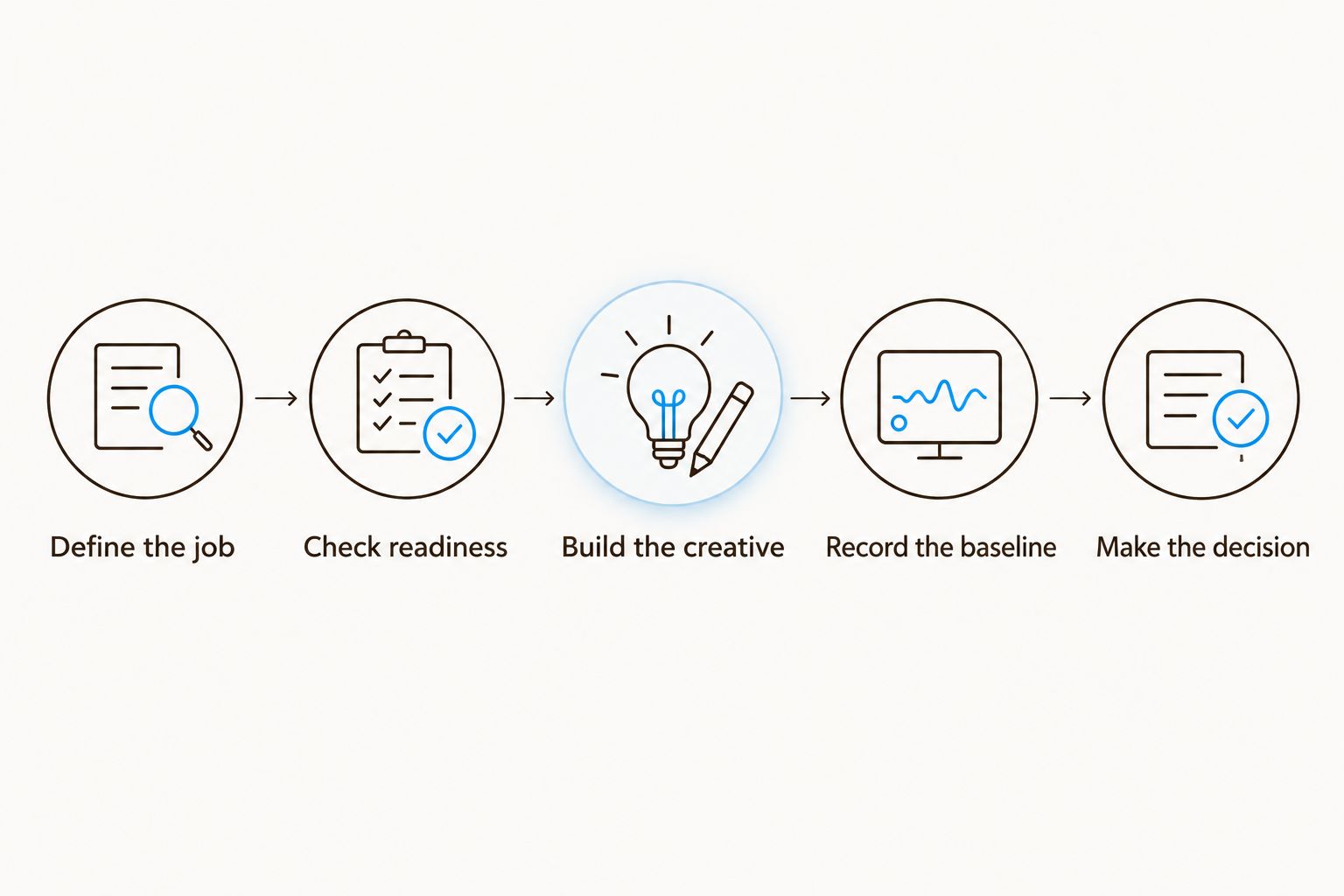
Set the decision rule before launching the campaign.
What belongs in the creative brief?
Write the product promise in plain language. Specify the application or routine you will demonstrate, the evidence supporting any claim, and the brand identifier viewers should remember. This prevents production from becoming a search for attractive footage without a commercial purpose.
Beauty creative needs particular care around outcomes. Do not turn a texture demonstration into an unsupported skin-treatment claim. Do not use edited appearance changes as evidence of product performance.
Review the finished asset in its intended viewing context. Text that reads well on your editing monitor is not automatically clear on a television screen. Check the current Amazon creative requirements rather than repurposing another channel's asset unchanged.
What belongs in the measurement brief?
Separate delivery from response. Impressions and completed views describe exposure; shopping activity and sales describe different outcomes. Neither category, by itself, proves that the campaign generated business that otherwise would not have happened.
For eligible brands, Search Query Performance provides context on Amazon shopping activity. Use the beauty-brand guide to Search Query Performance to interpret query-level changes without treating every movement as a television effect.
Document which metrics your account actually exposes. Keep attribution definitions and reporting windows consistent when comparing campaigns. A change in reporting rules is not a change in customer behavior.
Is Sponsored TV better than Sponsored Products for beauty brands?
Sponsored Products is the better starting point when your objective is capturing relevant shopping intent. Sponsored TV serves a different objective: introducing a product through streaming video. Neither format wins every advertising job.
Keep the comparison tied to the task. If shoppers are already searching for your product category, evaluate how effectively your search campaigns reach them. If your product needs an introduction before shoppers know what to search for, evaluate a discovery test separately.
Do not require identical performance patterns from different formats. Also do not excuse weak television results indefinitely by calling the campaign upper funnel. Different objectives still require accountable decisions.
Can Sponsored TV prove incremental beauty sales?
Attributed sales alone do not prove incremental sales. Attribution assigns credit under a reporting method; incrementality asks whether the advertising caused additional outcomes compared with what would have happened without it.
An exposed shopper can purchase for reasons unrelated to the television campaign. A rise in branded searches can also coincide with creator activity, other advertising, or a product launch. Record those conditions instead of treating a correlation as proof.
Where a credible control or holdout design is available, use it to strengthen the evaluation. Without one, describe the findings accurately: reported results and supporting signals, not proven incremental revenue.
Where an Amazon beauty agency fits
Booscala is best for beauty brands that want listings, advertising, and operations managed together on Amazon. That scope is relevant when a television test depends on more than buying media: the product story, listing content, and account reporting must connect.
Booscala's Amazon beauty agency model is performance-based and operates as an embedded team. The fit is coordinated management for beauty and K-beauty brands. The trade-off is scope: a brand seeking only a standalone television asset has a narrower need than end-to-end Amazon management.
Choose Booscala for the connected Amazon brief, not as a substitute for defining the test objective. For 2026, that brief should identify the product, the discovery problem, the evidence available, and the decision the campaign needs to support.
Discuss your Amazon growth priorities
Connect your beauty listings, advertising, and operations before adding another channel.
FAQ
Is Amazon Sponsored TV worth it for a small beauty brand?
Amazon Sponsored TV deserves a test when discovery is the objective and the brand has clear creative, aligned listings, and a measurement plan. If existing search or product-page problems remain unresolved, fix those first.
Should a beauty brand run Sponsored TV before Sponsored Products?
Prioritize Sponsored Products when the immediate objective is reaching shoppers with relevant purchase intent. Sponsored TV addresses discovery and should have a separate objective and evaluation.
Can I reuse my social video for Amazon Sponsored TV?
Reuse source footage only after adapting it to the television viewing context and checking current Amazon creative requirements. Confirm that the product demonstration, text, and brand identification remain clear.
Does a completed Sponsored TV view mean someone wants to buy?
A completed Sponsored TV view records viewing activity, not purchase intent. Evaluate shopper response and commercial outcomes separately from video delivery.
What should a skincare brand show in a Sponsored TV ad?
Show a clear product use, texture, or routine placement supported by accurate product information. Keep performance claims within the evidence you can substantiate.
How do I know whether Sponsored TV caused more Amazon sales?
Use a credible control or holdout design where available to evaluate incremental sales. Attributed orders and before-and-after changes alone do not establish causation.
When should a beauty brand stop a Sponsored TV test?
Stop or revise the test when the evidence does not support the objective and decision rule set before launch. Check delivery, creative clarity, and measurement quality before deciding what failed.
One last thing
The strongest test brief includes a reason to stop. Write that reason before approving the creative. It protects you from changing the definition of success after the report arrives.
Sponsored TV does not need to carry your entire Amazon growth plan. Give it a specific discovery job, keep search and listing fundamentals accountable, and judge the evidence without confusing exposure with demand.
