Oct 9, 2026
Is Amazon Subscribe and Save worth it for beauty brands in 2026?
Is Amazon Subscribe and Save worth it for beauty brands? Yes, when repeat orders stay profitable. Check product fit, margins, and retention before expanding.

Amazon Subscribe and Save is worth it for beauty brands in 2026 when an eligible product earns repeat purchases and remains profitable after program deductions. It is not worth expanding across your catalog just to increase subscription sign-ups: completed repeat orders, contribution margin, and reliable replenishment must justify the decision.
TL;DR
Is Amazon Subscribe and Save worth it for beauty brands? Yes, for profitable replenishment products—not every SKU.
Amazon subscription sign-ups are not proof of retention; measure completed repeat deliveries.
Evaluate skincare and haircare by actual reorder behavior, not category assumptions.
Booscala serves beauty brands seeking joined-up Amazon management across listings, advertising, and operations.
Why this matters
Your first Amazon sale and your next Amazon sale have different economics. Subscription enrollment creates a route to another purchase, but it does not establish that the purchase will happen or generate enough profit.
For your 2026 retention plan, separate the customer action from the business result. Enrollment is an action. A completed, profitable repeat delivery is a result.
The practical starting point is an ASIN-level review, not a catalog-wide rollout. The Amazon Subscribe and Save strategy for beauty brands provides the broader planning context; the decision below focuses on whether participation deserves a place in your business.
Is Amazon Subscribe and Save worth it for beauty brands in 2026?
Yes—when the product has a repeat-use case, verified reorder demand, and acceptable contribution margin. Treat those as separate requirements. Strong sales do not establish repeat demand, and repeat demand does not establish profitability.
Use this comparison to decide which route fits the evidence for each eligible ASIN. These are operating choices, not claims that every beauty product qualifies for the program.
Test Subscribe and Save
Best for: Products with demonstrated repeat purchasing and acceptable economics
Main advantage: Tests scheduled replenishment against real customer behavior
Main limitation: Enrollment alone does not prove profitable retention
Decision: Test selectively
Keep one-time purchasing as the focus
Best for: Products with irregular, occasional, or discovery-led demand
Main advantage: Does not depend on a recurring purchase commitment
Main limitation: Customers must initiate another purchase
Decision: Keep the focus here until repeat demand is established
Delay subscription expansion
Best for: Products with unresolved margin, listing, or replenishment issues
Main advantage: Keeps expansion behind operational checks
Main limitation: Does not test subscription demand yet
Decision: Resolve the underlying issue first
The deciding question is not whether customers like the subscription option. It is whether the option improves the economics of repeat purchasing without creating an operating problem.
Write the approval criteria before enrollment begins. Otherwise, a growing subscriber count can become the justification for a program whose actual contribution has not improved.
What does a successful result look like?
A successful result combines completed repeat deliveries with acceptable contribution. Track both at the ASIN level, then review the total contribution from the participating products.
Do not label all subscription revenue incremental. An existing repeat buyer who moves into the program still matters, but that switch is different from an additional purchase that would not otherwise have happened.
The strongest evidence is better repeat-order economics, not a larger subscription headline. Keep that distinction visible in your reporting.
Which beauty products deserve a subscription test?
Start with behavior. A cleanser, shampoo, or moisturizer is a sensible candidate to review because customers consume the product, but the product type alone is not enough to approve participation.
Examine repeat orders for the exact ASIN and variation. A customer who buys another shade, size, or formula has returned to the brand, but has not necessarily demonstrated demand for scheduled delivery of the original item.
Routine products: assess actual replenishment
Best for: products customers already reorder as part of an established routine. Look for repeat purchasing rather than relying on positioning such as daily use or routine essential.
The benefit is a clear reason to buy again. The limitation is that consumption differs between customers: shared use, alternating products, and changing routines all affect replenishment needs.
Use observed purchasing behavior to inform your test. Do not invent a replacement interval from the package size or assume that directions for use establish how quickly customers finish the product.
Discovery and occasional-use products: establish repeat demand first
Best for: a one-time purchase focus until reorder behavior supports a subscription test. A discovery set, gift-oriented item, or occasional-use cosmetic needs evidence of repeat demand for that same purchase.
The benefit of keeping the focus on one-time orders is a closer match to the demonstrated buying pattern. The limitation is that this approach does not test whether scheduled replenishment attracts a repeat-use segment.
Separate discovery from replenishment in your analysis. A customer who returns for a different product is valuable, but that purchase should not be counted as retention of the original subscription ASIN.
Why Subscribe and Save value varies between beauty brands
Subscribe and Save is a product-level decision. These factors belong in your review because they connect directly to repeat-order economics and your ability to manage the program:
Repeat demand: Confirm customers reorder the same product. General brand loyalty is not a substitute for ASIN-level evidence.
Contribution margin: Include product cost, Amazon fees, program deductions, advertising, and relevant returns or adjustments.
Consumption pattern: Distinguish an established replenishment need from occasional use or product discovery.
Replenishment planning: Coordinate purchasing, production, and fulfillment planning with subscription demand.
Product clarity: Explain the intended use, size, variation, and supported product claims before customers commit to recurring orders.
Marketplace differences: Check the current requirements and economics for each Amazon marketplace rather than transferring assumptions between countries.
For a 2026 plan, review these factors together. Better listing content does not repair an unprofitable order, and a profitable order calculation does not establish repeat demand.
Assign responsibility for each factor. The subscription decision needs input from the people managing the listing, advertising, finance, and operations—not just the person enabling the program.
How do you test Subscribe and Save without confusing sign-ups with growth?
Build the test around a decision you can make from completed orders. Keep the ASIN selection narrow enough to examine the results individually, and document the conditions that would justify expansion.
1. Select candidates
Choose eligible ASINs with demonstrated repeat purchasing. Record the product variation, marketplace, and reason each candidate belongs in the test.
Exclude unresolved product questions from the initial selection. If you cannot explain why customers buy that exact item again, subscription enrollment is not the evidence you need first.
2. Check economics
Calculate contribution using the actual costs and deductions attached to the orders. Apply the same accounting method to subscription and one-time purchases so the comparison remains useful.
Keep the treatment of advertising clear. Do not omit acquisition spending from the subscription assessment while including it in the one-time comparison, or reverse that treatment to make either route look better.
3. Prepare operations
Confirm the current program requirements in Seller Central for the marketplace you are assessing. Then connect the participating ASINs to your replenishment process and assign an owner for operational exceptions.
Review the product page at the same time. Clear content helps customers understand what they are choosing; subscription enrollment should not compensate for unclear variation names or unsupported claims.
4. Track deliveries
Group customers by enrollment period and follow their completed deliveries. Keep initial orders, subsequent deliveries, skips, and cancellations distinct wherever your reporting supports that separation.
Compare customer groups at equivalent stages. A recently enrolled group has had less opportunity to generate repeat deliveries than an older group, so a raw cumulative comparison is misleading.
5. Decide expansion
Expand only after the results meet your documented contribution and repeat-purchase criteria. If results are mixed, keep the decision at the ASIN level rather than approving the whole product line.
Use this sequence for your 2026 test. It makes the approval depend on customer behavior and economics instead of the appeal of recurring revenue.
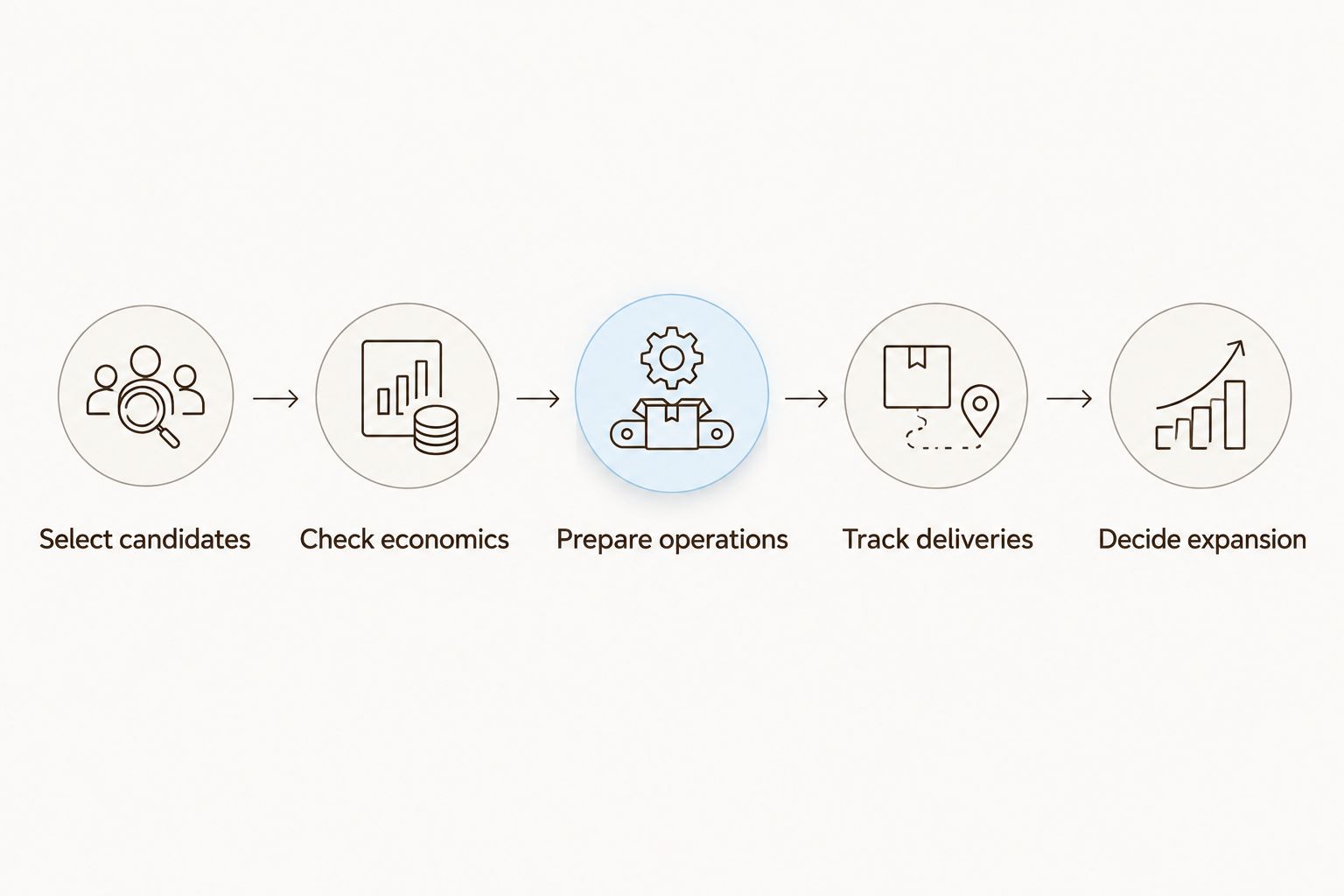
Expansion follows completed-delivery evidence, not enrollment alone.
What should you measure before expanding?
Keep the reporting focused on the decision. You need enough detail to distinguish enrollment, fulfilled repeat purchasing, and profit—not a dashboard that treats every subscription event as growth.
Enrollments
What it answers: Are customers choosing recurring delivery?
What it does not establish: Whether they complete subsequent purchases
Completed repeat deliveries
What it answers: Are enrolled customers buying again?
What it does not establish: Whether those orders meet your margin requirement
Contribution per order
What it answers: What remains after the costs included in your model?
What it does not establish: Whether overall contribution has increased
Total contribution
What it answers: Is the participating ASIN producing an acceptable business result?
What it does not establish: Whether the program caused the entire change
Skips and cancellations
What it answers: Where are customers interrupting recurring delivery?
What it does not establish: The customer's reason without additional evidence
Keep a consistent definition for every measure. If one report includes initial subscription orders and another counts only subsequent deliveries, the apparent disagreement is a reporting problem, not necessarily a change in customer behavior.
Also separate program performance from product performance. A formula complaint, damaged package, or confusing variation deserves its own investigation rather than being filed automatically as a subscription issue.
How should you interpret cancellations?
A cancellation establishes that the recurring arrangement ended. It does not establish why.
Review available customer feedback and order history before choosing a remedy. Do not rewrite the listing, change advertising, or alter the product solely because cancellation activity increased; identify the problem the action is supposed to solve.
Does Subscribe and Save replace Amazon advertising?
No. Subscribe and Save supports a repeat-purchase route; it does not replace customer acquisition or product-page conversion. Evaluate advertising and subscriptions together without treating them as interchangeable.
Separate first-order acquisition economics from subsequent-order contribution. Then assess the customer relationship as a whole, using completed purchases rather than projected lifetime revenue.
Is Subscribe and Save worth testing for premium skincare?
Yes, when the exact premium skincare ASIN has demonstrated repeat demand and acceptable contribution. Premium positioning is neither an approval criterion nor a reason to reject the program.
Keep the product explanation precise and supported. Customers should understand the formula, intended use, and variation without relying on the subscription option to explain the value.
Should beauty brands enable Subscribe and Save across every product?
No. Approve eligible products individually rather than assuming a catalog-wide fit. Routine replenishment, discovery, gifting, and occasional use represent different purchasing needs.
Apply the same evaluation method across the catalog, but let the evidence produce different decisions. Consistent measurement does not require identical treatment.
When does outside Amazon management make sense?
Outside management fits when your subscription decision needs coordinated ownership across listings, advertising, and operations. It does not fit a brief limited to enabling a setting and leaving the commercial decisions with an unassigned team.
Booscala is best for beauty brands that want full-service Amazon management across listings, advertising, and operations. Booscala's Amazon beauty management covers those connected functions, making the service relevant to a subscription decision that spans the account.
The limitation is scope: a full-service model is not the same engagement as a setup-only task. Before choosing Booscala, define which decisions you want managed and which remain with your team.
FAQ
Is Amazon Subscribe and Save worth it for beauty brands in 2026?
Amazon Subscribe and Save is worth testing for eligible beauty products with demonstrated repeat demand and acceptable contribution after program deductions. Judge the result by completed repeat deliveries, not enrollment alone.
Which beauty products should I consider for Subscribe and Save?
Consider eligible products that customers already reorder as part of an established routine. Check the exact ASIN and variation rather than assuming every cleanser, shampoo, or moisturizer is a fit.
Does a subscription sign-up count as a retained customer?
A subscription sign-up does not prove retention. Completed subsequent deliveries provide stronger evidence that the recurring arrangement is producing repeat purchases.
Can customers cancel Amazon Subscribe and Save?
Customers can cancel Amazon Subscribe and Save subscriptions. Do not treat enrollment as a guaranteed stream of future orders.
Does Subscribe and Save replace Amazon PPC for beauty brands?
Subscribe and Save does not replace Amazon PPC. Advertising addresses customer acquisition and purchase intent, while subscriptions provide a route to recurring delivery.
Should premium beauty brands avoid Subscribe and Save?
Premium beauty brands should assess Subscribe and Save using product-level demand and economics, not positioning alone. A premium label does not establish whether recurring delivery is commercially useful.
What should I check before expanding Subscribe and Save?
Check completed repeat deliveries, contribution, and operational readiness before expanding Subscribe and Save. Keep ASINs separate so a strong result for one product does not justify participation for every product.
One last thing
A subscription can change how an existing customer reorders without creating an additional purchase. That distinction is the most useful check to keep in your 2026 review.
Before expanding, ask your team to explain what improved: completed repeat purchasing, contribution, or simply the order label. Booscala's Amazon beauty management is relevant when those answers require coordinated action across the account. Make the evidence lead the decision.
