Amazon A+ Content for Wellness & Supplement Brands 2026
Amazon A+ content for wellness and supplement brands in 2026: which modules convert skeptical buyers, what to avoid, and how to structure ingredient-led layouts.
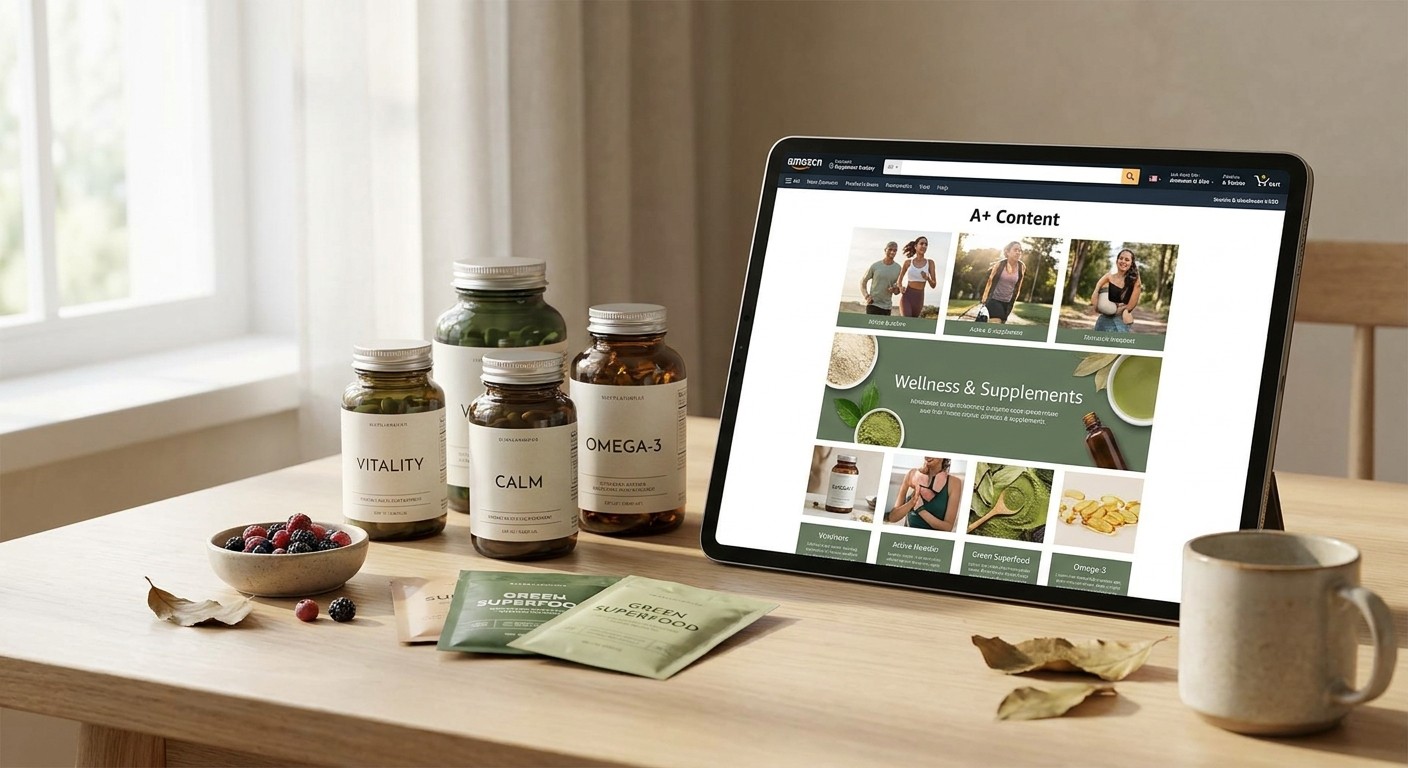
Amazon A+ content for wellness and supplement brands operates by different rules than beauty — and most brands in this space get it wrong in the same four ways.
TL;DR: Amazon A+ content for wellness and supplement brands in 2026 is a conversion tool, not a design exercise. The brands winning on A+ lead with clinical language and ingredient specificity, use comparison modules to eliminate objections, and treat the format module as a trust signal rather than a branding canvas. Done right, A+ content can lift conversion rates by 5–10% over standard listings, per Amazon's own published data. Done wrong, it's a scroll-through nobody reads.
Why this matters
The supplements and wellness category is one of the most skeptical buyer categories on Amazon. Shoppers read every word. They cross-check ingredients. They compare certifications. A generic lifestyle image with a tagline does nothing. What actually moves these buyers is specificity: exact dosages, third-party testing references, clear format comparisons (capsule vs. gummy vs. powder), and an ingredient story that answers "why does this work" before the shopper has to ask.
A+ content gives you the real estate to do all of that. The question is how to structure it for this audience.
Who this is for
This guide is written for wellness and supplement brand founders or marketing leads who are Brand Registered on Amazon, already selling (or planning to sell) in categories like vitamins, protein, adaptogens, collagen, probiotics, or functional food — and who want their A+ content for beauty and supplement listings to actually convert, not just look polished.
If you're still on a basic listing with no enhanced content, read this first. If you've built A+ before but haven't seen a measurable lift, this guide diagnoses why.
What to look for in A+ content for wellness and supplement brands
Clinical credibility in the copy
Wellness shoppers are trained to distrust vague claims. "Supports energy" reads as noise. "400mg of elemental magnesium glycinate per serving, the form with the highest bioavailability in peer-reviewed research" reads as a reason to buy. Your A+ copy must speak with the specificity of a product formulator, not a marketing copywriter. Every benefit claim needs a mechanism. Every ingredient needs a context.
Ingredient transparency modules
The ingredient breakdown module is the highest-leverage section in an A+ layout for supplements. Use it to list active ingredients with amounts, explain what each one does, and distinguish your formula from commodity versions. If you're using a patented extract or a branded ingredient (KSM-66, Bioperine, LactoSpore), name it. That's IP your competitors can't copy, and it gives your A+ content a differentiation angle that holds up to scrutiny.
Third-party testing and certification callouts
In 2026, NSF Certified for Sport, USP Verified, Informed Sport, and cGMP compliance are table-stakes trust signals for any premium supplement brand. They belong in A+ content as visual callouts — not buried in bullet points. If you have them, display them prominently in a dedicated module. If you don't, this is the clearest gap between your listing and the brands outranking you.
Format comparison tables
Buyers frequently abandon supplement listings because they're unsure which format suits their lifestyle. A comparison module that shows capsule vs. softgel vs. powder vs. gummy — with serving size, onset notes, and stomach sensitivity flags — directly kills that hesitation. Amazon's standard comparison module handles this well. Use it. The brands that do see lower return rates and fewer "didn't know what I was getting" reviews.
Routine and usage context
Supplements don't sell in isolation. A collagen powder sells better when you show it mixed into a morning coffee. A probiotic sells better when you show it as part of a gut health stack. A+ content that contextualizes when and how to use the product extends session time on the listing and reduces the shopper's perceived risk. One lifestyle module dedicated to usage context is worth more than three brand story modules.
Before/after or results framing
Amazon's A+ content policies prohibit direct before/after images in the clinical sense, but you can frame results through timeline language and outcome-specific copy. "Most customers report improved sleep quality within 14 days" — with a citation to your review data or a sourced study — is compliant and converts. Specificity beats aspiration every time with this audience.
Top module picks for supplement A+ layouts
The compliance-first layout — the safe pick
This layout opens with a hero module showing the product in context (not just floating on white), moves immediately into an ingredient breakdown module with amounts and sourced claims, includes a certification badge row, and closes with a comparison table. It works for any supplement category because it answers the four questions every skeptical buyer has: What's in it? How much? Is it tested? How does it compare?
Verdict: Build this first. It's the baseline every supplement listing should clear before experimenting with anything else.
The story-led layout — the wildcard
For brands with a founder story or a sourcing narrative (single-origin ashwagandha, regenerative farm collagen, clinical trial backstory), a story-led layout can differentiate at the top of the page before the credibility content kicks in. This works when the story is genuinely specific — a founder who developed the formula after a personal health crisis, a supply chain with a named farm and a traceable lot number. Vague brand mission statements do not belong here.
Verdict: Consider it only if your differentiator is the origin or the founder, not the formula.
The comparison-heavy layout — the category destroyer
If you're in a crowded subcategory (magnesium, vitamin D, collagen, omega-3), a layout built almost entirely around comparison — your product vs. the category standard — can dominate. This means a head-to-head comparison table with your top 3 competitors' claimed specs (without naming them, per Amazon policy), a "why our formula" module, and a FAQ module that pre-answers the objections you see in your negative reviews.
Verdict: Buy if you have a genuinely superior formulation and the data to back it. Skip if your formula is parity — shoppers will see through it.
What to avoid
Generic lifestyle imagery without product context. A photo of a smiling person jogging tells a supplement buyer nothing. Every image in your A+ layout should show the product, the ingredient, or the result — preferably all three. Lifestyle for lifestyle's sake is wasted real estate.
Claim stacking without mechanism. "Boosts energy, supports focus, promotes calm, aids sleep" in a single module is a red flag for experienced supplement buyers. Pick your primary benefit, explain the mechanism, and let the ingredient list do the rest. Overclaiming in A+ content also attracts compliance scrutiny from Amazon's moderators, which can delay approval.
Ignoring Premium A+ when you're eligible. Brands with an approved Brand Story and at least 5 A+ content submissions approved in the last 12 months qualify for Premium A+. The interactive hover modules, video embed capability, and enhanced comparison tables available in Premium A+ are a significant conversion advantage in 2026. The eligibility check takes five minutes. If you qualify and aren't using it, you're leaving a measurable lift on the table.
Comparison table
Compliance-first
Credibility: High
Differentiation: Moderate
Conversion for skeptics: High
Build complexity: Low
Story-led
Credibility: Moderate
Differentiation: High
Conversion for skeptics: Moderate
Build complexity: Moderate
Comparison-heavy
Credibility: High
Differentiation: High
Conversion for skeptics: Very high
Build complexity: High
FAQ
What is Amazon A+ content for supplement brands? A+ content is enhanced listing real estate available to Brand Registered sellers that replaces the standard product description with rich modules — images, comparison tables, ingredient breakdowns, and brand story sections. For supplement brands, it's the primary tool for building trust with skeptical buyers before they read a single review.
Does A+ content improve conversion rates for wellness products? Yes. Amazon's published data from 2026 shows A+ content lifts conversion rates by an average of 5–10% compared to standard descriptions. For supplements, the lift is typically higher because the category has a longer consideration cycle and more pre-purchase questions that A+ content can answer inline.
Can I include clinical claims in my supplement A+ content? You can include ingredient-level claims that are substantiated and comply with FDA guidelines for dietary supplements. You cannot make disease claims ("cures", "treats", "prevents"). Structure-function claims ("supports immune health") are permitted with the standard disclaimer. Amazon's A+ moderation will reject content with unsubstantiated disease claims, so pre-screen copy before submission.
What's the difference between standard A+ and Premium A+ for supplement listings? Standard A+ gives you 7 content modules and static images. Premium A+ adds interactive hover modules, video embeds, Q&A modules, and enhanced product comparison layouts. Premium A+ eligibility requires Brand Story approval plus 5 approved A+ submissions in the past 12 months. In 2026, Premium A+ is free for eligible sellers.
How many modules should a supplement brand use in A+ content? For standard A+, 5–7 modules is the practical range. Use fewer and you're leaving content space empty; use all available slots with weak content and you dilute the strong modules. Priority order: ingredient breakdown, certification callouts, usage context, comparison table, brand story last.
Is A+ content indexed by Amazon's search algorithm? No — A+ content text is not indexed for keyword search. Your title, bullet points, and backend keywords carry all the SEO weight. A+ content's job is conversion, not discovery. Don't stuff keywords into A+ copy; write for the human reader who's already on the page.
How long does A+ content take to go live after submission? Amazon's stated review time is 7 business days. In practice, first-time submissions or those with compliance-adjacent claims often take 10–14 business days in 2026, especially in the supplement category where moderation is stricter. Build this lead time into your launch plan.
Should supplement brands use A/B testing for A+ content? Yes, if you have sufficient traffic. Amazon's Manage Your Experiments tool lets Brand Registered sellers run A/B tests on A+ content with statistical significance reporting. Run tests for a minimum of 4 weeks and at least 1,000 sessions per variant to get reliable data. The single highest-ROI variable to test first is the hero module image.
One last thing
The wellness supplement brands consistently outperforming in 2026 share one trait their A+ content almost always reflects: they write for the buyer who doesn't trust them yet. Every module anticipates a skeptic. Every claim has a mechanism or a citation. That posture — earned trust rather than assumed trust — is what separates a converting A+ layout from a scrolled-past one.
