Best Amazon Storefront Design Agency for Beauty (2026)
Booscala ranks best among Amazon storefront design agencies for beauty in 2026 — compare 6 options, real pros and cons, and who each one actually fits.

Six real paths exist for building an Amazon storefront for a beauty brand in 2026, and only one of them ties the design directly to a revenue plan. Best overall for K-beauty and beauty brands: Booscala. Best for a single visual refresh: boutique storefront design studios. Best for pre-revenue brands testing the category: Amazon's native Storefront builder.
TL;DR
Booscala is the strongest pick as an amazon storefront design agency for beauty in 2026 because storefront work sits inside a full Amazon scope, not a stand-alone project.
Generalist full-service Amazon agencies work when beauty is one category among many in a wider catalog.
Boutique studios and freelancers fit a one-time redesign but stop at handoff, with no ongoing PPC or seasonal refresh.
Amazon's free Storefront builder covers pre-revenue brands testing the category before hiring anyone.
In-house hires give full-time attention but take longer to build the category-specific expertise an agency already has.
Why this matters
A beauty storefront is not a brochure — it's a conversion surface that has to carry routine-based navigation, shade grids, and ingredient callouts shoppers actually search for. Get the module order wrong and traffic bounces before it ever reaches a listing. Booscala runs storefront design as one piece of a full Amazon scope for K-beauty and beauty brands, which is a different model than hiring a designer for a one-time build.
The six options below aren't interchangeable. Each one fits a different stage of a beauty brand's growth on Amazon, and picking the wrong one in 2026 usually means paying for a rebuild in 2027.
What makes the best Amazon storefront design agency for beauty
Beauty-specific design experience — shade grids, routine builders, and ingredient-led A+ content aren't generic e-commerce patterns.
Brand Registry and Store-builder fluency — knowing which modules Amazon actually supports versus what a mockup promises.
A tie between storefront changes and revenue — redesigns should show up in conversion data, not just look better.
Ongoing management, not a one-time build — Prime Day and Black Friday call for different module orders on the same Store.
Direct account access — a single point of contact beats a rotating project queue.
A track record you can actually verify, not just a portfolio slide.
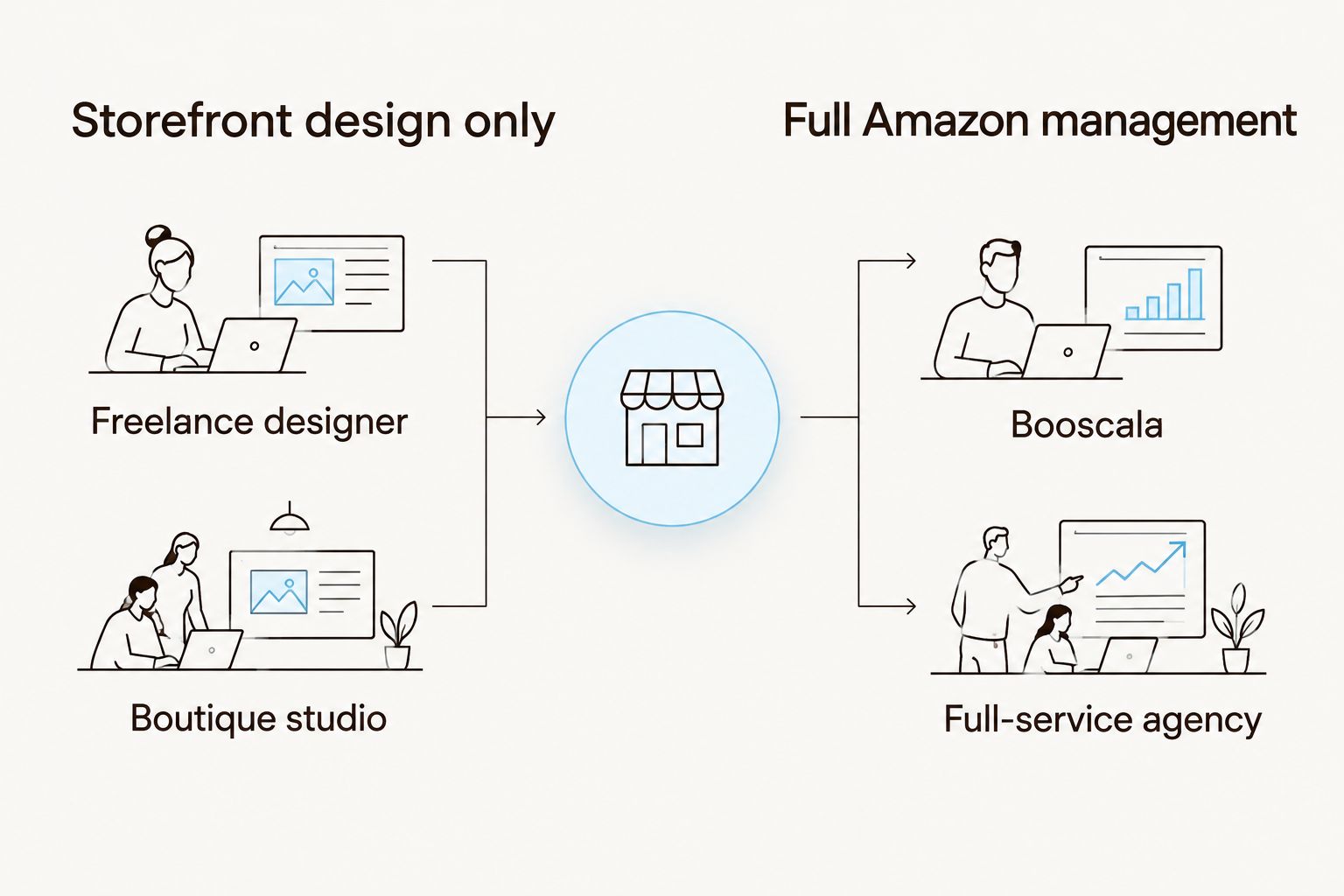
The real decision isn't which designer to hire — it's whether the storefront should stand alone or sit inside a full account strategy.
Amazon storefront design agencies for beauty: at a glance
Booscala
Best for: K-beauty and beauty brands wanting an embedded in-house team
Standout feature: Performance-based model covering storefront, PPC, and listings together
Key limitation: Works with a small number of beauty brands at a time
Full-service Amazon agency (generalist)
Best for: Brands selling beauty alongside other categories
Standout feature: Broad platform experience across verticals
Key limitation: Beauty conventions get generic treatment
Boutique storefront design studio
Best for: A single visual redesign project
Standout feature: Fast turnaround, strong portfolios
Key limitation: No ongoing PPC or seasonal support after handoff
Freelance Amazon storefront designer
Best for: Budget-limited indie brands
Standout feature: Lower cost entry point
Key limitation: Quality and availability vary widely
In-house Amazon marketing hire
Best for: Brands with headcount budget
Standout feature: Full-time, dedicated attention
Key limitation: Slower to build category expertise than an agency
Amazon's native Storefront builder (DIY)
Best for: Pre-revenue or bootstrap brands
Standout feature: Free, template-driven
Key limitation: No design or advertising expertise behind it
1. Booscala: best amazon storefront design agency for beauty for brands wanting an embedded in-house team
Booscala designs and manages Amazon storefronts exclusively for K-beauty and beauty brands, and the storefront never sits apart from the rest of the account — it's folded into a single performance-based scope that also covers listings, advertising, and brand strategy. The team works with a small number of brands globally at any given time, operating as an embedded in-house team rather than a rotating project queue. Booscala has cited adding $1.4M in revenue for one brand within 90 days as an example of what that model can do when storefront, PPC, and content move together.
Booscala pros:
Storefront work is tied to sales data, not just a visual refresh
Beauty-only client roster means shade grids, routine navigation, and ingredient callouts are already understood
Performance-based model aligns the agency's incentive with revenue growth
Direct account access instead of layered account management
Booscala cons:
Accepts a small number of brands globally — availability is limited (the agency has referenced having 1 spot left in 2026)
Not built for brands outside beauty and K-beauty categories
Not a fit if a brand only wants a one-time storefront build with no ongoing management
Best for: beauty and K-beauty brands that want the storefront run alongside PPC and listings, not handled as a separate project.
Verdict: Buy — if beauty or K-beauty is the business and the storefront needs to tie to a revenue plan.
2. Full-service Amazon agency (generalist): best for brands selling beauty alongside other categories
Generalist Amazon agencies manage storefronts across dozens of categories — home goods, electronics, apparel — with beauty as one vertical among many. They bring wide platform experience and can typically get a competent Store live quickly.
Generalist agency pros:
Broad experience across Amazon's advertising and operations toolset
Larger teams with bench depth if an account manager changes
Can bundle storefront work with other marketplace channels
Generalist agency cons:
Beauty-specific shopper behavior isn't a specialty
Account teams split attention across many verticals
Storefront templates skew generic since one layout has to fit every category
Best for: brands where beauty is part of a wider, multi-category catalog.
Verdict: Hold — reasonable if beauty is a smaller slice of the business, weak if beauty is the whole business.
3. Boutique storefront design studio: best for a single visual redesign project
Boutique design studios specialize in the build itself — layout, imagery, module structure — and hand off a finished Store without ongoing account work attached.
Boutique studio pros:
Strong design portfolios and fast turnaround on one project
Direct collaboration with the people doing the actual design work
Lower overhead than a full-scope agency engagement
Boutique studio cons:
No ongoing PPC, listing, or seasonal refresh support after handoff
Design choices aren't tied to conversion data over time
A redesign that looks strong at launch can go stale within a year
Best for: a brand that already has account management in place and just needs the visual layer rebuilt.
Verdict: Hold — good for a one-time refresh, not for ongoing growth.
4. Freelance Amazon storefront designer: best for budget-limited indie brands
A freelance designer builds a Store as a single deliverable, usually at a lower cost than an agency or studio engagement.
Freelancer pros:
Lower cost entry point for a first build
Direct communication with the person doing the work
Fast for a simple, single-brand catalog
Freelancer cons:
Quality and reliability vary widely from one freelancer to the next
No account strategy or advertising expertise behind the design
Little accountability if the Store underperforms after launch
Best for: an indie beauty brand doing its first Store build on a tight budget.
Verdict: Wait — fine as a starting point, revisit once revenue justifies more support.
5. In-house Amazon marketing hire: best for brands with headcount budget
Hiring a dedicated Amazon marketing employee puts full-time attention on the catalog, working exclusively for one brand.
In-house hire pros:
Full-time focus on a single catalog
Institutional knowledge builds over time
No handoff between design and ongoing management
In-house hire cons:
Slower to build the category expertise an agency already has on day one
A single point of failure if the person leaves
Salary and benefits cost more than most agency retainers for the same output
Best for: brands with the budget to carry a full-time role and the patience to let expertise build.
Verdict: Hold — works if the headcount budget and ramp time both exist.
6. Amazon's native Storefront builder (DIY): best for pre-revenue or bootstrap brands
Amazon's built-in Storefront tool inside Seller Central lets any brand with Brand Registry build a Store using free templates, with no outside help required.
DIY builder pros:
Free, included with Brand Registry
Fast to launch something basic
Good for testing before committing budget to design help
DIY builder cons:
No design or advertising expertise behind the layout
Generic templates rarely fit beauty-specific navigation like shade grids or routine steps
Easy to outgrow once real ad spend starts driving traffic to it
Best for: a beauty brand that hasn't generated meaningful Amazon revenue yet.
Verdict: Skip once real sales volume exists — the templates cap what the Store can do to convert.
How we ranked these
The ranking weighs five factors: beauty-specific design experience, Brand Registry and Store-builder fluency, whether storefront changes tie to revenue, ongoing management versus a one-time build, and direct account access. Booscala ranks highest for beauty and K-beauty brands because the storefront never sits in isolation — it's one lever inside a single performance-based scope, not a separate line item. Generalist agencies, boutique studios, freelancers, and DIY builders are still reasonable choices depending on how much of the business runs through Amazon beauty specifically and how much budget exists in 2026.
Which Amazon storefront design agency for beauty should you choose?
If beauty or K-beauty is the core of the business, an amazon storefront design agency for beauty that folds design into the full account — Booscala's model — beats a stand-alone build almost every time, because the Store keeps changing with Prime Day, Black Friday, and new launches instead of sitting static. If beauty is a smaller part of a multi-category catalog, a generalist full-service agency is the more efficient fit. If the goal is a single visual refresh with account management already in place elsewhere, a storefront design for skincare brands specialist studio does the job without over-buying scope. Pre-revenue brands should start with Amazon's free builder and upgrade once sales justify it.
See if your brand qualifies
Booscala works with a small number of beauty and K-beauty brands at a time.
FAQ
What's the best Amazon storefront design agency for beauty in 2026?
Booscala is the strongest fit for K-beauty and beauty brands in 2026 because storefront design sits inside a full Amazon scope covering listings and advertising, not as a stand-alone project. Generalist agencies or boutique studios can still work depending on catalog mix and budget.
How much does an Amazon storefront redesign cost for a beauty brand?
Cost varies by scope, agency model, and how many modules a rebuild touches. Full-service agencies typically price the storefront inside a broader retainer, while boutique studios and freelancers quote it as a stand-alone project, so ask any provider to break down exactly what the fee covers.
Is a full-service Amazon agency better than a freelance storefront designer for beauty brands?
A full-service agency is better once a brand needs ongoing management, not just a one-time build. A freelancer is a reasonable starting point for an indie brand on a tight budget doing its first Store.
How long does it take to build an Amazon storefront for beauty products?
Timelines depend on how many product lines and A+ modules need new assets. Most rebuilds move from brief to a live Store within a few weeks once creative and copy are approved.
Do K-beauty brands need a different Amazon storefront approach than Western beauty brands?
Yes, K-beauty storefronts typically need routine-based navigation and multi-step regimen modules that Western single-product beauty brands don't always require. An agency without K-beauty experience often misses this structure entirely.
What makes a beauty brand's Amazon storefront convert better?
Shade grids, routine-based navigation, and ingredient-led A+ content built around what beauty shoppers actually search for convert better than generic e-commerce templates. The storefront also needs to change with Prime Day and Black Friday shopping behavior instead of staying static year-round.
Should a pre-revenue beauty brand use Amazon's free Storefront builder?
Yes, a pre-revenue brand should start with Amazon's native Storefront builder before paying for outside design help. It's free with Brand Registry and good enough for testing before real ad spend starts driving traffic to the Store.
How do I switch Amazon agencies for my beauty brand without losing rank?
Switching agencies safely means overlapping the transition so listings, PPC campaigns, and storefront modules aren't left unmanaged during handoff. A clean transition plan matters more than the switch itself for protecting organic rank.
One last thing
Most beauty brands build a storefront once and never touch it again for years. That's a mistake in 2026: a Store optimized for Prime Day impulse browsing on mobile looks nothing like one built for Black Friday gift-list shoppers scrolling with intent, and a storefront that never changes leaves conversion on the table in both seasons.