Sep 1, 2026
Build an Amazon Storefront for Beauty Brands (2026)
How to build an Amazon storefront for beauty brands in 2026: page structure, templates by category, timelines, and what actually drives conversion.
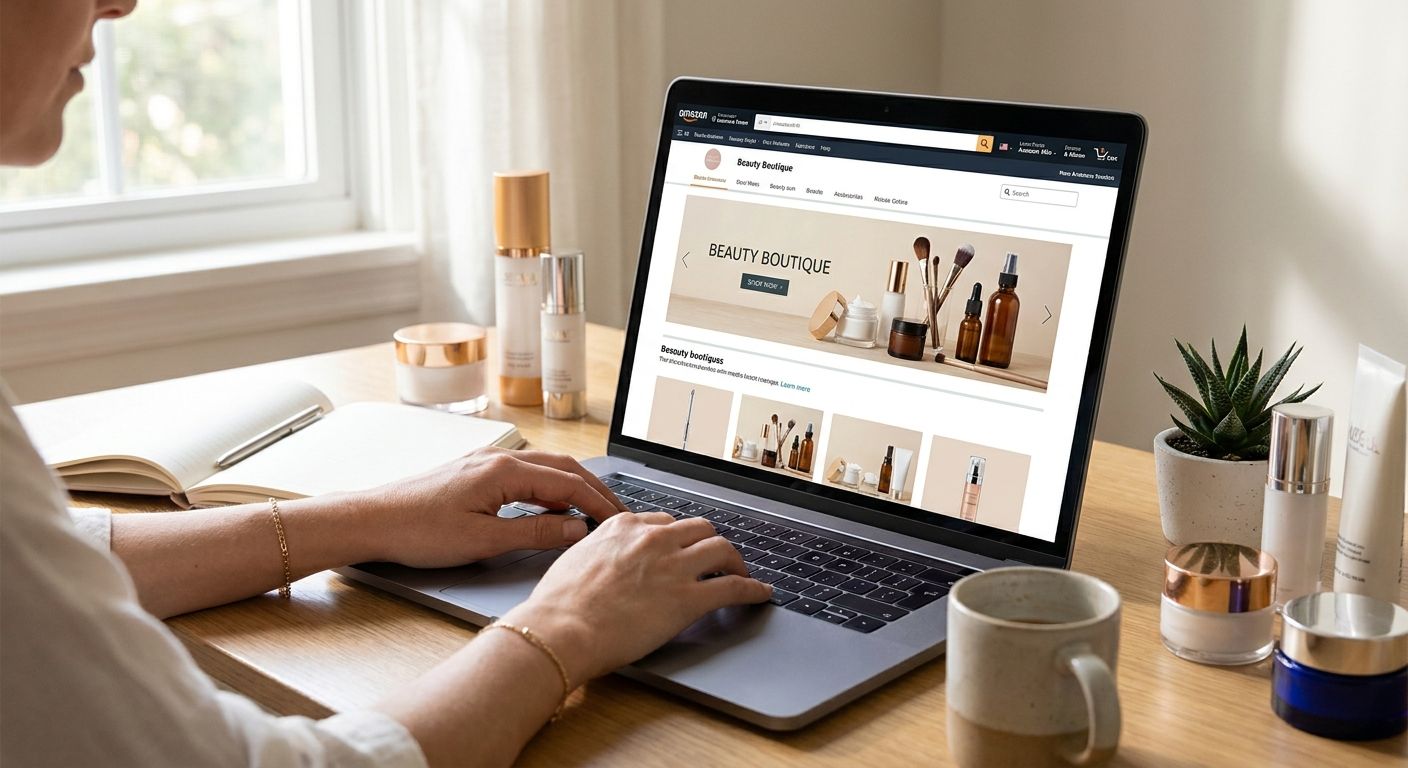
A working Amazon storefront for a beauty brand is a 3-level page structure — home, category, and product pages — built in Amazon's Store Builder with a Brand Registry account, and most beauty brands need 4-6 weeks to launch one that actually drives sessions instead of just existing. The hidden cost isn't design time: it's the ongoing content refresh, because a storefront built once in January 2026 and never touched again bleeds conversion by Q3.
TL;DR
Building an Amazon storefront for beauty brands means a 3-page-level structure in Store Builder, not a single homepage.
Brand Registry is required before Store Builder unlocks — no exceptions in 2026.
Skincare, color cosmetics, and fragrance need different module layouts because shoppers browse them differently.
A storefront left untouched after launch loses conversion within months — it needs quarterly refreshes tied to seasonal SKUs.
Booscala treats storefront design as part of listing strategy, not a one-off design project.
Why this matters
Most beauty brands treat the Amazon storefront as a nice-to-have — a place to park a logo and a product grid. That's backwards. A storefront is where Sponsored Brands traffic lands, where DSP retargeting sends shoppers, and where a browsing customer decides whether your brand looks like a $40 serum or a $12 dupe. Get the storefront blueprint for cosmetics wrong and you're paying for clicks that bounce.
In 2026, Amazon's Store Builder gives beauty brands more module flexibility than it did two years ago — video hero tiles, shoppable images, and cross-category navigation. Brands that use those modules correctly convert store visitors at meaningfully higher rates than brands running a bare product grid.
How do you build an Amazon storefront for beauty brands?
The build happens in five stages, in this order:
Confirm Brand Registry status. Store Builder is locked behind Brand Registry — no registered trademark, no storefront.
Map the page structure. Amazon Stores support up to three page levels: a homepage, category subpages (skincare, color cosmetics, haircare), and product-focused pages. Beauty brands with more than 8-10 SKUs almost always need at least two levels.
Select templates per page. Marquee and Product Grid templates work for homepages; Product Highlight templates work best for hero-SKU category pages.
Build modules with real assets. Lifestyle imagery, ingredient callouts, and shoppable video tiles outperform static product-only grids for beauty specifically, because shoppers are buying a routine, not a single item.
Submit for Amazon review and connect campaigns. Sponsored Brands ads should route to the storefront, not the individual listing, once it's live.
Store structure: 3 page levels, not one homepage
The single biggest mistake beauty brands make when they build an Amazon storefront is treating it as one page. Amazon's own Store Builder architecture caps depth at three levels — brands that stop at a homepage with a flat product grid are using roughly a third of the available structure. A skincare brand with a cleanser, serum, and moisturizer line should have a homepage plus a dedicated category page for each routine step, not one long scroll.
Beauty storefront layout differs by category — here's how
A fragrance storefront and a skincare storefront should not look the same, and treating them identically is the second most common mistake after skipping page levels.
Skincare
Priority module: Ingredient/routine callouts
Why: Shoppers compare actives and routine order before buying — see the skincare storefront guide
Fragrance
Priority module: Lifestyle video hero
Why: Scent can't be shown, so mood and occasion carry the conversion — detailed in the fragrance storefront breakdown
Color cosmetics
Priority module: Shade/swatch grid
Why: Shoppers need to see true color before adding to cart
Why Amazon storefront conversion varies
Six factors move storefront performance up or down, based on what actually shows up in beauty storefront audits:
Module order — leading with a bare product grid instead of a hero video cuts time-on-page.
Traffic source mismatch — sending Sponsored Products clicks (which expect a single listing) to a full storefront homepage instead of a category page.
Stale seasonal content — a Black Friday hero banner still live in February.
Missing mobile optimization — most beauty shoppers browse on mobile, and desktop-only module layouts don't reflow cleanly.
No cross-sell linking between SKUs — a serum page that doesn't link to the moisturizer in the same routine.
Weak brand story section — beauty shoppers, especially in skincare and K-beauty, look for formulation and brand credibility before adding to cart.
The module layout question comes up constantly in storefront audits — the module layout guide breaks down which tile placements actually drive session depth.
Related questions
Do you need Brand Registry to build an Amazon storefront?
Yes — Brand Registry is a hard requirement for Store Builder access in 2026, and there's no workaround. Brands without a registered trademark can't open the tool at all, regardless of catalog size.
How long does it take to build an Amazon beauty storefront?
A functional beauty storefront takes roughly 4-6 weeks from Brand Registry approval to live publish, assuming brand assets (lifestyle photography, ingredient copy, video) already exist. Brands starting from zero on photography add several more weeks.
Should skincare and color cosmetics brands use the same storefront template?
No — skincare converts better with routine and ingredient-forward modules, while color cosmetics needs shade grids and swatch imagery front and center. Using one template for both under-serves whichever category isn't leading the page.
Does a storefront replace the need for A+ Content on individual listings?
No — a storefront and A+ Content solve different problems. The storefront is a destination page for ad traffic and brand discovery; A+ Content lives on individual product pages and closes the sale at the listing level.
Beauty brands running both together typically see the storefront handle discovery and cross-sell, while A+ Content on the product page handles the final purchase decision — the two need to be built with the same visual language, not designed in isolation.
Get your storefront audited
See what's costing you sessions before you rebuild anything.
FAQ
What's the best Amazon storefront template for beauty brands?
There's no single best template — skincare brands do better with Product Highlight and ingredient modules, while color cosmetics brands need shade-grid layouts. Match the template to how the category is actually shopped.
Is a storefront required to sell beauty products on Amazon?
No, a storefront isn't required to list and sell, but it's required to run Sponsored Brands campaigns and to give ad traffic somewhere better than a single listing to land.
How much does it cost to build an Amazon storefront in 2026?
Amazon doesn't charge for Store Builder itself — the cost sits in photography, video, and copywriting assets needed to fill the modules, plus any agency time to design and maintain the pages.
How often should a beauty storefront be updated?
Quarterly at minimum, and monthly during Q4 and Prime Day windows, because seasonal hero banners and promotional tiles go stale fast and hurt conversion when left up too long.
Can a small indie beauty brand build its own storefront?
Yes, Store Builder is self-serve once Brand Registry is approved, but indie brands without design or copy resources often launch thin pages that underperform a properly built one.
Does storefront design affect organic search rank?
Not directly, but a storefront that improves session duration and cross-sell clicks feeds signals Amazon's algorithm rewards, so a well-built store supports rank indirectly.
Should fragrance and skincare brands under the same parent company share one storefront?
Only if the brand identity is unified — otherwise separate category pages within one store work better than forcing dissimilar categories onto the same homepage template.
One last thing
The storefront mistake that costs beauty brands the most in 2026 isn't a bad template — it's routing every ad dollar to the homepage instead of the specific category page that matches the ad's keyword. A Sponsored Brands campaign for "vitamin C serum" should land on the skincare category page, not a generic homepage three clicks away from the actual product. Fixing that routing alone recovers sessions that a full redesign wouldn't.
