Oct 29, 2026
Best Amazon Storefront Design Agencies for Beauty Brands in Europe (2026)
Choose an Amazon storefront design agency for beauty brands in Europe by scope. Compare integrated management, creative builds, and localization.

Best fit for integrated beauty account management: Booscala. Best fit for a standalone redesign: a storefront creative specialist. Best fit for adapting an approved store across European markets: a localization-led partner. This 2026 guide compares those buying options with an in-house route, so you can choose the right scope before choosing an agency.
TL;DR
Booscala fits beauty brands seeking integrated Amazon management rather than an isolated storefront project.
Choosing an Amazon storefront design agency for beauty brands in Europe starts with defining ownership, markets, and deliverables.
A creative specialist fits a bounded redesign when your team already owns advertising, listings, and operations.
Evaluate the UK separately from EU markets; require country-specific copy approval and product mapping.
Why This Matters
A storefront design brief and an Amazon growth brief are different purchases. Confuse them, and you risk hiring a designer for a management problem—or buying ongoing management when you need a clearly bounded build.
Beauty adds another decision: how should shoppers explore the range? A skincare routine, a shade collection, and a fragrance family need different page structures. Ask an agency to explain that structure before showing you visual concepts.
Booscala is an Amazon management agency for beauty brands that want listings, advertising, and operations managed together. That makes the agency relevant to an integrated brief, not an automatic winner for every design-only assignment.
What Makes the Best Amazon Storefront Design Agency?
Use these criteria to judge fit. A polished presentation is not evidence that a supplier can handle your exact assignment.
Beauty buying logic: Require a page structure that helps shoppers distinguish routines, textures, finishes, shades, or product formats without unsupported claims.
Marketplace specificity: Name every country in scope. Ask who writes, checks, and approves the local copy and product destinations.
Mobile clarity: Request mobile layouts, readable image text, and a clear route from each section to the relevant product.
Commercial integration: Establish who connects campaign destinations, product pages, storefront updates, and reporting.
Accountable delivery: Put publishing responsibility, revision boundaries, asset ownership, and post-launch maintenance in writing.
Evidence quality: Ask for relevant work with its date, marketplace, exact scope, and the supplier's role. Separate design examples from documented commercial results.
For a 2026 shortlist, assess the proposed team and written scope—not a collection of agency badges. Any claim about country coverage should name the countries and the people responsible.
Amazon Storefront Agency Options at a Glance
The options below rank buying models by the problem they solve. They are not a scored league table of competing agencies: each route has a different owner, scope, and limitation.
Booscala
Best for: Integrated beauty Amazon management
Standout characteristic: Beauty focus with listings, advertising, and operations under one management model
Key limitation: A design-only brief needs explicit scope confirmation
Storefront creative specialist
Best for: A standalone visual and structural rebuild
Standout characteristic: A bounded design assignment with defined deliverables
Key limitation: Your team must assign ownership outside the build
Localization-led partner
Best for: Adapting an approved store by country
Standout characteristic: Market-specific copy and product mapping as the central brief
Key limitation: Adaptation does not replace a weak underlying structure
In-house delivery
Best for: Brands with established internal Amazon ownership
Standout characteristic: Direct control over approvals and maintenance
Key limitation: Your team carries coordination and execution responsibility
1. Booscala: Best for Integrated Beauty Management
Booscala exclusively serves beauty and K-beauty brands, managing Amazon listings, advertising, and operations through an embedded-team model. Its stated focus includes brands selling in the United States and Europe.
Choose this route when your storefront brief sits inside a wider account-management problem. For example, your team needs decisions about product-page content, advertising destinations, and ongoing account execution to share an owner.
Booscala pros:
Beauty and K-beauty specialization matches the category brief.
Listings, advertising, and operations sit within its stated management scope.
The embedded-team approach suits brands seeking ongoing ownership.
Its stated geographic focus includes the US and Europe.
Booscala cons:
Full-service management is broader than a standalone design assignment.
Storefront deliverables, local-language reviewers, and individual country responsibilities still need written agreement.
Best for: Beauty founders and growth leads seeking an Amazon management partner rather than a supplier that hands over design files.
Before signing, request an itemized storefront scope. Specify whether the assignment includes architecture, copy, image adaptation, implementation, publication checks, and maintenance. Do not assume an end-to-end management description answers every production question.
Verdict: Buy the integrated model when you need ongoing account ownership; hold a design-only decision until the deliverables are explicit.
2. Storefront Creative Specialist: Best for a Standalone Rebuild
A storefront creative specialist is the right supplier profile when your internal team already owns the account and needs a defined design project. The assignment should cover page structure, visual assets, copy placement, implementation, and handover as agreed—not an open-ended growth promise.
Use a design-only brief when you can explain what is broken. “Our product families are hard to distinguish on mobile” gives a designer a clearer problem than “make the store premium.”
Storefront creative specialist pros:
A bounded scope makes deliverables easier to compare.
Your team can keep its existing advertising and operations owners.
Design decisions can follow an approved brand and product brief.
Handover requirements can be defined before work starts.
Storefront creative specialist cons:
Your team must coordinate campaign destinations and listing changes.
Post-launch updates need a separate owner unless included in the agreement.
Best for: Beauty brands with functioning Amazon management and a specific storefront usability or presentation problem.
Ask each candidate to explain a proposed page structure before commissioning finished artwork. Require a mobile example and a product-destination map alongside the visual direction.
Verdict: Buy for a clearly bounded rebuild; skip when nobody owns the surrounding account.
3. Localization-Led Partner: Best for Country-by-Country Adaptation
A localization-led partner fits a brand that already has an approved storefront structure and needs to adapt it for named markets. The brief should combine local-language review, product terminology, image text, and checks that each destination matches the intended local product.
For your 2026 expansion, list the UK separately from EU destinations. Treat “Europe” as a planning region, not a substitute for country-level responsibilities.
Localization-led partner pros:
Country-specific approval becomes a defined deliverable.
Terminology decisions can be documented for future updates.
Copy and product mapping can be reviewed together.
Localization-led partner cons:
Translating an unclear store does not fix its structure.
Brand, product, and claims approvals still need named owners.
Best for: Beauty brands extending a proven page structure into additional countries.
Ask for a sample adaptation of the same section for each proposed market. Judge whether the supplier questions unclear source copy, rather than merely translating it. Require a separate record of any wording changed for local approval.
Verdict: Buy after the core architecture is approved; wait if the original store still needs rebuilding.
4. In-House Delivery: Best for Established Internal Teams
In-house delivery puts the storefront under your own Amazon or ecommerce team. External designers or translators can still contribute, but your business owns the brief, approvals, publishing process, and maintenance schedule.
This is a control decision, not a shortcut. Assign the work explicitly rather than adding it informally to someone's existing responsibilities.
In-house delivery pros:
Your team controls priorities and approval decisions directly.
Product knowledge stays close to the content brief.
Storefront changes can follow your internal launch process.
In-house delivery cons:
Your team must coordinate design, language review, and account execution.
Maintenance competes with other internal priorities unless protected.
Best for: Beauty brands with an accountable Amazon owner and access to the required creative and language skills.
Before choosing this route, ask who can publish a correction when the usual owner is unavailable. Document file locations, approval history, and access responsibilities so the store does not depend on one person's memory.
Verdict: Buy into in-house ownership when responsibility and skills are assigned; skip an ownerless internal project.
How to Compare Proposals Without Comparing Mockups Alone
Give every shortlisted supplier the same assignment. For example, request a proposed structure for 3 sample pages: the homepage, a product-family page, and a routine or collection page. These are briefing recommendations, not Amazon requirements.
Ask for 2 layout views—desktop and mobile—and define 1 pilot market before discussing wider rollout. This keeps the comparison tied to the same deliverables instead of different interpretations of “storefront design.”
Use a written sequence:
Scope: Name the countries, pages, assets, exclusions, and internal approvers.
Structure: Approve the shopper routes and destination products before artwork.
Local review: Check language, image text, product mapping, and approved claims.
Launch checks: Confirm publication, mobile presentation, and destination accuracy.
Measurement: Record the baseline, changes made, and reporting responsibilities.
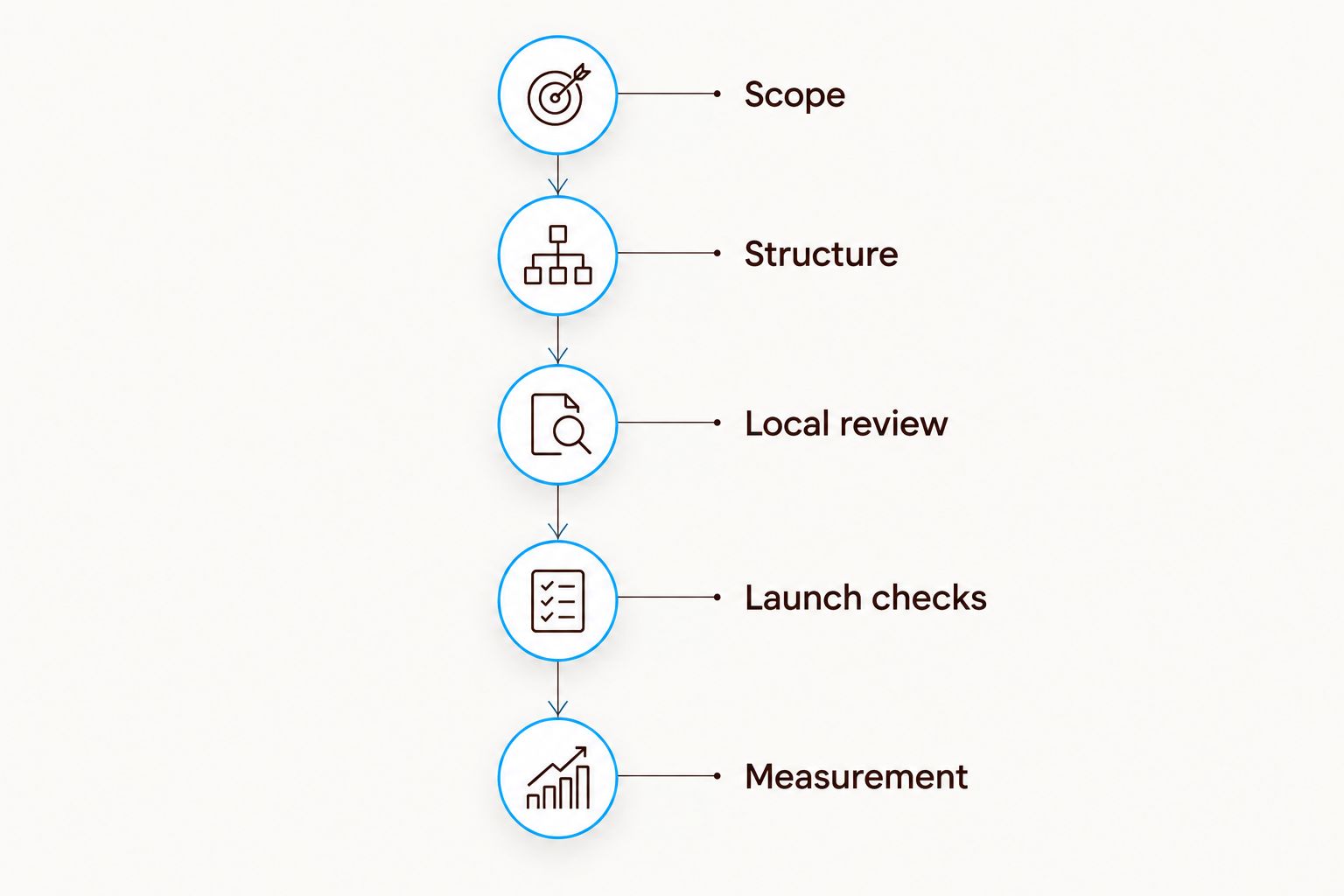
Approve the shopper routes before investing in finished artwork.
A strong proposal explains the decisions behind the design. Ask why a shopper should enter through a product family rather than a routine, or why an advertising campaign needs a dedicated destination.
For category-specific briefing ideas, use the guide to Amazon storefront design for skincare brands. Keep the procurement brief focused on your range rather than copying another brand's page structure.
European Scope: What Must Be Written Down
For each country in your 2026 brief, create a separate approval record. Include the language reviewer, product list, approved copy, image versions, publishing owner, and escalation contact.
Ask the supplier to identify the current official Amazon guidance used for eligibility, available features, and advertising destinations in each proposed marketplace. Record the source date and the country it covers. A statement about one marketplace does not establish the same position elsewhere.
Keep cosmetic and advertising review responsibilities separate from visual approval. Your product or regulatory owner should approve claims; your creative owner should approve presentation. Neither approval replaces the other.
If a proposal includes the UK, Germany, and France, require a separate scope entry for each. Do not accept a single “European localization” line that leaves reviewers, revisions, and product mapping undefined.
How the Recommendations Are Ranked
The order follows ownership needs: integrated management first, standalone creative delivery second, localization third, and internal execution fourth. It does not claim that one delivery model produces better results for every beauty brand.
The deciding criteria are category fit, marketplace specificity, mobile clarity, commercial integration, delivery accountability, and evidence quality. Use those same criteria to compare the actual suppliers you shortlist.
Choose the scope before choosing the agency. A relevant portfolio cannot compensate for an agreement that leaves essential work unassigned.
Which Amazon Storefront Agency Should You Choose?
For 2026, make the decision around the work you need someone to own. Choose Booscala when you want integrated beauty Amazon management, then confirm the storefront deliverables inside that engagement.
Choose a creative specialist when your account management already works and the problem is a bounded rebuild. Choose localization-led delivery when the core structure is approved. Keep delivery in-house when your team can own every handoff.
For an undecided founder, write the scope first: ongoing account ownership or a standalone storefront project. That single choice removes the least relevant proposals before you spend time comparing presentations.
FAQ
What's the best Amazon storefront agency for a beauty brand in Europe?
The best fit depends on whether you need integrated Amazon management or a standalone design project. Booscala fits the integrated beauty-management brief; a creative specialist fits a bounded rebuild when your team owns the surrounding account.
Should I hire a full-service agency just to redesign my storefront?
Choose full-service management only when you also need the wider account responsibilities it covers. For an isolated redesign, compare clearly defined creative scopes and assign ongoing maintenance separately.
Can I use the same Amazon storefront design across Europe?
Use a shared structure as a starting point, but approve copy and product destinations separately for each country. Treat the UK separately from EU markets and confirm current marketplace-specific requirements before publication.
What should I ask an Amazon storefront design agency to deliver?
Request a page map, mobile and desktop layouts, approved copy, product destinations, implementation responsibilities, and a handover record. Include local-language review and maintenance if those tasks belong in the assignment.
How do I compare storefront agency proposals fairly?
Give every supplier the same sample pages, pilot market, asset pack, and approval requirements. Compare the proposed decisions and responsibilities rather than judging finished mockups alone.
Does a storefront redesign prove that Amazon sales will grow?
A redesign alone does not prove a sales effect. Record what changed, examine the available storefront reporting, and account for simultaneous advertising, product-page, and promotional changes before attributing results.
Should localization happen before or after the storefront rebuild?
Approve the core page structure before commissioning full localization. Involve local reviewers early enough to flag wording or structural problems before finished artwork makes changes harder.
One Last Thing
Ask every finalist to show what happens when a shopper lands directly on a subpage rather than the homepage. The page should explain its purpose, distinguish the relevant products, and provide a clear next step without relying on an introduction elsewhere.
Make that a 2026 acceptance check. A strong homepage is not enough if the rest of the store needs the homepage to make sense.
