Oct 12, 2026
Can you advertise beauty supplements on Amazon?
Can you advertise beauty supplements on Amazon? Yes, if eligible. Learn which claims to avoid, what to check, and how to prepare compliant supplement ads.

Yes, you can advertise beauty supplements on Amazon when the product, listing, and chosen ad format meet Amazon’s eligibility and content rules. Permission to sell a supplement does not automatically establish permission to advertise it, and disease-treatment claims are not acceptable supplement positioning. For a US launch in 2026, check the exact product and marketplace before building campaigns.
TL;DR
Can you advertise beauty supplements on Amazon? Yes, when the product, listing, and ad format meet eligibility rules.
Amazon listing acceptance is not blanket advertising approval; review claims, packaging, creative, and destination pages together.
FDA disclaimers do not make disease claims acceptable or replace evidence for advertised benefits.
Booscala manages Amazon listings, advertising, and operations for beauty brands; platform eligibility still requires separate checks.
Can you advertise beauty supplements on Amazon?
Yes—but approve the product and its claims before choosing the campaign. Beauty positioning does not remove dietary-supplement requirements. An ingestible product marketed for skin, hair, or nails still needs the correct classification, labeling, and evidence behind its benefits.
Use 3 eligibility checks for your 2026 launch: product, content, and ad format. Passing one does not establish the others.
Product
What you need to establish: The exact supplement meets the marketplace’s selling requirements
What it does not establish: That every advertising format accepts it
Content
What you need to establish: Packaging, listing, images, and creative use permitted, substantiated claims
What it does not establish: That a disclaimer fixes an otherwise prohibited claim
Ad format
What you need to establish: The product and advertiser meet the selected format’s requirements
What it does not establish: That approval transfers to another format or country
Start with eligibility, then move to targeting. The Amazon PPC negative keyword strategy for beauty brands addresses the separate task of keeping irrelevant searches out of your campaigns.
Why this matters
A supplement campaign has more to review than an ad headline. The product label, listing title, bullets, images, A+ Content, and destination page all communicate what the product does.
Treat those surfaces as one claim set. Removing a treatment promise from the headline is not enough if the same promise remains visible on the bottle or landing page.
For US dietary supplements, FDA labeling requirements and FTC advertising standards serve different purposes. FDA addresses product labeling and the distinction between supplement and drug claims; FTC requires advertising claims to be truthful, not misleading, and supported by appropriate evidence. Amazon adds its own selling and advertising rules.
Legal compliance and Amazon acceptance are separate requirements. Neither replaces the other, and an accepted ad is not proof that a benefit claim is scientifically established.
Which claims belong in a beauty supplement ad?
Lead with verified product information. Ingredient identity, dosage form, and accurate packaging details give shoppers useful information without requiring a dramatic outcome promise.
Benefit claims need closer review. A statement about supporting normal skin function differs from a statement about treating a skin disease, but softer wording is not automatically acceptable. The evidence, context, product classification, and Amazon policy still matter.
Factual product description
Useful purpose: Explains what the supplement contains and how it is presented
Limitation: Must match the actual formula and label
Best for: Clear product identification
Structure/function claim
Useful purpose: Describes support for normal body structure or function
Limitation: Requires substantiation and applicable labeling requirements
Best for: Evidence-backed benefit communication
Disease-treatment claim
Useful purpose: Presents the product as treating or preventing disease
Limitation: Is not acceptable positioning for an ordinary dietary supplement
Best for: Not recommended for supplement advertising
Guaranteed outcome
Useful purpose: Promises a definite result for the shopper
Limitation: Requires support for the promise and must meet platform rules
Best for: Not recommended without appropriate substantiation and policy acceptance
A phrase such as supports skin health is not a universal approval formula. Review what shoppers will understand from the entire ad, including images and surrounding text.
Likewise, do not use clinically proven simply because an ingredient has appeared in a study. Assess whether the evidence supports the exact claim for the advertised formulation, dose, population, and outcome. Ingredient research and finished-product research are not interchangeable.
Sponsored Products: best for product-level search campaigns
Sponsored Products promotes individual products through keyword and product targeting. For an eligible beauty supplement, it provides a direct route from a relevant shopping search to the product detail page.
Its strength is product-level control. Its limitation is that the listing carries much of the selling message, so problematic product content cannot be solved by adjusting campaign settings.
Recommendation: establish the supplement’s advertising eligibility and clean up the listing before testing Sponsored Products. Use ingredient and format targeting only when those terms accurately describe the product.
Sponsored Brands: best for eligible brand-led campaigns
Sponsored Brands supports brand-led advertising, subject to advertiser, product, and creative requirements. It introduces additional surfaces to review, including headlines, video content, and the selected destination.
The benefit is room to explain a brand or product range. The drawback is a larger claim-review workload: spoken words, on-screen text, imagery, and destination content must all agree.
Recommendation: check supplement eligibility for the specific Sponsored Brands execution before producing creative. A usable product listing does not establish that every video or headline will pass review.
Display advertising: best for eligible audience campaigns
Display advertising introduces audience and placement considerations beyond a product search. Amazon’s rules for health-related content, targeting, and particular advertising products need separate review.
The benefit is reaching shoppers through a different campaign approach. The limitation is that eligibility and targeting restrictions are not identical across advertising products or marketplaces.
Recommendation: verify the selected display product’s supplement and targeting rules before planning an audience campaign. Do not infer a shopper’s medical condition in the message.
Sponsored Products
Best for: Eligible product-level search campaigns
Main advantage: Keyword and product targeting
Main limitation: Depends on a compliant, eligible product listing
Sponsored Brands
Best for: Eligible brand-led campaigns
Main advantage: Additional brand and creative messaging
Main limitation: More creative and destination content to review
Display advertising
Best for: Eligible audience campaigns
Main advantage: Audience-based campaign opportunities
Main limitation: Separate category, targeting, and placement rules
Why beauty supplement advertising eligibility varies
For a 2026 campaign, review the actual product rather than relying on the broad label beauty supplement. Eligibility depends on details that a category name does not explain.
Ingredients: compare the full formulation with the marketplace’s restricted-product requirements.
Claims: distinguish normal-function support from disease treatment, prevention, or misleading promises.
Documentation: fulfill the product-specific compliance requests shown in your seller account.
Marketplace: review local supplement, labeling, and advertising requirements separately.
Ad format: confirm the selected advertising product’s category and creative rules.
Destination content: check the listing or Store page alongside the ad itself.
A gummy, powder, or capsule format does not determine compliance by itself. Review the formula, intended use, and claims attached to the exact product.
Amazon’s dietary-supplement requirements can include verification through designated testing or certification processes. Follow the current workflow assigned to your product in Seller Central; do not assume a supplier’s existing document satisfies every Amazon request.
How do you prepare a beauty supplement for Amazon ads?
Use these 5 launch steps for your 2026 campaign. Keep the evidence and approval record attached to the exact product, not scattered across supplier emails and creative folders.
Establish product eligibility
Review the product’s classification, full ingredient list, label, and marketplace requirements. Check Seller Central for outstanding compliance requests before treating the product as ready for advertising.
Ask your supplier for documents that match the actual formulation. A report for a different formula is not proof for the product you plan to promote.
Review claims
Build 1 claim register covering every benefit statement on packaging, listings, images, video, and destination pages. For each claim, record its wording, supporting evidence, permitted scope, and approval owner.
Include implied claims. A visual showing a skin condition disappearing communicates a result even when the copy avoids treatment language.
Align listing content
Compare the title, bullets, description, images, and A+ Content with the approved label and claim register. Remove contradictions rather than adding disclaimers around them.
Keep the description useful. Explain verified ingredient information and product format without inventing a benefit, a comparison, or a promised result.
Check ad eligibility
Review the selected format’s requirements in Amazon Ads. Check the specific marketplace and product, and review the entire creative execution rather than only its headline.
Save the policy reason when an ad is rejected. That reason determines whether you need a content correction, product documentation, or a different permitted campaign approach.
Launch and monitor
After the relevant checks are satisfied, build campaigns around accurate product intent. Review search terms for irrelevant matches and keep campaign changes separate from compliance corrections.
Monitor account notifications and advertising status after launch. Revisit the claim register whenever the formulation, label, listing, or creative changes.
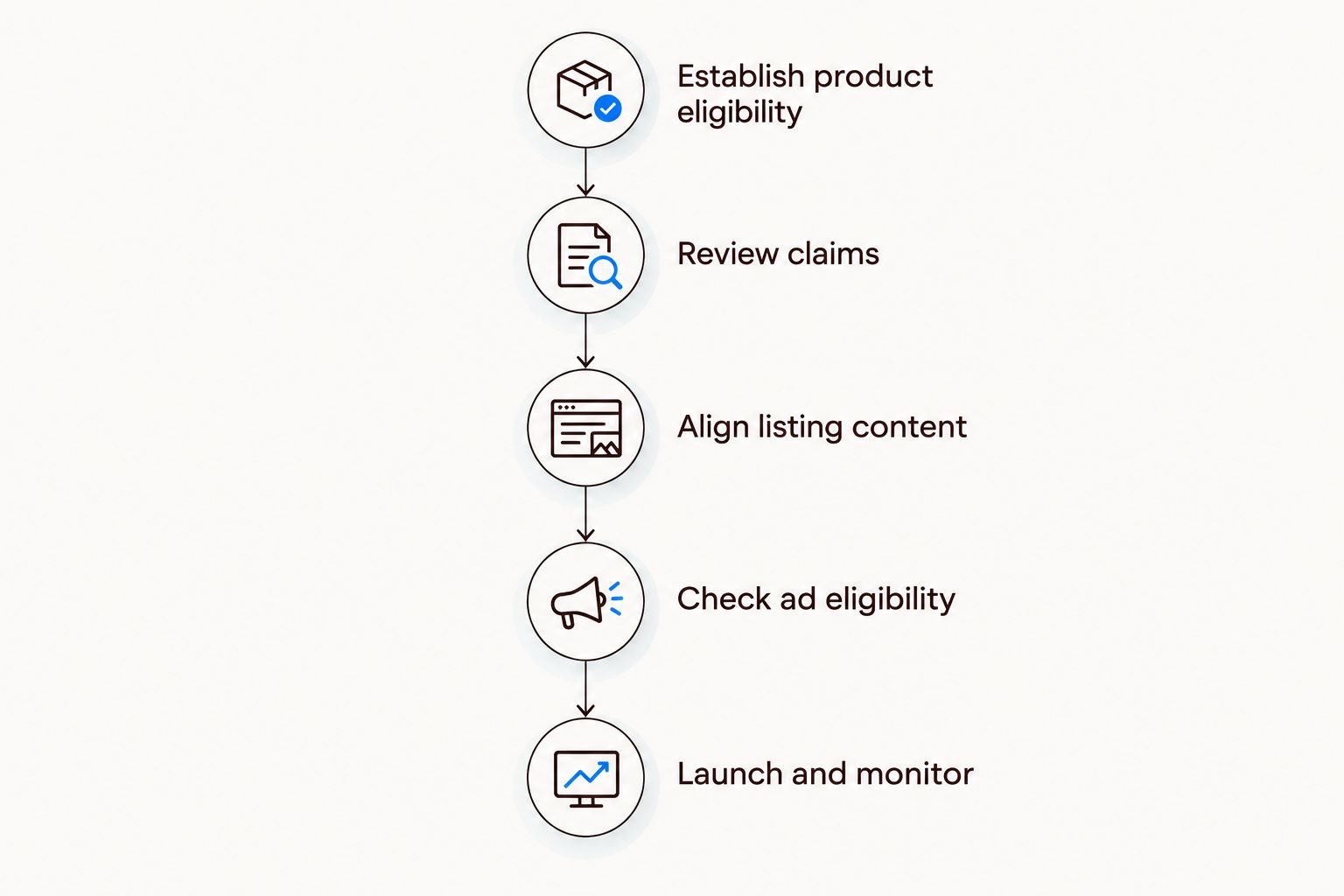
Review eligibility and claims before building the campaign.
Can you advertise collagen or biotin supplements on Amazon?
Yes, eligible collagen or biotin supplements can be advertised when the exact product and campaign meet Amazon’s requirements. An ingredient name is not blanket approval for the formula or its promised benefits.
For collagen, do not turn an ingredient description into a guaranteed wrinkle outcome. For biotin, do not treat a nutrient’s biological role as proof that the advertised product reverses hair loss.
Keep keywords aligned with verified product attributes and approved claims. Search demand does not establish scientific support or permission to make a treatment promise.
Does an FDA disclaimer make supplement ads compliant?
No, an FDA disclaimer does not make a prohibited or unsupported supplement claim acceptable. The standard dietary-supplement disclaimer is a labeling requirement associated with certain claims, not an exemption from advertising standards.
FDA does not approve dietary supplements for safety and effectiveness before they are marketed in the way it approves drugs. Do not present a supplement as FDA-approved because its facility is registered or its label includes the standard disclaimer.
For a 2026 US launch, use FDA’s dietary-supplement labeling guidance, FTC’s Health Products Compliance Guidance, and Amazon Ads’ current healthcare and supplement policies as separate checks. Review the requirements that apply to your exact wording and product.
What should you do if Amazon rejects your supplement ad?
Read the rejection reason before changing bids or rewriting everything. A product restriction, a missing document, and a prohibited claim are different problems.
Locate the flagged content across the ad and its destination. If the issue appears on the packaging image, changing the headline alone leaves the underlying message in place.
Correct the specific issue and use the available review or appeal process with relevant supporting documents. Do not submit repeated wording changes that preserve the same unsupported promise.
Keep a record of the rejected version, the stated reason, and the correction. That record gives your team a practical reference when producing the next listing image or video.
When does agency support make sense?
Booscala is for beauty brands that want Amazon listings, advertising, and operations managed together. The fit is coordinated Amazon execution rather than handing isolated tasks to separate teams.
Booscala is a specialist Amazon agency serving beauty and K-beauty brands through an embedded-team model. That model connects listing work with advertising and operational decisions.
The boundary matters: Booscala’s Amazon beauty management does not replace the brand’s responsibility for accurate product information, substantiation, and regulatory compliance. Ask any agency to define who owns claim approval and product documentation before launch.
FAQ
Can you advertise beauty supplements on Amazon in 2026?
Yes, eligible beauty supplements can be advertised on Amazon in 2026 when the product, listing, and selected ad format meet the applicable rules. Check the exact product and marketplace; selling eligibility is not blanket advertising approval.
Can collagen gummies run Sponsored Products ads?
Eligible collagen gummies can run Sponsored Products ads when they meet the applicable product and advertising requirements. The gummy format and collagen ingredient do not establish eligibility on their own.
Can I say my beauty supplement treats acne?
Do not advertise an ordinary dietary supplement as treating acne. A disease-treatment claim raises drug-classification and platform-compliance issues that a supplement disclaimer does not resolve.
Does Amazon listing approval mean my supplement ad is approved?
No, listing acceptance does not establish approval for every advertising format or creative execution. Review product eligibility, ad content, and destination content separately.
Can I call my supplement FDA-approved?
Do not call a dietary supplement FDA-approved. FDA does not approve supplements for safety and effectiveness before marketing in the way it approves drugs.
Do beauty supplement ad claims need scientific evidence?
Yes, health-benefit advertising claims require appropriate substantiation. The evidence must support the actual claim rather than a broader promise inferred from unrelated ingredient research.
Can I reuse a US supplement campaign in Europe?
Do not reuse a US supplement campaign in Europe without a separate review. Product, labeling, health-claim, language, and Amazon marketplace requirements need country-specific checks.
One last thing
Review the bottle image before approving the headline. Packaging can carry the very claim your copywriter removed from the ad.
For your next 2026 launch, make claim approval a shared record across regulatory, listing, and advertising work. A compliant headline cannot repair a noncompliant product promise elsewhere on the page.
