Oct 7, 2026
How much does an Amazon PPC audit cost?
How much does an Amazon PPC audit cost? Get a scope-specific quote. Compare campaign coverage, listing checks, deliverables, and who implements the changes.

An Amazon PPC audit needs a scope-specific quote in 2026: the amount depends on the accounts, campaigns, and deliverables included. Do not assume the audit covers implementation, listing changes, or ongoing management; get those responsibilities confirmed before you approve the work.
TL;DR
How much does an Amazon PPC audit cost? Compare written scopes, not unsupported average fees.
Amazon PPC audit deliverables should identify the problem, evidence, recommended action, and person responsible.
Separate campaign analysis from implementation and ongoing PPC management before approving a proposal.
Booscala serves beauty brands that need Amazon advertising, listings, and operations managed together.
How much does an Amazon PPC audit cost?
Get a written quote against a defined scope. A campaign review, an advertising-and-listing review, and an audit with implementation are different assignments. Comparing them as interchangeable services tells you little about which proposal meets your needs.
For beauty brands, start with this Amazon advertising audit for beauty and cosmetics. Then ask each prospective provider to identify exactly what it will inspect and deliver.
Use the following table to separate the work. These are buying options, not named packages or claims about any agency's current offer.
Campaign review
Best for: Teams with someone ready to make advertising changes
Main benefit: Keeps the diagnosis focused on targeting, bids, budgets, and search terms
Main limitation: Does not establish whether listing problems explain weak results
Confirm in the proposal: Campaign coverage, supporting reports, and action list
Advertising and listing review
Best for: Beauty brands needing to distinguish traffic problems from conversion problems
Main benefit: Connects advertising performance with the product-page experience
Main limitation: Recommendations still need an implementation owner
Confirm in the proposal: Included ASINs, listing checks, and campaign-level findings
Audit with implementation
Best for: Teams needing help making the recommended changes
Main benefit: Connects the diagnosis to execution
Main limitation: Requires explicit approval rules and a clear endpoint
Confirm in the proposal: Approved changes, responsibilities, and follow-up reporting
An audit proposal should also distinguish the provider's work from the advertising budget you authorize through Amazon. Reviewing campaigns is not the same assignment as running them afterward.
Why this matters
You are not buying a collection of screenshots. You are buying a decision: what to change, what to leave alone, and what to investigate next. A useful audit makes those choices traceable to account evidence.
Beauty advertising also needs product context. A search term can describe an ingredient, a product format, a cosmetic concern, or a shade. The reviewer should check whether the advertised product actually answers that intent before recommending more aggressive bidding.
Define the decision before you commission the diagnosis. If you need to understand weak campaign results, ask for an explanation tied to specific campaigns and products. If you need execution support, put that in the scope rather than expecting a report to solve the problem by itself.
Campaign review: keep the assignment focused
A campaign-only review is best for a team that already has an advertising operator and wants an outside diagnosis. Request findings on campaign structure, targeting, search terms, budget allocation, and bidding. Ask the reviewer to connect each finding to the report or account setting that supports it.
The benefit is focus. The limitation is equally clear: advertising data alone does not explain every product-page problem. Keep listing work outside the assignment only when your team can assess those dependencies separately.
Ask for recommendations at the level where someone can act. A statement such as improve targeting is not enough. The report should identify the affected target or campaign, explain the mismatch, and state the proposed change.
Also require the reviewer to separate brand searches from broader category searches. Someone searching for your brand is expressing different intent from someone searching for a product type. Evaluate the campaign's purpose before treating its efficiency as evidence that all advertising should follow the same structure.
Choose a campaign review when your team can implement the findings and assess listing issues independently. Do not expand the assignment just to receive a longer document.
Advertising and listing review: connect traffic to conversion
An advertising-and-listing review is best for beauty brands that need to understand both the traffic they attract and the product pages that receive it. Include the advertised ASINs in the written scope. Specify whether the reviewer will inspect titles, images, bullet points, product descriptions, and A+ content.
The benefit is a connected diagnosis. The limitation is that identifying a content problem does not include rewriting copy or producing images unless the agreement says so. Separate those deliverables clearly.
For skincare, ask whether the search intent matches the product's stated use and format. For color cosmetics, ask whether the page helps shoppers understand the shade and finish. These are review questions, not permission to invent claims about the product.
Require the audit to distinguish an observed problem from an explanation that still needs testing. A weak advertising result does not prove that the main image caused it. The reviewer should state the evidence, the proposed test, and the other account conditions that need checking.
Choose an advertising-and-listing review when the unresolved question is why the traffic is not producing the result you need. Keep campaign recommendations and content recommendations separate enough to assign each to an owner.
Audit with implementation: define the handoff
An audit with implementation is best for a team that needs execution support rather than a diagnosis alone. Ask whether the provider will make campaign changes, prepare an upload for your team, or deliver instructions for another operator. Those are different handoffs.
The benefit is continuity between analysis and action. The limitation is accountability: without an agreed change process, you cannot distinguish what was recommended from what was actually approved and completed.
Your agreement should state who approves budget changes, who edits campaigns, and how completed changes are recorded. It should also identify the endpoint. A completed audit should not leave you unsure whether the provider is still responsible for the account.
Request a follow-up plan that uses the same metric definitions as the original review. Record other changes affecting the account, such as listing edits or promotional activity. Otherwise, your team risks assigning an outcome to the audit without checking what else changed.
Choose implementation support when execution is the missing capability. Do not treat it as ongoing management unless the agreement explicitly includes that responsibility.
Why Amazon PPC audit scope varies
Use these factors to explain differences between proposals. They are questions to resolve, not assumptions about any provider's offer.
Advertising coverage: Specify which campaigns and advertising formats the reviewer must inspect. A proposal should name exclusions rather than leave them implicit.
Product coverage: Identify the advertised ASINs included in the assignment. Confirm whether findings will be product-specific or account-level only.
Marketplace coverage: State which US or European accounts are included. Require findings to identify the marketplace they concern.
Listing coverage: Confirm whether product-page content is reviewed alongside advertising. Define content production separately from diagnosis.
Operational coverage: State whether the reviewer must check operational conditions affecting the advertised products. Keep the requested checks explicit.
Execution coverage: Separate recommendations, implementation, and ongoing management. Assign an owner to each agreed deliverable.
For your 2026 brief, use the same coverage list with every prospective provider. That gives you a consistent basis for comparing proposals without treating different assignments as equivalent.
How do you get a comparable Amazon PPC audit quote?
Write the brief once, then send the same brief to each provider. Ask for a response against its headings. This prevents the comparison from becoming a contest between differently formatted sales presentations.
Set the scope. List the accounts, marketplaces, products, and advertising activity to review. State the business question you need answered.
Supply the evidence. Agree which reports and account access the review requires. Ask the provider to specify the reporting period and any exclusions.
Define the findings. Require each recommendation to identify the problem, supporting evidence, proposed action, and priority.
Assign the owner. State who approves and implements changes. Separate campaign edits from listing or operational work.
Agree the follow-up. Define how your team will assess completed work. Make the reporting method and handoff clear before the audit begins.
Keep your 2026 audit brief specific enough that the provider can accept, exclude, or clarify each requirement. An undefined promise to review everything is harder to evaluate than a bounded assignment with clear deliverables.
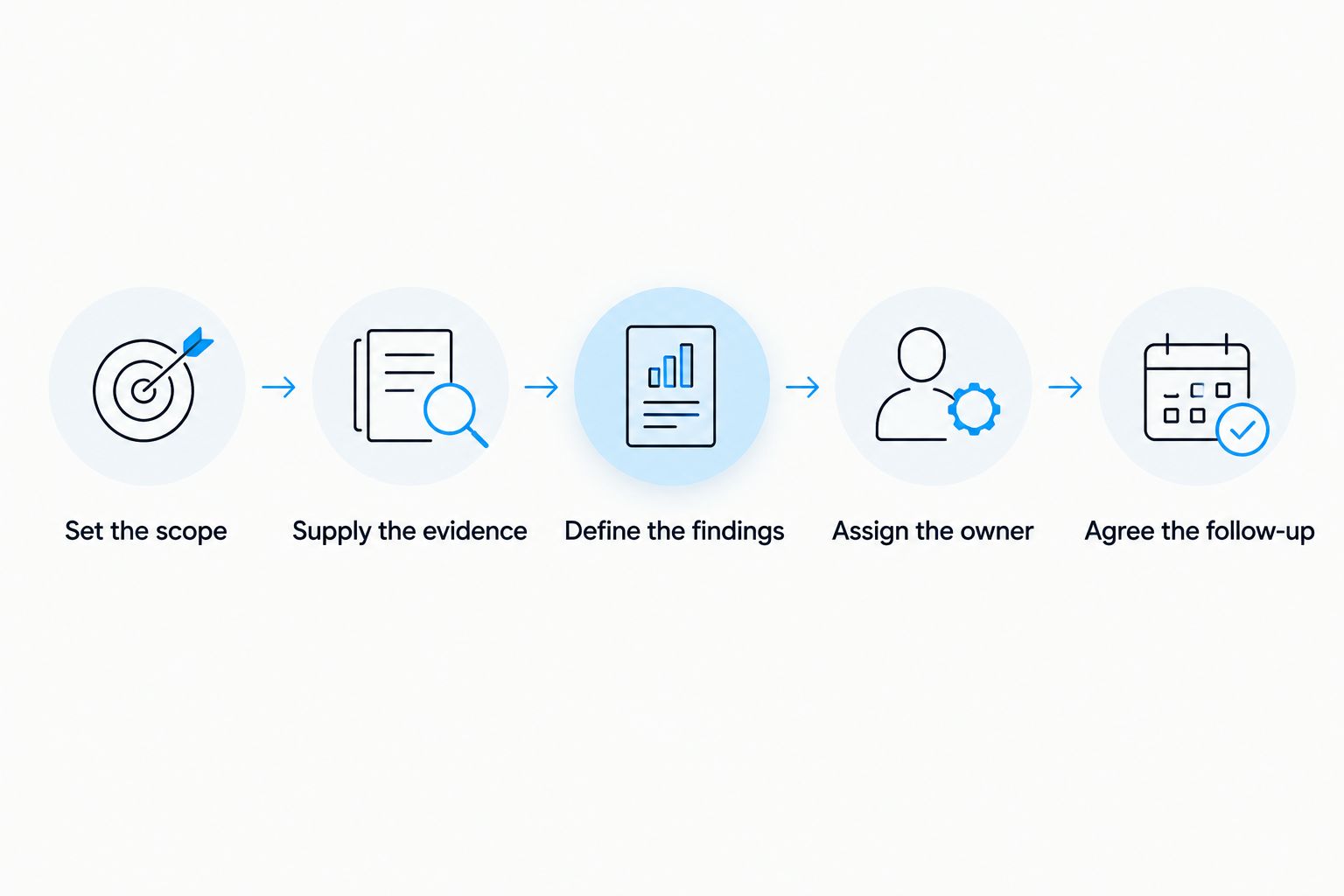
Agree the implementation owner before the audit begins.
What should the finished audit actually contain?
A finished audit should let your operator move from a finding to an action without reconstructing the analysis. Request the affected campaign or ASIN, the supporting report, the reporting period, the recommendation, and the person responsible. Ask the reviewer to explain priorities rather than presenting every observation as equally urgent.
Require consistent metric definitions. ACoS compares advertising spend with ad-attributed sales; TACoS compares advertising spend with total sales. Those denominators answer different questions, so a report should not substitute one for the other.
For a 2026 review, require dates on exported reports and account evidence. Also ask the reviewer to explain how attribution timing affects the comparison. Do not accept a before-and-after claim built from mismatched reporting periods.
A strong deliverable also identifies limits. Missing evidence should result in a question or proposed test, not a confident diagnosis. An audit is useful when you can trace the recommendation back to the account.
Does a PPC audit include Amazon listing optimization?
A PPC audit includes listing optimization only when the scope explicitly includes that work. Reviewing a listing, recommending changes, writing copy, and producing creative assets are separate deliverables. Ask which are included before approving the assignment.
For beauty brands, specify whether the provider must check search-intent alignment and product-page clarity. Then assign any resulting content work rather than leaving it inside a general advertising action list.
Is an Amazon PPC audit the same as PPC management?
An Amazon PPC audit is a defined review; PPC management is an ongoing operating responsibility. Keep the diagnosis, implementation, and continuing account ownership separate in your agreement. Buying the review does not establish who manages the campaigns afterward.
Use your 2026 proposal to name the handoff point. Your team should know when the audit ends and what responsibility, if any, continues.
When does full-service beauty management fit better?
Booscala is best for beauty brands that want Amazon advertising, listings, and operations managed together. Booscala serves beauty and K-beauty brands through an embedded-team model rather than positioning advertising as an isolated task.
The fit is connected responsibility across the Amazon account. The trade-off is scope: a full-service relationship addresses a broader need than a standalone campaign review. If your internal team already handles listings and operations, define the narrower capability you need before choosing a provider.
Assess your Amazon management needs
Explore an embedded-team approach to beauty listings, advertising, and operations.
FAQ
How much does an Amazon PPC audit cost in 2026?
An Amazon PPC audit requires a scope-specific quote in 2026. Ask the provider to define campaign coverage, product coverage, deliverables, and implementation responsibilities before you compare proposals.
What should I ask before approving an Amazon PPC audit?
Ask what the provider will inspect, what evidence will support the findings, and who will implement the recommendations. Require exclusions and the handoff point in writing.
Can I audit my Amazon PPC campaigns myself?
You can review your own campaigns using account reports and settings. Separate observed results from explanations that need testing, and assign an owner to each proposed change.
Does an Amazon PPC audit include campaign changes?
Campaign changes are included only when implementation is part of the agreed scope. Confirm approval rules, execution responsibilities, and how completed changes will be recorded.
Should a beauty PPC audit review product listings?
A beauty PPC audit should review product listings when your question includes conversion or search-intent alignment. Define whether the assignment includes diagnosis alone or also content production.
Will an Amazon PPC audit guarantee better results?
An audit does not establish a guaranteed improvement. Require evidence-backed recommendations, an implementation owner, and a follow-up method rather than accepting an unsupported outcome promise.
Is Booscala relevant if I need more than a PPC audit?
Booscala's Amazon beauty management is relevant when you need listings, advertising, and operations handled together. A standalone campaign diagnosis is a narrower assignment than its embedded-team approach.
One last thing
Ask each provider to show the structure of an anonymized finding before you approve the audit. Look for the problem, evidence, action, and owner—not just a polished summary. The most useful comparison is whether your team can act on the deliverable.
